
Apathy in dementia is a loss of motivation or drive. The person you love is not being lazy, stubborn or unkind. They may need a lot of encouragement just to start small things, and without that support they may well do nothing. It is very common, it is often misunderstood, and there is a lot you can do to help. Most of it comes down to gentle structure, company and activities that feel safe to try.
We run a daytime community for older adults in Nether Alderley, and we see every day how much a warm, well-paced day can change someone's engagement. This guide explains what apathy looks like, why it happens, how it differs from depression, and what tends to help at home and beyond.
Key Takeaways
- Apathy means reduced motivation and emotional response. It is a symptom of dementia, not a choice or a character flaw.
- It is different from depression: a person with apathy may not be worried or sad about how things are.
- Non-drug approaches such as activities, music, art and cognitive stimulation are generally the first thing to try.
- Small, familiar, low-pressure invitations work better than asking "what would you like to do?"
- Speak to the GP if you notice a change, so other causes such as low mood can be looked at.
Table of Contents
- What apathy in dementia looks like
- How common is it?
- Why does it happen?
- Apathy or depression?
- When to talk to a professional
- What helps: practical ideas for families
- Cognitive Stimulation Therapy and group activity
- Our perspective
- Try a day with us
- FAQ
- Sources
What apathy in dementia looks like
Apathy can be easy to miss because it is quiet. Nothing dramatic happens. Things simply stop happening. The Alzheimer's Society lists the signs families most often notice:
- sitting for long periods without appearing to do anything
- relying on other people to suggest and organise activities
- less interest in joining conversations
- not seeming worried about their own problems
- unemotional responses to news or personal events
- no energy or motivation for routine tasks
- sleeping a lot during the day
A few everyday examples: your mum used to phone her sister every Sunday and now never mentions it. Your dad has stopped reading the paper, but if you hand it to him, he will read it happily. A favourite biscuit tin sits untouched until someone opens it.
That last point matters. Often the ability is still there. What has gone is the spark that starts things.
Families sometimes hear "he just doesn't try any more". In reality, the TUH apathy factsheet describes apathy as a reduction in the drive to pick a goal, start it and finish it. It also notes that the person is often not bothered by the changes, which are more noticeable to the people around them.
How common is it?
Very. The Alzheimer's Society says most people with dementia will develop apathy, particularly in the later stages. It can appear earlier in dementia with Lewy bodies, Parkinson's disease dementia and frontotemporal dementia.
Numbers vary between studies because researchers measure it differently. A 2024 review of 20 studies is one example of how wide the range can be, which is why you will see figures anywhere from a fifth to nine in ten. A review of behavioural symptoms reported that apathy affects over 70% of people with Alzheimer's disease in the mild to moderate stages and more than 90% in the later stages.
The takeaway for families is simple: if you are seeing this, you are far from alone.

Why does it happen?
There are two broad explanations, and for many people both play a part.
Changes in the brain. Dementia can damage the areas involved in processing thoughts and emotions and in motivation. The TUH factsheet describes it as the brain's "on switch" being affected.
Coping with a hard situation. The Alzheimer's Society explains that for many people apathy may be related to coping with the difficulties of living with dementia. Everyday tasks become more effortful, tedious, frustrating or even humiliating. After enough difficult moments, it can feel safer to stop trying.
That second explanation is the hopeful one. The same Alzheimer's Society blog suggests that this is where there may be more realistic hope of improving things. If confidence has drained away, confidence can be rebuilt, gently.
The TUH factsheet also describes a cycle that families will recognise: a person withdraws, loses confidence and abilities, feels a sense of failure, and withdraws further. Breaking that cycle is the heart of good support.

Apathy or depression?
They can look alike from the outside, and they can happen together. The difference is in how the person feels.
| Apathy | Depression | |
|---|---|---|
| Feelings | Often not worried or upset | More negative feelings, such as sadness or guilt |
| Behaviour | Passive, goes along with others | Often avoids people, may be pessimistic |
| Other signs | Not typically anxious or ruminating | May show anxiety, poor sleep, loss of appetite |
The Alzheimer's Society says depression involves more negative feelings such as sadness or guilt, whereas a person with apathy may not be worried by their symptoms. A 2023 review sets out the fuller contrast in behaviour, anxiety and sleep, and notes that telling the two apart can be challenging because they can occur together.
This is why a GP conversation is worthwhile. If low mood is part of the picture, it deserves its own attention. The Alzheimer's Society also says there is little evidence that antidepressants help apathy in Alzheimer's, mixed or vascular dementia, and some evidence they may make it worse. So please do not start, stop or change any medication without the GP or pharmacist.
When to talk to a professional
See the GP if you notice a change in motivation, energy or interest that is new, getting worse, or affecting eating, sleeping, washing or safety. The NHS advises that if you are worried about someone else, you can encourage them to make an appointment and offer to go along. Someone who knows the person well can describe the changes. The same page notes that depression, anxiety, delirium, thyroid problems and medication side effects can also affect how a person seems, which is why a check-up helps.
Professionals may use structured questionnaires to measure apathy. The Apathy Evaluation Scale, for example, has self-rated, informant-rated and clinician-rated versions, and the Neuropsychiatric Inventory is completed with a family member or carer. You do not need to prepare anything formal. A few notes on what has changed, and when, are the most useful thing you can bring.
What helps: practical ideas for families
The Alzheimer's Society is candid that apathy is very difficult to treat with medicines or talking therapies. Its advice is to support the person to stay as active as possible and keep their confidence up, in safe spaces where they can try things without worrying about getting them wrong. The TUH factsheet agrees that non-drug approaches should generally come first, and that life activities, music, art and cognitive stimulation can all help.
Here is how we would put that into practice.
1. Invite, don't ask
"What would you like to do today?" asks for a decision, and decisions are exactly what apathy makes hard. Try "I'm going to put the kettle on, come and help me with the cups", or simply put the activity in their hands.
2. Build on what they have always loved
A retired gardener may respond to a pot of herbs. A former teacher may enjoy sorting photographs. Our guide to personalised dementia activities has five quick ideas that start from the person's own history.
3. Keep it short and successful
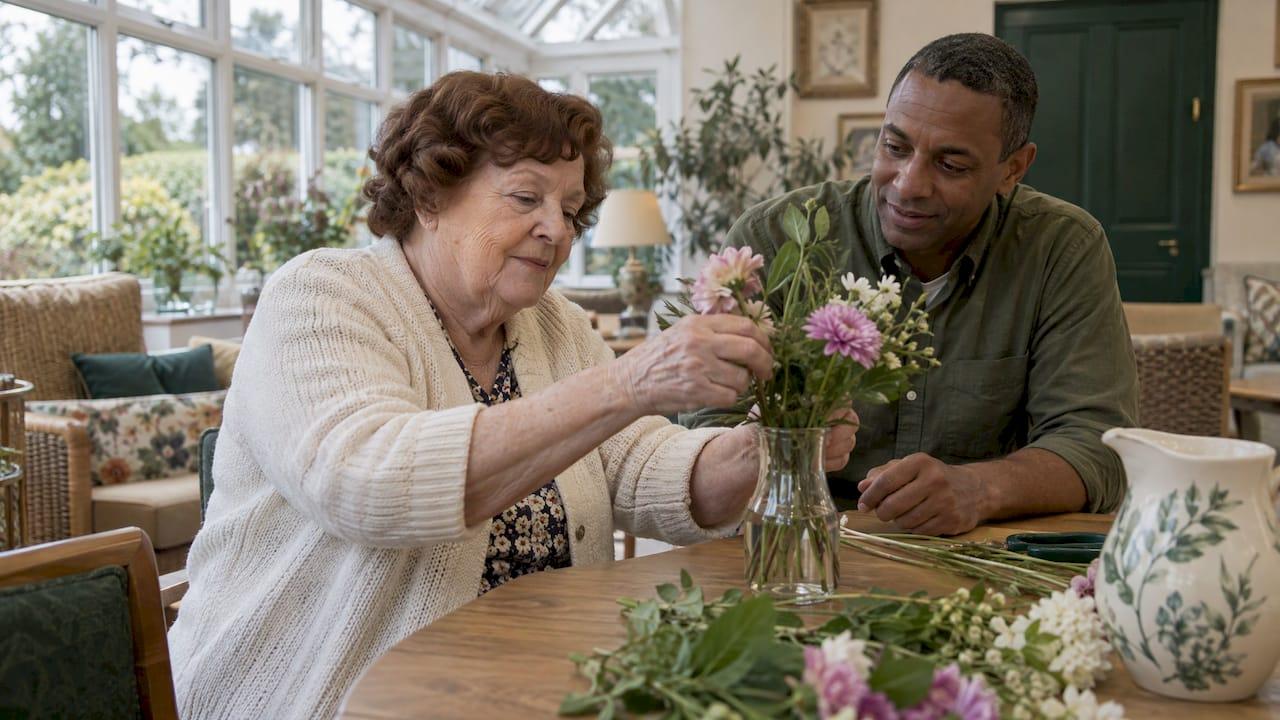
Ten minutes that go well beat an hour that ends in frustration. Aim for tasks with no wrong answer: sorting, matching, arranging flowers, stirring. Our dementia-friendly games work in the same spirit.
4. Use music and the senses
Familiar songs often get through when conversation does not. Try ten minutes of music to start communication, or a few sensory activities such as scented hand cream, textured fabrics or a bowl of warm water.
5. Make space for creativity
Painting, collage and clay ask nothing of memory. If you would like a starting point, see creative arts for dementia.
6. Keep a gentle rhythm to the day
Predictable mealtimes, a morning walk and something to look forward to in the afternoon reduce the number of decisions the person has to make. Good food and drink matter too, and our notes on nutrition for dementia cover easy wins.
7. Be patient with the energy dips
If the person sleeps a lot in the day, try the more active ideas after they have woken, not straight after a meal. Celebrate the small starts without fuss.
Cognitive Stimulation Therapy and group activity
Cognitive Stimulation Therapy (CST) is a programme of themed group sessions, with activities such as reminiscence, word games and discussion. NICE recommends it for mild to moderate dementia. Group settings add something no activity sheet can: other people. A shared task, a laugh over a quiz and a familiar face on a Tuesday all give a reason to take part.
Research on CST has looked at different outcomes. A UK trial of individual CST delivered at home with a carer found it improved the quality of the caregiving relationship and carers' quality of life. If you are planning sessions yourself, our CST 14-session plan for group activities is a practical place to begin.
Support matters for you too. The Alzheimer's Society notes that apathy can put a strain on family and friends, because it is hard to care every day for someone who does not seem to mind what happens. Feeling worn down by this is understandable, and it is not a failing.
Our perspective
We have learned that apathy is rarely about "won't". It is usually about "can't get started", and the right surroundings do much of the starting for you.
That is why we built our days the way we did. Doors open at 9:30am and the day runs to 4:30pm, Monday to Friday. There is breakfast on arrival, a cooked two-course lunch, afternoon tea and a hydration station that is there all day. Between those, the programme mixes physical, creative, cognitive and social activities, with live entertainment each week.
Our care team is fully qualified and trained to deliver Cognitive Stimulation Therapy. We cap attendance at 35 members a day so everyone is known by name, and a person who is quiet is noticed, welcomed and invited, never left in a corner.
For many families, the biggest change is that the person with dementia is no longer the only audience. Other people, a friendly rhythm and activities pitched at the right level invite someone back into the day. And you, as a carer, get dependable daytime respite to rest, work or simply breathe.
Scott @ The Clubhouse
Try a day with us
If you would like to see how this feels in practice, we offer a complimentary taster day. You can be our guest for the day and see the building, meet the team and share lunch. Day passes are £120 per day, including VAT, and our 10-Session Pass gives you ten days for the price of nine. We welcome adults aged 50 and over, including people living with mild to moderate dementia, and we also support family carers, live-in carers and home care providers.
The Alderley Clubhouse serves families around Alderley Edge, Wilmslow, Knutsford and Macclesfield. The building is purpose-designed, dementia-friendly and fully accessible, with secure parking and a drop-off point at the door.
FAQ
Is apathy the same as laziness?
No. Apathy is a symptom linked to changes in the brain and to the emotional strain of living with dementia. The person is not choosing to be unmotivated. Gentle invitations and familiar activities usually work better than pressure or reminders.
Is apathy a sign of depression?
Not necessarily, although the two can appear together. A person with apathy often isn't distressed by how things are, while depression involves more sadness or guilt. If you are unsure, ask the GP to look at both.
Does apathy get worse as dementia progresses?
It tends to become more common as dementia advances, particularly in the later stages, and can appear earlier in some types such as frontotemporal dementia. It can vary from day to day, and regular, achievable activity helps keep confidence up.
Can medication help?
The Alzheimer's Society says apathy is difficult to treat with medicines, and antidepressants have little evidence of benefit for it in Alzheimer's. Please discuss any medication with the GP or pharmacist. Non-drug approaches are usually the first thing to try.
How can a day club help someone with apathy?
A good day club offers structure, company and activities pitched at the right level, so the person does not have to start things alone. At The Alderley Clubhouse, our qualified team delivers Cognitive Stimulation Therapy and a full daily programme, and you can start with a complimentary taster day.
Sources
- Apathy and dementia, Alzheimer's Society
- When the motivation is gone: supporting a person with apathy, Alzheimer's Society Dementia Connect
- Supporting a person with dementia who has depression, anxiety or apathy, Alzheimer's Society
- Apathy factsheet, Tallaght University Hospital
- Distinguishing apathy from depression: a review, PMC (2023)
- Behavioral and psychological symptoms of dementia, PMC
- The impact of individual Cognitive Stimulation Therapy, PMC (2017)
- How is dementia diagnosed? NHS 111 Wales
- Apathy in Dementia: Apathy Evaluation Scale, Journal of Neuropsychiatry and Clinical Neurosciences
- The current status of apathy in patients with dementia, PubMed