
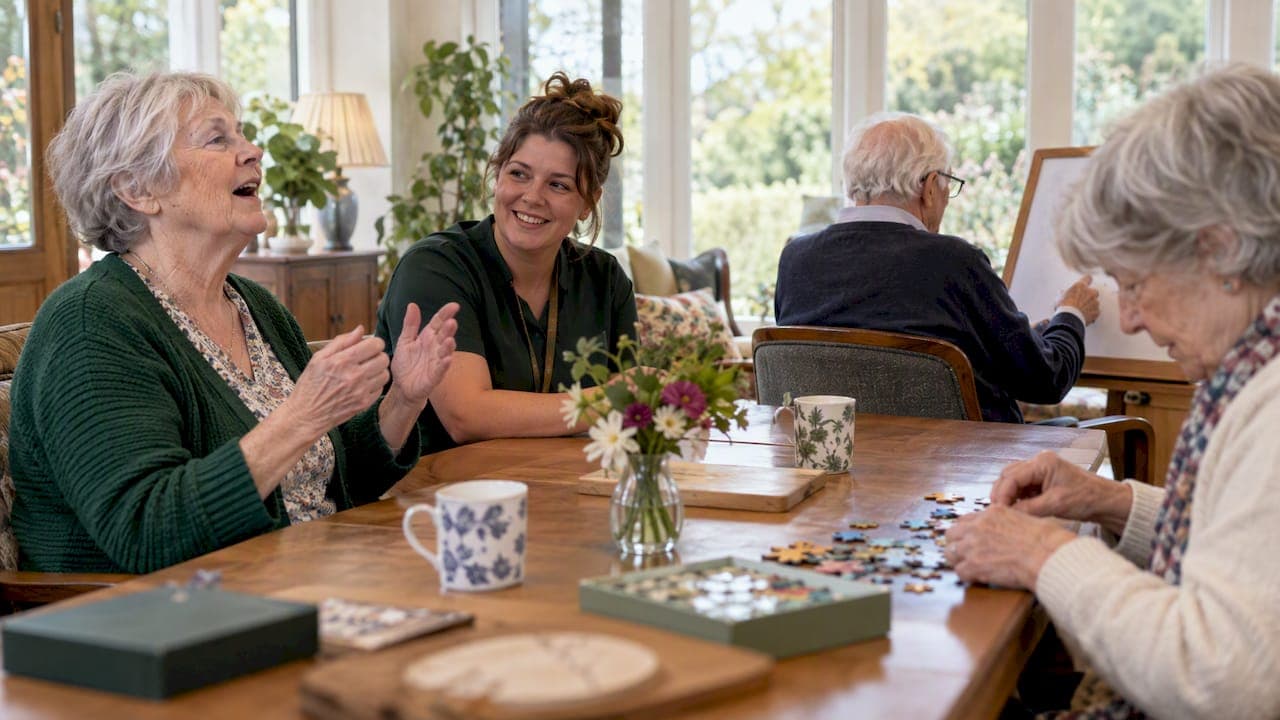
The group activities that help most are music and singing, reminiscence, creative and sensory work, gentle movement, and simple games, and the choice always comes back to one rule: match the activity to the person's own interests, abilities and stage of dementia. Get that match right, and a session supports mood, memory and connection. The practical formats, the evidence behind Cognitive Stimulation Therapy, and where to find a group near you all follow below.
TL;DR:
- Matching activities to a person's interests and abilities is crucial for boosting mood, memory, and connection during group sessions.
- Familiar music and reminiscence sessions effectively support mood and recall, especially when tailored to the individual's past decade.
- Sensory and creative activities like touch boxes, scented fabrics, and simple crafts focus on participation over perfection, suitable for all dementia stages.
- Short, well-structured physical activities and outdoor sessions enhance mobility and confidence without requiring high stamina or coordination.
- Consistent, person-centred day programmes with trained staff and structured activities provide reliable respite and meaningful engagement for families.
Table of Contents
- The most effective group activity types and who they suit
- Music and singing groups: practical format and adaptations
- Reminiscence and memory-trigger groups: themes and safety
- Creative and sensory activities, with later-stage options
- Gentle movement, exercise and outdoor groups
- Games, puzzles and group tasks that foster connection
- Cognitive Stimulation Therapy explained: evidence and questions to ask
- Running successful group sessions: a practical checklist carers can use
- Where to find groups and what to ask before attending
- Scott @ The Clubhouse: how structured day programmes support families
- Day passes and how they offer dependable group activities and respite
- FAQ
- Sources
The most effective group activity types and who they suit
Different activities suit different stages and personalities, so it helps to think of them as a toolkit rather than a single answer. NHS guidance lists singing, walking groups, gentle exercise, arts and crafts, reminiscence, dementia cafés and sensory gardens among the strongest group options, spanning physical, mental, social and creative needs.
- Music and singing: lifts mood and supports memory recall, and works well even with limited mobility.
- Reminiscence: uses familiar objects and photos to spark conversation and connection.
- Creative and sensory crafts: focus on process over outcome, suit most stages with adaptation.
- Gentle movement: seated exercise or short walks, good for circulation and confidence.
- Simple games: bingo, sorting or baking tasks, build social contact with low pressure.
Try a few formats across several weeks and note which ones spark the most engagement for that particular person. What works brilliantly for one member of a group can fall flat for another.
Music and singing groups: practical format and adaptations
Familiar songs reach people in ways conversation sometimes can't. Alzheimer's Society guidance notes that familiar music supports mood and memory recall, and that movement during a music session can be spontaneous rather than choreographed, which suits people with reduced mobility.
A simple session template:
- Warm up with a well-known tune everyone can hum or tap along to.
- Spend some time on familiar songs from the person's younger years.
- Bring in percussion instruments such as tambourines or shakers for those who want to join in physically.
- Use simple lyric prompts rather than expecting full recall of verses.
For hearing loss, sit close and face the person directly. For later stages, the session may drop the structure altogether and focus on one song, repeated gently.
Pro Tip: Build a playlist around the decade when the person was a teenager or in their twenties, since music from that period is usually the most deeply remembered.
Reminiscence and memory-trigger groups: themes and safety
A good reminiscence session starts with a theme, not a question. Guidance on running reminiscence activities stresses that sessions work best when prepared around a clear theme and sensory triggers, with facilitators ready to manage emotional responses rather than push for recall.
A workable structure:
- Open with a short introduction to the day's theme, such as seaside holidays or school days.
- Bring out the trigger itself: a photograph, an object, even a scent, and let it do the work.
- Allow gentle discussion to unfold at its own pace, without correcting details.
- Close with simple orientation (today's date, the weather) and a cup of tea.
If someone becomes upset, acknowledge the feeling calmly and move to something lighter. Never press someone to "remember properly".
Creative and sensory activities, with later-stage options
The point of a craft session isn't the finished piece, it's the doing. Collage, simple clay work and painting with large, easy-to-hold brushes all let people join in at their own level, whatever stage they're at.
For later-stage dementia, guidance on activities recommends simplifying tasks and focusing on sensory stimulation such as touch, taste and smell, since participation may be non-verbal.
- Touch boxes: filled with varied textures such as fabric, shells or soft brushes.
- Scented fabrics: familiar smells like lavender or citrus can prompt a reaction even without words.
- Hand massage: with a pleasant hand cream, often calming and welcomed.
Choose materials with care: avoid small items that could be swallowed, and check anything used near the face or hands is safe to touch. Our sensory activity ideas for carers cover more one-step options that work well at home.
Pro Tip: Keep a sensory box ready to hand, so you've always got a calm, familiar activity on standby when a session needs a change of pace.
Gentle movement, exercise and outdoor groups

Movement doesn't need to be strenuous to do good. Seated exercise, gentle tai chi, short walks and gardening sessions all support mood and mobility without demanding stamina or coordination that may no longer be there.
Before any outdoor or physical session, run through a short safety checklist:
- Check the route for trip hazards and seating along the way.
- Confirm appropriate footwear and that any walking aids are to hand.
- Note medication timing and plan toilet breaks in advance.
- Check the weather and have a wet-weather backup ready.
Keep sessions short and end on something to celebrate, even if it's just reaching a bench together. Our guide to gardening for dementia has more detail on running outdoor sessions inclusively.
Games, puzzles and group tasks that foster connection
Low-pressure games build social contact without the stress of "getting it right". Picture bingo, large-piece jigsaws, simple sorting tasks and group baking all give people something shared to focus on.
- Adapt the rules: drop scoring if it causes frustration, and let pairs work together rather than insisting on solo turns.
- Reduce sensory overload by keeping background noise low and lighting even.
- Pair a quieter member with someone more confident to ease them in gently.
A peer-reviewed study on group activities and engagement found that games, choral singing and baking often produced higher engagement and more positive mood than unstructured time, though which activity worked best varied by person. Our dementia-friendly games guide has more ideas for quieter group members. Track what lands and swap out anything that consistently doesn't.
Cognitive Stimulation Therapy explained: evidence and questions to ask
Cognitive Stimulation Therapy, or CST, is a structured programme, not a loose set of activities. NICE and NHS England recommend offering group CST to people with mild to moderate dementia, with a standard programme running 14 sessions of 45 minutes, held twice weekly over seven weeks. Each session follows a set pattern: a warm-up, a song, an orientation board, and mixed activities such as current-affairs discussion or practical tasks.
Because CST is manualised, it's worth asking any provider a few direct questions before signing up: is there a documented programme they follow, are facilitators trained specifically in CST, and is there a maintenance plan once the initial course ends? Generic "cognitive activities" claims aren't the same thing. Our own explanation of how CST works sets out what a genuine programme looks like in practice.

Running successful group sessions: a practical checklist carers can use
Planning well in advance makes the difference between a session that flows and one that falls apart halfway through.
- Before the session: choose a theme, check the room is accessible, gather any aids or props, and keep groups small where attention spans are shorter.
- During the session: give single-step instructions, introduce one stimulus at a time, position staff so everyone is visible, and use an orientation board for date and weather.
- After the session: note how engaged people seemed and their mood, and keep a short record so you can see what worked.
- Always have a backup: a simpler activity ready to switch to if the planned one isn't landing.
Practical guidance on running activities in care settings recommends checking hearing aids are in and working, and having that backup activity ready before you start.
Pro Tip: Keep sessions between 15 and 60 minutes depending on ability, and watch for early signs of fatigue rather than waiting for someone to disengage completely.
Our dementia-friendly design guide covers room layout and timing in more depth if you're setting up a regular group.
Where to find groups and what to ask before attending
Finding the right group often starts with the Alzheimer's Society service finder, which lists dementia cafés, singing groups including Singing for the Brain, and local memory clinics that may run CST.
Before attending, it's worth asking:
- How accessible is the venue, and is there step-free access and suitable seating?
- What's the typical group size, and how are staff trained?
- Can a carer stay for the first visit, and what's the cost and booking process?
- How does the group handle distress if someone becomes upset?
For a first visit, keep the explanation simple and arrive a little early so the person can settle before the group starts.
Scott @ The Clubhouse: how structured day programmes support families
Group activities work best within a steady routine, which is exactly what a day programme offers. Our team at The Alderley Clubhouse delivers Cognitive Stimulation Therapy with capped attendance, so sessions stay person-centred. Families managing full-time caring often find day passes make the biggest practical difference.
— Scott @ The Clubhouse
Day passes and how they offer dependable group activities and respite
Finding a reliable group, week in and week out, is one of the hardest parts of caring for someone with dementia. We built our Day Pass Membership around that exact problem: a full day of structured activities, qualified staff trained in CST, and meals included, so you know what you're getting every single time.
- Day passes cover a full daytime schedule, with meals included.
- A 10-Session Pass offers a multi-day package option.
- Attendance is limited to keep groups manageable, so staff can provide personal attention.
This suits families needing consistent daytime respite, as well as those simply looking for structured company and stimulation for a relative with mild to moderate dementia. Check current availability and book directly through the day pass booking page.
This article is general information, not a substitute for advice from a qualified doctor. Consult a qualified healthcare professional about your own circumstances before acting on anything here.
FAQ
What are some fun group activities for people with dementia?
Music and singing, reminiscence with photos or objects, simple arts and crafts, gentle movement, and games such as picture bingo all tend to work well. The NHS lists these alongside walking groups and sensory gardens as strong options, chosen by interest, mobility and stage.
What are some good group games for people with dementia?
Picture bingo, large-piece jigsaws, simple sorting tasks and group baking all build connection without pressure. A peer-reviewed study found games, choral singing and baking often produced higher engagement and more positive mood than unstructured time.
What is the 90 second rule for dementia?
This isn't a term used in NHS, NICE or Alzheimer's Society guidance, so there's no established definition to point to. If you've heard it elsewhere, it's worth checking the original source rather than assuming a single fixed meaning.
What are some creative activities for people with dementia?
Collage, simple clay work, and painting with large brushes all let someone join in at their own pace, with the focus on the process rather than the result. For later stages, sensory stations such as touch boxes or scented fabrics, as described in guidance on activities, often work better than traditional crafts.
Does Cognitive Stimulation Therapy actually help?
CST is the only non-drug therapy recommended by NICE for people with mild to moderate dementia, delivered as 14 structured 45-minute sessions over seven weeks. We deliver CST as part of our regular programme, with staff trained specifically to run it.
Sources
- NHS – Activities for people living with dementia
- Cognitive Stimulation Therapy (CST): summary of evidence on cost‑effectiveness (NHS England)
- The impact of group activities and their content on persons with dementia attending them (PMC)