
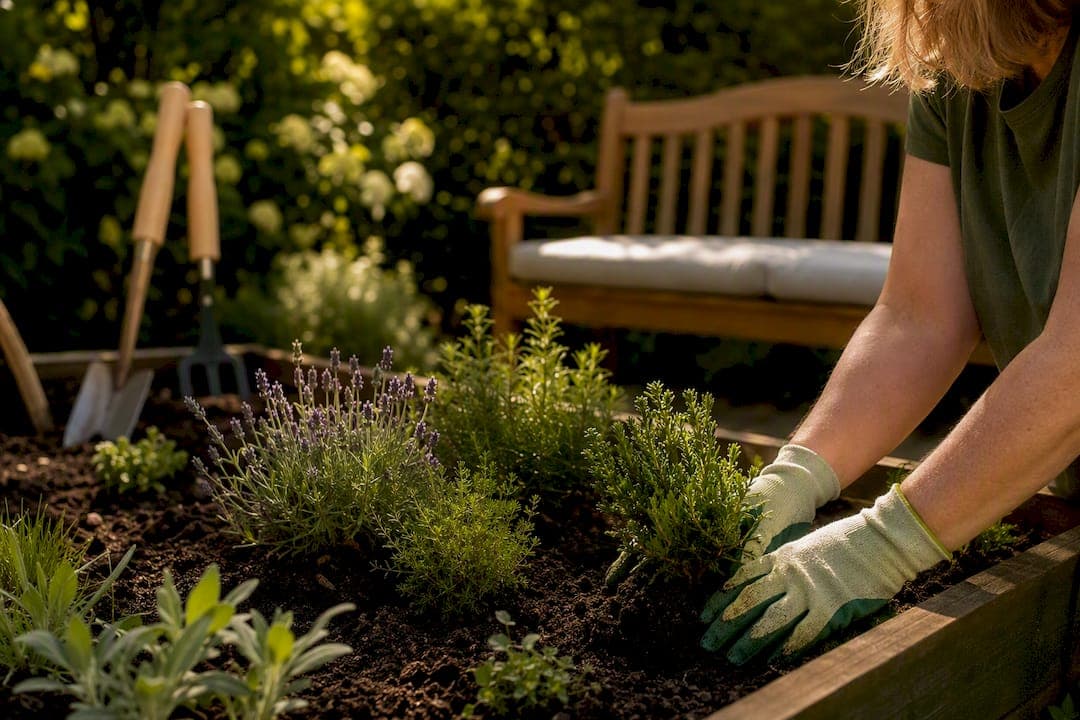
Gardening can improve mood, reduce agitation and boost social engagement for people living with dementia. The first step is simple: involve the person in choosing what to plant, then try a short, supervised activity and watch how they respond.
Horticultural therapy sessions typically last 45 to 60 minutes and have been shown to reduce agitation and stabilise emotions. Around one in eleven people over 65 in the UK live with dementia, so most families will face this question sooner or later: what can we actually do together outdoors?
- Ask what they used to grow, or what flowers they loved as a child.
- Keep the first session under an hour, and stay close by.
- Judge success by their mood afterwards, not by how tidy the bed looks.
Quick fact: Horticultural therapy sessions of 45 to 60 minutes have been linked to reduced agitation and improved social interaction in people with dementia.
Key Takeaways
Gardening for dementia works best when it's short, person-centred, safe by design, and adapted continually as needs change.
| Point | Details |
|---|---|
| Start small and personal | Ask about favourite plants and try a 45 to 60 minute supervised session first. |
| Design for the future | Build wide paths and adaptable raised beds before mobility or vision changes force a redesign. |
| Prioritise safety | Avoid toxic and thorny plants, use soft-grip tools, and secure any water feature. |
| Match tasks to stage | Independent projects suit early stage; sensory contact matters most in late stage. |
| Reassess regularly | Watch for hesitation or frustration and simplify tasks as abilities shift. |
Table of Contents
- What research says about therapeutic gardening for dementia
- Design principles for a dementia-friendly garden
- Sensory planting and simple activity ideas
- Safety and maintenance checklist for plants, tools and water
- Which gardening tasks suit each stage of dementia
- How a dementia-friendly gardening session runs at Alderley Clubhouse
- Planning a garden that still works in five years' time
- Seasonal planning and weather for dementia-friendly gardens
- Gardening as a route to social connection
- Adjusting the garden as needs change over time
- Planning for emergencies in outdoor spaces
- Technology and monitoring for safer, richer garden time
- Book a supervised, dementia-friendly gardening session
- What most gardening advice for dementia gets wrong
- Sources
What research says about therapeutic gardening for dementia
Evidence on horticultural therapy is more encouraging than most families expect. Studies reviewed in BMC Geriatrics found that structured garden activity improved mood, reduced agitated behaviour and enhanced communication compared with sitting indoors doing nothing in particular.
Sessions of 45 to 60 minutes appear frequently in the research, long enough to settle into a task, short enough to avoid fatigue. Success in these studies wasn't measured by yield or neatness. It was measured by engagement, calmness and how much the person smiled or spoke.
That said, the evidence has limits. Sample sizes in many trials are modest, and outcomes vary by individual. The honest takeaway is that gardening works best as an ongoing experiment: try an activity, watch how the person responds, then adjust. Don't expect one approach to suit everyone, and don't give up after one quiet afternoon.
Design principles for a dementia-friendly garden
Good design does most of the heavy lifting before anyone even picks up a trowel. Get the layout right and the garden becomes easier to enjoy, not harder to navigate.
- Start with the person, not the plot. Ask about favourite colours, plants from childhood, or a rose they once grew. A garden built around personal memory sparks recognition far more reliably than a generic scheme.
- Create one clear, circular route. A dementia-friendly garden works best with a simple loop path and no dead ends, so someone can walk, look around, and return to where they started without confusion or a sense of being lost.
- Use high-contrast materials. Many people with dementia experience visual changes that make depth perception difficult. Pale paving against dark planting beds, or a contrasting edge on steps, helps the eye read the space correctly.
- Add frequent seating and shade. Benches every few metres, positioned off the main path rather than blocking it, let someone rest without feeling they've failed to keep up.
- Choose level, non-slip surfaces throughout. Gravel looks lovely in magazines and is a trip hazard in real gardens. Firm, flat paths matter more than kerb appeal.
Pro Tip: Walk the proposed route yourself with your eyes half-closed and one hand trailing a wall. If you feel uncertain about where to go, so will they.
Sensory planting and simple activity ideas
Sensory gardening leans on smell, touch and colour rather than complex tasks, which makes it forgiving for people at almost any stage of dementia.
Reliable choices include:
- Lavender, rosemary and mint — all strongly scented and safe to touch, recommended specifically for their sensory and memory-triggering qualities.
- Pelargoniums and soft-leaved salvias — bright colour with no sharp edges or toxic sap.
- Sunflowers and marigolds — big, cheerful, and easy to sow from seed with minimal fine motor control.
Simple tasks work better than ambitious projects. Sowing seeds into pots, deadheading spent blooms, watering with a lightweight can, or potting up a small plant all give a clear beginning and end within a few minutes. Building a wildlife corner or hanging a bird feeder adds a reason to keep returning to the garden, even on days when active gardening feels like too much.
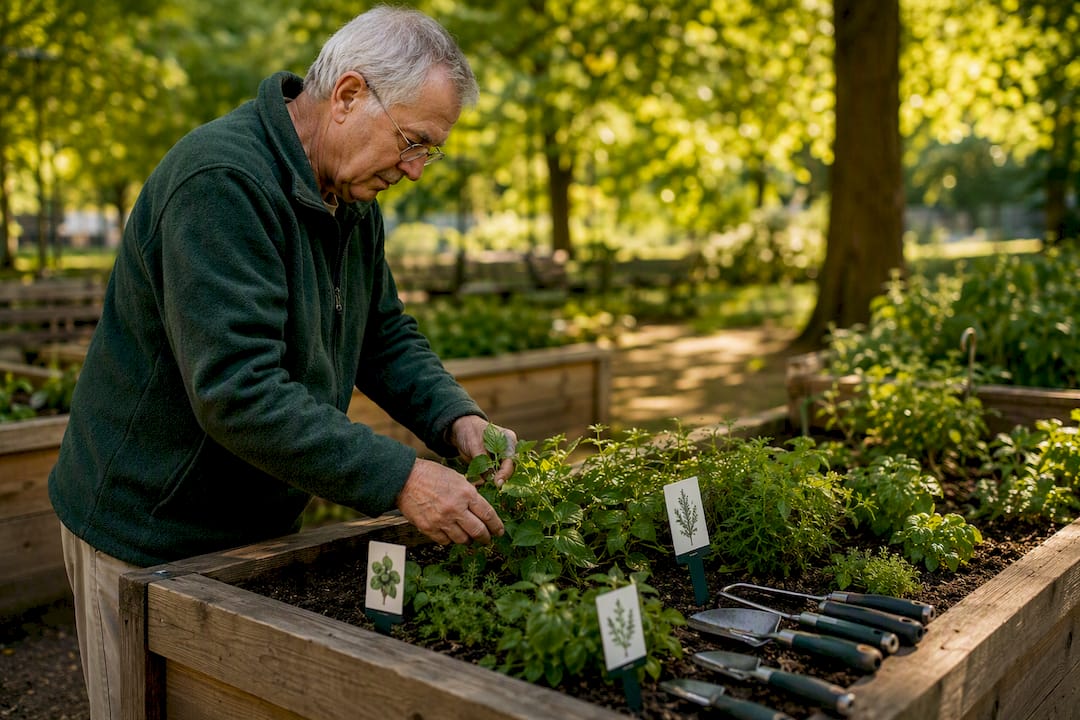
Small adaptations make a big difference: raised beds at waist height, picture labels instead of written plant names, tactile markers along path edges, and easy-grip, padded-handle tools all lower the barrier to joining in.
Safety and maintenance checklist for plants, tools and water
A dementia-friendly garden needs the same safety thinking you'd apply to a young child, adapted for an adult who deserves dignity and independence wherever possible.
- Avoid toxic and thorny species. Steer clear of plants toxic if ingested or with sharp thorns, including foxglove, yew, and toxic bulbs such as daffodil and narcissus, all of which can cause serious harm if mistaken for something edible.
- Choose edible and soft-textured alternatives. Herbs, soft ornamental grasses and thornless roses give tactile interest without the risk.
- Stick to lightweight, soft-grip hand tools. Skip power tools entirely; a hand fork and a padded trowel do the job with far less danger.
- Store tools out of sight, but nearby. A closed bench or box keeps blades away from confused hands while staying within easy reach for the carer.
- Keep water features shallow and enclosed. Fit a grille or barrier over ponds, supervise near any standing water, and use non-slip surfacing around taps and butts.
Which gardening tasks suit each stage of dementia
Gardening should flex with the person, not the other way round. Task suitability shifts significantly across the disease course, and matching the activity to the stage avoids frustration on both sides.
- Early stage: independent planning and planting suit well here. Longer sessions, goal-oriented projects like growing tomatoes from seed to harvest, and decision-making over what to plant all support continued autonomy.
- Middle stage: shorter, supervised tasks work best. Repetitive, procedural jobs, such as watering the same pots each visit or deadheading roses, offer comfort through familiarity rather than novelty.
- Late stage: the garden becomes about sensory contact rather than task completion. Sitting outside, smelling lavender, feeling soft leaves, or simply watching birds at a feeder can still bring real comfort.
How a dementia-friendly gardening session runs at Alderley Clubhouse
At Alderley Clubhouse, activity blocks typically run within the 45 to 60 minute window that horticultural therapy research supports, embedded within a day built around Cognitive Stimulation Therapy principles.
- Our purpose-designed, dementia-friendly space includes accessible raised beds and secure, level paths.
- Every session is led by fully qualified, trained staff.
- Attendance is capped at 35 members a day, so pacing and support stay personal.
If you'd like to see how it works in practice, book a welcome tour or explore our facilities and activities.
Planning a garden that still works in five years' time
The garden you design today needs to still make sense when eyesight, balance and mobility have all shifted, and dementia rarely announces those changes in advance.
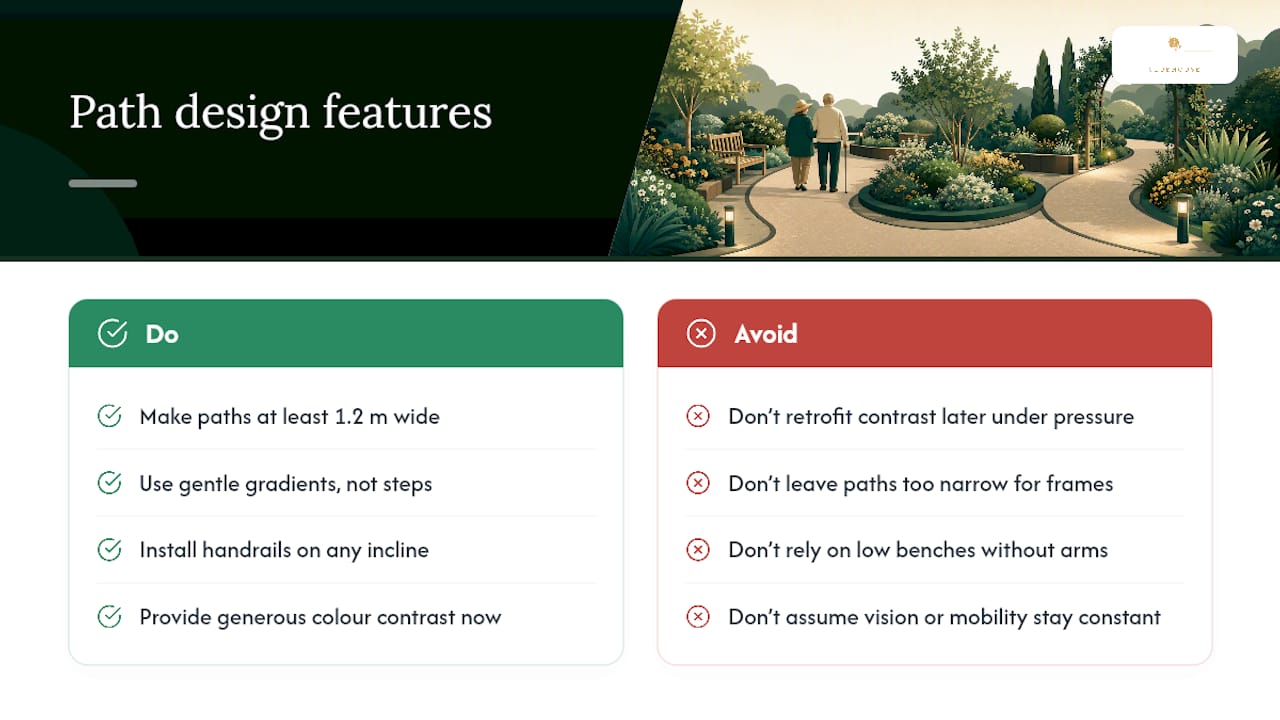
Vision often changes gradually with dementia, including reduced depth perception and difficulty distinguishing similar tones. A path that looks perfectly clear today may become a puzzle of confusing shadows in eighteen months. Build in generous colour contrast now, between path and lawn, step edge and tread, bench and background, rather than retrofitting it later under pressure.
Mobility tends to follow a similar pattern of slow decline punctuated by sudden change, perhaps after a fall or a hospital stay. Design paths wide enough for a walking frame or wheelchair from the outset, even if nobody needs that width yet. Aim for at least 1.2 metres where possible, with gentle gradients rather than steps, and handrails along any incline.
Raised beds deserve particular thought. A bed built at a comfortable height for someone standing today may be unusable for someone seated in a wheelchair next year. Where budget allows, consider beds with a lower front edge that could accommodate a wheelchair user's knees underneath, or plan for a second, lower bed to be added later.
Seating should anticipate stiffer joints and less flexibility. Chairs with arms and a firm seat height around 45 to 50 centimetres are far easier to rise from than low garden benches. Fit at least one seat with a back and armrests within the first few metres of any route, since that's often where someone will need to pause first.
Seasonal planning and weather for dementia-friendly gardens
British weather makes year-round garden use genuinely difficult, and pretending otherwise sets carers up to fail. Planning for every season from the outset keeps the garden usable rather than a fair-weather luxury.
Summer brings its own risks. Heat and sun exposure matter more for older adults, who regulate temperature less efficiently and may not recognise thirst or overheating themselves. Shaded seating, a shelter or pergola, and easy access to drinks are essential rather than optional extras during warmer months.
Autumn and winter shorten the usable daylight window considerably, and wet leaves or frost turn paths treacherous fast. Choose hard-wearing, textured paving that stays grippy when damp, and keep pathways clear of leaf litter through a simple weekly sweep. A canopy or covered seating area extends outdoor time even in drizzle, which matters because fresh air and daylight support sleep and mood regardless of season.
Spring offers the richest sensory rewards, with bulbs, blossom and birdsong all arriving at once, so it's worth timing your most engaging planting for maximum flowering in March and April. Choose a mix of early and late-flowering varieties so there's always something happening in the beds, since a garden that looks the same in July as it did in April loses its power to mark time and stimulate memory.
Whatever the season, keep a simple rule in view: fifteen minutes outside on a mild, bright day often achieves more for mood than an hour indoors ever could.
Gardening as a route to social connection
Gardening rarely happens in isolation, and that's precisely its value. Shared tasks give people a reason to talk without needing to make conversation from scratch, which matters enormously for someone who finds open-ended chat exhausting.
Working alongside another person on a defined task, potting up seedlings together, or comparing notes on which tomato plant is doing best, creates natural, low-pressure interaction. Nobody has to hold a thread of conversation for twenty minutes. The task carries the moment, and words can come and go around it.
Structured, community-based garden programmes offer real value here, particularly for reducing loneliness in both the person living with dementia and their carer. Group sessions with dementia-aware volunteers or staff give families a break from the constant responsibility of one-to-one supervision, while still keeping the person engaged and safe.
Family visits benefit too. Grandchildren who feel awkward making small talk with a grandparent living with dementia often relax the moment there's a watering can in hand and a row of seedlings to check on. The garden becomes the shared project, and the relationship happens around it rather than depending on it.
Even solitary gardening carries a social echo. Growing herbs to give away, or flowers to pick for a visitor, gives the activity a purpose that reaches beyond the garden gate.
Adjusting the garden as needs change over time
A dementia-friendly garden isn't a one-off installation. It needs regular, honest reassessment, because the person using it in 2026 may need something quite different from the person who used it eighteen months earlier.
Watch for practical signals rather than waiting for a formal review. Is the person hesitating at a particular junction in the path, suggesting the route has become confusing? Are they gripping the tool differently, or struggling with a task that was easy last season? Small behavioural shifts, reluctance to go outside, increased unsteadiness, difficulty following a two-step instruction, all point towards adaptations worth making sooner rather than later.
Keep a simple, informal log if more than one carer is involved. A shared notebook or phone note recording "found the loop path confusing today" or "loved the mint, ignored the lavender" builds a picture over weeks that's far more useful than relying on memory alone.
Reassess tasks every few months rather than assuming today's activity level is fixed. Someone who was independently deadheading roses in spring may need the task simplified to simply holding the flowers while someone else cuts by autumn. This isn't failure. It's the garden doing its job of adapting to the person, which is the entire point of person-centred care in the first place.
Physical changes to the space itself, an extra handrail, a lower step converted to a ramp, additional seating at a new resting point, should follow the same principle. Build for flexibility from the start and these adjustments become minor tweaks rather than expensive redesigns.
Planning for emergencies in outdoor spaces
Every dementia-friendly garden needs a clear answer to the question: what happens if something goes wrong out here?
Falls are the most common concern, and the most preventable with basic planning. Keep a phone or call system within reach of the garden at all times, whether that's a carer carrying a mobile or a fixed intercom near the door. Know in advance which entrance is nearest to each part of the garden, so help can reach someone quickly rather than navigating the longest route round.
Wandering presents a different risk, particularly for people who might walk further than intended or become disoriented even within a familiar space. Secure boundaries, a locked gate rather than a low hedge, matter more in a dementia-friendly garden than in an ordinary one. Boundaries should be secure enough to prevent an unsupervised exit but shouldn't feel like a prison; discreet fencing dressed with climbing plants achieves both.
Weather emergencies deserve a plan too. Sudden rain, a heatwave, or an unexpected drop in temperature all call for a quick, clear route back indoors and someone who knows to check on the person regularly during any outdoor session, particularly in summer heat or winter cold.
Finally, make sure any water feature has a specific emergency response attached to it, not just a general safety barrier. Know who supervises it, how quickly it can be drained or covered, and who to call if something happens near it. A written plan pinned inside a shed door costs nothing and could matter enormously on the one day it's needed.
Technology and monitoring for safer, richer garden time
Simple technology now fills gaps that used to rely entirely on constant human supervision, and it's worth considering even in a modest domestic garden.
Door and gate sensors that trigger a chime or phone alert when opened give carers a few extra seconds of warning if someone heads outside unsupervised. These are inexpensive, widely available, and require no technical skill to fit.
Wearable GPS trackers or pendant alarms offer reassurance for families managing wandering risk, allowing someone a degree of independent garden access without constant hovering nearby. Some models double as fall detectors, sending an alert automatically if the wearer goes down and doesn't get up within a set time.
Weatherproof outdoor cameras, positioned to cover key areas like a pond or gate rather than blanket surveillance, let a carer glance at a phone screen before deciding whether to go out and check. Used thoughtfully, this supports independence rather than undermining it. The person still has their own time in the garden; the carer simply has peace of mind without needing to sit alongside them for the whole session.
None of this replaces attentive, person-centred supervision. Technology works best as a backup layer, catching the moments a carer can't be watching every second, not as a substitute for knowing the person and the garden well.
Book a supervised, dementia-friendly gardening session
Reading about dementia-friendly gardening is one thing. Seeing it done well, with trained staff, the right layout and a calm pace, is another entirely. At Alderley Clubhouse, gardening sits within a full day of Cognitive Stimulation Therapy activity, in a purpose-designed space with capped attendance so every member gets proper attention.
If you're weighing up whether a structured, supervised setting would suit your family member better than a garden project at home, or simply want to give a family carer a reliable day of respite, visit our Alderley Clubhouse homepage to see what a typical day includes. Ready to see it in person? Book your welcome tour today and watch a session for yourself before deciding.
What most gardening advice for dementia gets wrong
Most guidance on this topic treats the garden as a finished project: build the right paths, plant the right lavender, and you're done. That misses the point entirely. The evidence on horticultural therapy shows benefit precisely because it's iterative, a 45 to 60 minute session, observed, adjusted, tried again, not because someone got the design perfect on the first attempt.
The bigger gap is realistic expectations. Families often measure success by how much gardening actually happens, when the research suggests mood and engagement matter far more than output. A person who spent twenty minutes smelling rosemary and never picked up a trowel had a successful session.
What should carers prioritise first? Not the plant list. The route. A confusing path undoes good planting choices instantly, while a simple, secure loop with a bench halfway round makes almost any planting scheme work. Get the walking right, and the gardening tends to follow.
— Scott @ The Clubhouse
This article is general information, not a substitute for advice from a qualified doctor. Consult a qualified healthcare professional about your own circumstances before acting on anything here.
Sources
- Horticultural therapy impact on people with dementia | BMC Geriatrics
- Gardening and outside spaces: Tips for people affected by dementia | Alzheimer’s Society
- Creating a dementia-friendly garden | RHS