
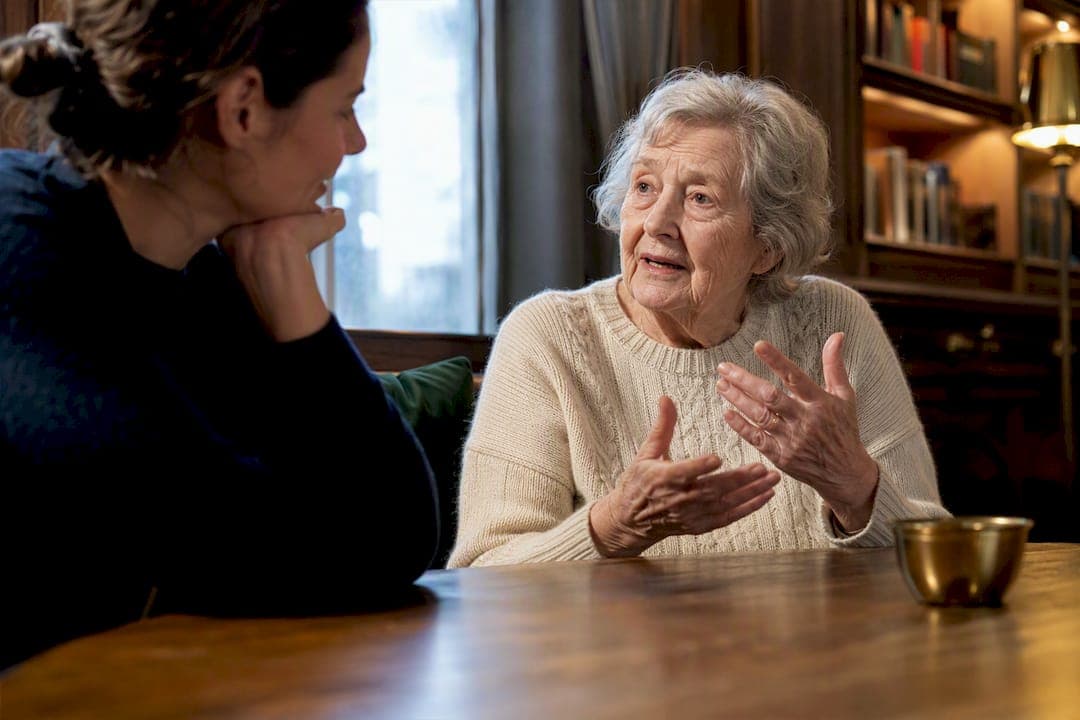
Validation therapy is a person-centred communication method that accepts the emotion behind what someone with dementia says rather than correcting the facts. We think it deserves a place in every family carer's toolkit, because the evidence shows low risk alongside real, if modest, benefits for distress and cooperation. It works best alongside practical techniques, which we walk through below, and it isn't right for every moment of care.
TL;DR:
- Validation therapy is low-risk and can improve cooperation by focusing on emotional needs rather than factual accuracy, especially as dementia advances.
- Techniques include affirming feelings, matching emotional tone, using reminiscence and sensory prompts, and employing silence to foster calmness and trust.
- Evidence shows small immediate benefits for cooperation, with validation producing an 11% chance of cooperation, but high-quality research remains limited and results vary.
- It is most effective when used consistently and combined with practical adjustments, and should never override safety in urgent situations.
- Formal training options are available, but most family carers benefit from simple, repeatable routines that emphasize restraint and empathy over perfection.
Table of Contents
- What is validation therapy for dementia?
- Practical validation techniques you can use today
- What the research actually says about validation therapy
- A step-by-step validation routine for everyday care
- When validation therapy isn't the right tool
- Where to get training and support as a carer
- How we use validation alongside cognitive stimulation therapy
- Our honest take on validation therapy
- Sources
- FAQ
What is validation therapy for dementia?
Validation therapy was developed by the American social worker Naomi Feil between 1963 and 1980, built around one central idea: correcting a person with dementia rarely helps, but acknowledging the feeling behind their words often does. Feil created what's now known as the Feil Method after watching older adults with cognitive decline become more agitated, not less, when carers insisted on the "right" version of events. Her training programme still runs through the Validation Training Institute, which certifies practitioners and carers worldwide in the technique.
The philosophy rests on a simple shift in priorities. Rather than asking "is this true?", validation asks "what does this person need right now?" If your mother believes she must collect her children from school, the goal isn't to remind her the children are 60 years old. It's to understand that she's feeling responsible, perhaps anxious, and to meet that feeling with warmth rather than argument.
Core principles include:
- Accepting emotional truth over factual accuracy. The feeling is real even when the situation described isn't.
- Restoring dignity. People living with dementia are treated as capable of meaningful communication, not corrected like children.
- Meeting the person in their reality. You step towards their world briefly, rather than insisting they step into yours.
- Building trust through empathy. Consistent validation reduces the sense of being constantly contradicted, which can be exhausting and frightening.
This is where validation therapy diverges sharply from reality orientation, an older approach that uses calendars, clocks, and repeated factual reminders ("It's Tuesday, you're at home, your husband passed away in 2019") to keep someone anchored to the present. Reality orientation can help in the earlier stages of mild cognitive impairment, when gentle factual grounding still feels reassuring rather than distressing. Validation tends to work better as dementia progresses and the person's grip on chronological time loosens, because insisting on facts they can no longer verify often triggers frustration or grief rather than comfort. Many carers use both, choosing the approach that fits the moment rather than picking a single doctrine and sticking to it rigidly.
Practical validation techniques you can use today
Validation therapy isn't a script you memorise once and recite forever. It's a set of behaviours you adapt to the person in front of you, their mood, and what's actually happening. Here are the techniques that carers and clinicians return to most often.
-
Affirmation and rephrasing. Repeat back the emotional content of what someone has said, in your own words, without agreeing to false facts you'd have to maintain later. If your father says, "I need to get to work, I'm late," you might say, "Work matters a lot to you. You've always taken it seriously." You've honoured the feeling of responsibility without promising a car ride to a job that no longer exists.
-
Matching emotion. Your tone of voice, posture, and facial expression should mirror the emotional register of the person you're supporting, not fight against it. If someone is anxious, don't respond with brisk cheerfulness. Lower your voice, slow your movements, and let your face show that you've registered their concern.
-
Centring through reminiscence and sensory prompts. Photographs, familiar music, a particular scent, or a well-worn object can anchor someone in a calmer emotional state. Asking "Tell me about your wedding day" often produces a more settled, engaged response than any attempt at factual correction ever could.
-
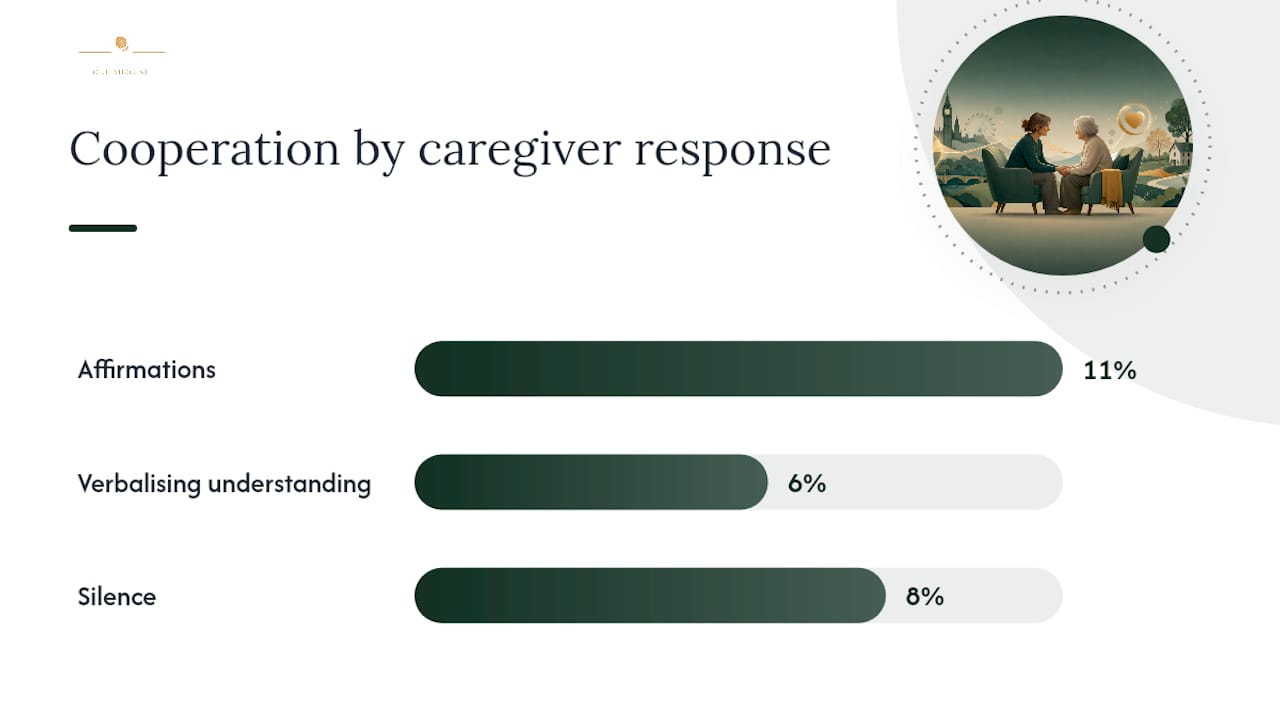
Silence and pacing. This is the technique carers underuse most. Sitting quietly with someone, without rushing to fill the gap, gives them time to process and often produces a calmer response than constant chatter. Research from a secondary analysis of homecare videos found that silence carried an 8% probability of producing cooperation from the person living with dementia, only slightly behind affirmation itself. That's a meaningful signal that doing less, at the right moment, can do more.
-
Safe redirection. When distress is rising and validation alone isn't settling things, gently shift attention rather than confronting the underlying belief. "Let's have a cup of tea while we think about that" respects the emotion while moving the moment forward.
Here's a short exchange that shows several of these techniques working together. A carer notices her mother searching anxiously for her handbag.
Mother: "Where's my handbag? I can't find my handbag. I need my purse."
Carer: "You're worried about your things going missing. That's an unsettling feeling." (affirmation, matched concern)
Mother: "Yes, I always keep it close."
Carer: (pause, three seconds) "Shall we look together? Tell me what it looks like." (silence, then redirection through a shared task)
Notice what didn't happen: no correction, no "you don't need it, you're not going anywhere," no argument about whether the purse actually exists. The emphasis on brief, high-quality empathetic exchanges over lengthy but low-quality interaction is sometimes called exquisite listening, and it's a useful phrase to hold onto. A 30-second exchange done well often outperforms five minutes of well-meant but poorly pitched reassurance.
Pro Tip: Keep your rephrasing genuinely open-ended rather than closed. "Tell me about your wedding day" invites a story; "Was your wedding day nice?" invites a one-word answer and closes the conversation down.
What the research actually says about validation therapy
The honest picture is mixed benefit, low risk. That's not a disappointing verdict. For carers weighing up whether to try something new, "unlikely to cause harm, plausibly helpful" is a reasonable basis for action, even without a guarantee.
Systematic reviews consistently flag the same problem: there simply aren't enough high-quality randomised trials to draw firm conclusions. Some small trials report improvements in behaviour or mood, others report no measurable difference, and the studies themselves vary hugely in how they define and measure "validation" in the first place. Older reviews reach a similarly cautious verdict, concluding there's no evidence of harm but insufficient evidence of consistent clinical benefit to recommend it as a standalone institutional treatment.
More recent research offers a sharper, more specific finding. A secondary analysis of recorded homecare interactions measured how different caregiver behaviours affected whether the person living with dementia cooperated with a request:
Affirmations produced an 11% probability of a cooperative response. Verbalising understanding produced 6%. Silence produced 8%.
Those numbers might look small on their own, but context matters here. This wasn't measuring whether validation "cures" agitation, it was measuring the immediate, moment-to-moment effect of specific communication choices on real cooperation during real care tasks.
A few reasons the evidence stays mixed:
- Studies use different definitions of "validation," so results aren't always comparable across trials.
- Sample sizes in dementia communication research tend to be small, which limits statistical power.
- Home settings, care homes, and hospital wards produce very different baseline stress levels, which affects how techniques land.
- Most trials measure short-term mood or behaviour, not long-term outcomes, so we know less about cumulative effect.
The practical takeaway for carers: treat validation as a low-cost, low-risk technique worth trying consistently, not a guaranteed fix. Watch how the person in front of you responds, and adjust. That's more useful than waiting for a definitive trial that may be years away.
A step-by-step validation routine for everyday care
Consistency matters more than perfection here. A simple, repeatable routine, practised daily, tends to embed faster than an elaborate technique you only half-remember under pressure.
-
Prepare before you approach. Check the environment first: is it noisy, too bright, too cold? Has the person eaten or had enough to drink recently? Small physical discomforts often masquerade as confusion or distress, and addressing them first makes every subsequent technique work better. Give yourself a moment too. Approaching a distressed person while you're rushed rarely goes well.
-
Open gently and match tone. Use a calm greeting that doesn't demand an immediate correct response. "Hello, I can see you're thinking hard about something" works better than "What's wrong with you?" Let your posture soften before you speak.
-
Listen for the feeling, not the fact. As the person talks, identify the underlying emotion, fear, loss, responsibility, boredom, rather than fixating on whether the details are accurate.
-
Rephrase and affirm. Reflect the feeling back in your own words. Keep sentences short. Avoid arguing even gently, "no, that's not right" almost always raises tension rather than lowering it.
-
Use silence deliberately. After you speak, count to three in your head before filling the gap. Processing time genuinely helps.
-
Redirect only if distress continues. If validation alone hasn't settled things after a minute or two, offer a gentle activity or environmental change, a walk, a cup of tea, familiar music, rather than repeating the same reassurance louder.
-
Note what worked. After the interaction, jot a quick mental or written note: which phrase settled things, which made them worse. Patterns build quickly once you're looking for them.
-
Review weekly and adapt. Dementia changes over time, and so should your approach. What worked last month might need adjusting now. If nothing seems to be helping and distress is increasing, that's a signal to talk to a GP rather than assume you're doing it wrong.
If you're practising alone, try this simple exercise: write down three phrases your relative uses often when anxious or confused, and prepare an affirming rephrase for each in advance. Having a ready response reduces the chance you'll default to correction under pressure.
Pro Tip: Practise with another family member first. Take turns playing the person living with dementia and the carer, using a real recent scenario. It feels awkward for about thirty seconds and then becomes genuinely useful, because you'll notice your own instinct to correct facts kick in, and that's exactly the habit you want to catch before it happens for real.
Small environmental adjustments multiply the effect of every technique above. Reducing background noise, checking the room temperature, and making sure seating is comfortable all lower the baseline agitation you're working against, something amenity and design guidance for dementia care settings covers in more depth if you're adapting a home environment. If you're weighing up whether your own home layout is working against you, design adaptations that support calmer spaces are worth a look too.
When validation therapy isn't the right tool
Validation has real limits, and knowing them protects the person you're caring for. Safety always overrides the technique.
- Immediate danger overrides validation. If someone is about to take the wrong medication, walk towards a hazard, or leave a gas ring on, give a brief, clear, factual instruction first. Validate the feeling afterwards, once the risk has passed.
- Sudden confusion may not be dementia at all. A rapid change in alertness or behaviour can signal delirium, often caused by infection, dehydration, or medication side effects, which needs urgent medical assessment rather than a communication technique.
- Combine, don't replace. In a genuine emergency, a calm factual command, "Stop, that's hot," paired with a validating tone straight afterwards, "I know that startled you," covers both safety and dignity.
- Persistent, worsening distress needs professional input. If validation techniques aren't reducing agitation over several weeks, that's a reason to speak to a GP rather than assume the approach has failed permanently.
- A carer's assessment can help you decide what's needed next, particularly if you're feeling out of your depth managing this alongside everything else.
Where to get training and support as a carer
You don't have to work this out alone, and formal guidance exists precisely because carers asked for it. NICE guidance on dementia care specifically recommends training staff and family carers in person-centred communication, which puts validation-style approaches on solid clinical footing rather than leaving them as informal advice.
A few practical starting points:
- NHS resources on looking after someone with dementia cover communication, respite options, and how to request a carer's assessment, which can recommend local support groups, short training courses, and practical respite.
- Alzheimer's Society runs local support groups, a helpline, and carer training sessions across the UK, often a faster route into practical skills than a formal certification.
- The Validation Training Institute, founded by Naomi Feil, offers structured certification for anyone wanting the full staged method, though most family carers get more day-to-day value from a short local workshop.
- A carer's assessment, arranged through your local council, can flag whether you'd benefit from respite, training, or additional support you hadn't considered asking for.
If you're deciding between a short carer workshop and the fuller Validation Training Institute certification, the honest answer is that most families need the former. The certified route suits professional care staff far more than someone supporting one relative at home. Practical, repeatable habits beat comprehensive theory when you're exhausted at 7pm and trying to defuse a difficult moment.
How we use validation alongside cognitive stimulation therapy
Our care team blends validation-style communication with structured Cognitive Stimulation Therapy, the only non-drug therapy NICE recommends for mild to moderate dementia. In practice, that means a session might open with a reminiscence prompt, a familiar song or photograph, met with the same affirming, unhurried tone described throughout this piece, before moving into structured cognitive activity.
We've noticed, in the way most experienced dementia teams do, that members settle faster when a carer matches their emotional pace rather than pushing an agenda. A member anxious about "getting home for the children" is far calmer after a few minutes of validated conversation and a cup of tea than after any attempt to explain the calendar to them.
If you'd like to see these techniques in a working day-centre environment, visiting during a day pass can offer a genuine sense of how validation and structured activity work together in practice, rather than reading about it secondhand.
Our honest take on validation therapy
The research doesn't support treating validation as a proven cure for distress, and it shouldn't be sold that way. What it does support is something more useful: a low-risk, teachable set of behaviours that measurably shifts cooperation in the moment, even when the long-term evidence base stays thin.
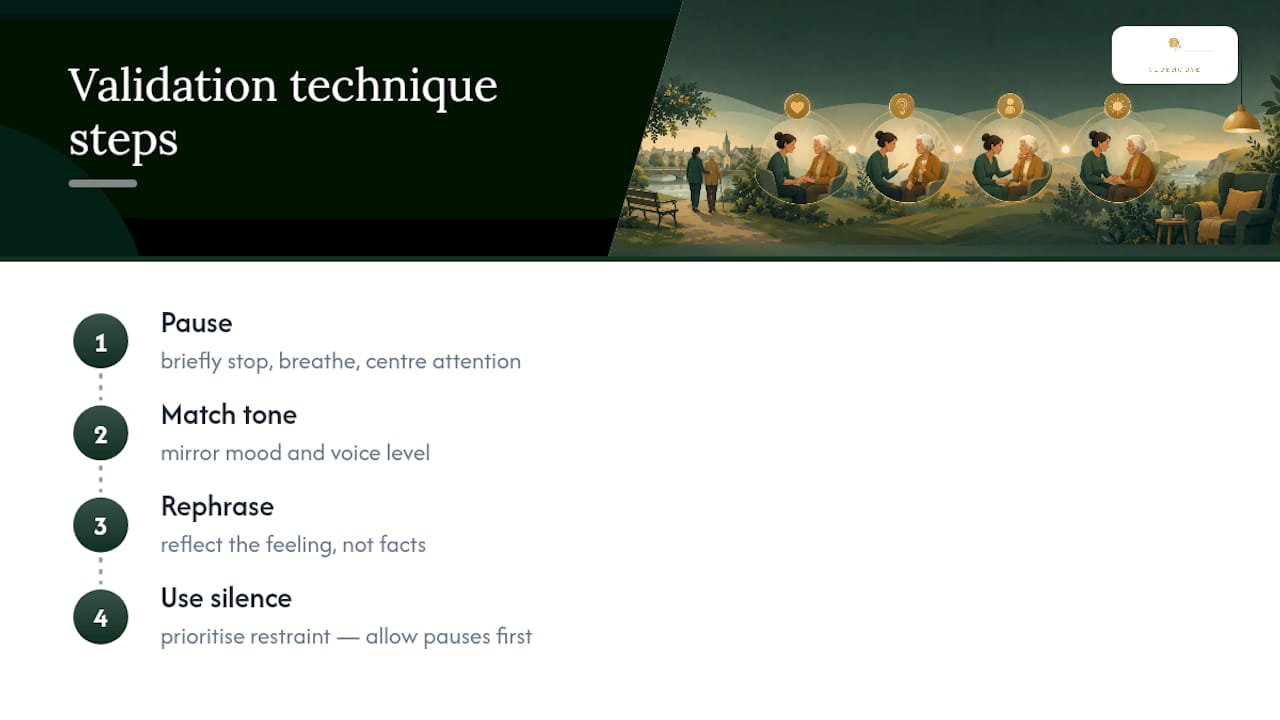
Where conventional advice falls short is in presenting validation as a fixed script to memorise rather than a responsive skill to practise. Naomi Feil's original staged model is thorough, but few family carers have the time or training to apply it rigorously. The pragmatic version, pause, match tone, rephrase, use silence, works because it's learnable in an afternoon and forgiving of imperfect delivery.
If you take one thing from this article, prioritise silence over speech. Carers instinctively fill every gap with reassurance or correction, and the data suggests restraint often serves the person better than another well-meant sentence. Practise that first, and the rest of the technique tends to follow.
— Scott @ The Clubhouse
This article is general information, not a substitute for advice from a qualified doctor. Consult a qualified healthcare professional about your own circumstances before acting on anything here.
Sources
- Responses of Persons Living with Dementia to Caregiver Validating Communication: A Secondary Analysis - PMC
- Validation therapy: a review of its contribution to dementia care (Review PDF)
- NICE guideline NG97: Dementia: assessment, management and support for people living with dementia and their carers
- NHS — Looking after someone with dementia (carer support)
FAQ
What is validation therapy for dementia?
Validation therapy is a communication method that acknowledges the emotion behind what a person with dementia says, rather than correcting factual inaccuracies, developed by Naomi Feil between 1963 and 1980.
What is an example of validation therapy?
If someone insists they need to collect their children from school, a carer might say, "Being there for your children matters a lot to you," acknowledging the responsibility they feel rather than pointing out their children are grown adults.
What is the average life expectancy for someone with stage 5 dementia?
Life expectancy at this stage varies considerably depending on age, general health, and the type of dementia involved, so it's best discussed directly with the person's GP or specialist, who can give guidance based on their individual circumstances.
What are odd behaviours associated with dementia?
Common changes include repeating questions, searching for people or objects from the past, wandering, becoming distressed at dusk (known as "sundowning"), and reacting strongly to situations that seem calm to those around them, all of which validation techniques can help ease.
How does validation therapy differ from reality orientation?
Reality orientation uses factual reminders such as calendars and repeated corrections to anchor a person in the present, while validation therapy accepts their emotional experience without insisting on factual accuracy, and tends to suit later-stage dementia better.