
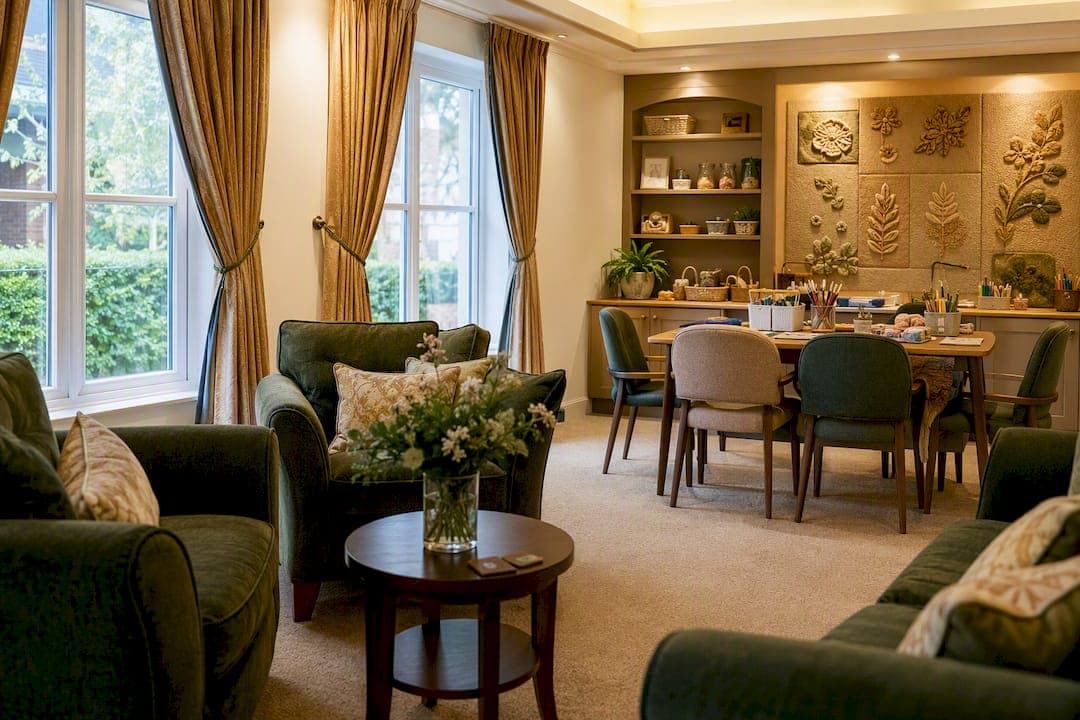
The features that matter most in accessible day centre design for dementia are cognitive accessibility, physical safety and a genuinely homely atmosphere. Clear signage and uncluttered layouts help someone with dementia work out where they are. Level access, handrails and non-slip flooring keep them safe. Familiar furnishings and small group sizes help them feel settled rather than institutionalised. A 2023 international position paper links this kind of environment to measurably reduced agitation and better orientation, and Dementia Australia's design principles back the same conclusion. At The Alderley Clubhouse, we see this play out daily.
When you're touring centres, look for:
- Level, step-free access from the car park or drop-off point to every room
- Clear, consistent signage with strong colour contrast
- Homely furnishings rather than clinical fixtures
- Small, capped group sizes rather than a large communal hall
- Quiet spaces alongside the main activity areas
Key Takeaways
Dementia-friendly design works when cognitive accessibility, physical safety and homely familiarity are combined, tested through participatory research, and reinforced by consistent, well-trained staff.
| Point | Details |
|---|---|
| Three priorities matter most | Cognitive accessibility, physical safety and homely familiarity should guide every visit assessment. |
| Space and bathroom ratios | Look for roughly 25 to 30 square metres per person and one accessible bathroom per ten attendees. |
| Sensory objects boost engagement | Co-designed tactile and audio features encourage storytelling and conversation, not just passive activity. |
| Staffing consistency is design | Small, consistent teams and visible-but-unobtrusive supervision reduce distress and support independence. |
| Maintenance sustains safety | Flooring grip, lighting tone and handrail fixings need regular checks, not a one-off installation. |
| The Alderley Clubhouse as example | Combines full accessibility with hospitality touches like a working fireplace and hostess trolley, and capped daily attendance. |
Table of Contents
- Evidence-based design principles that reduce stress in dementia care
- What to check room by room on a visit
- The details that make a centre feel like home, not a facility
- Why staffing and routine matter as much as the building itself
- How to judge a centre during a single trial visit
- Adapting design for physical disabilities and sensory loss
- Assistive technology and emergency systems built into the space
- Keeping a dementia-friendly centre safe and welcoming over time
- What we look for in a premium dementia-friendly day centre
- See these features in practice at The Alderley Clubhouse
- Sources
Evidence-based design principles that reduce stress in dementia care
Good design in a day centre is not decorative guesswork. It follows a set of principles that researchers have tested against real behavioural outcomes, and the differences show up in how settled someone feels within minutes of arriving.
Cognitive accessibility comes first. This means signage people can actually read and interpret, strong colour contrast between walls and doors, and furniture arranged with an obvious purpose. A 2023 position paper on dementia day care found that environments designed this way reduce behavioural disturbances such as agitation, and it recommends a minimum of 25 to 30 square metres of space per person attending, simply to guarantee enough personal room to feel comfortable rather than crowded.
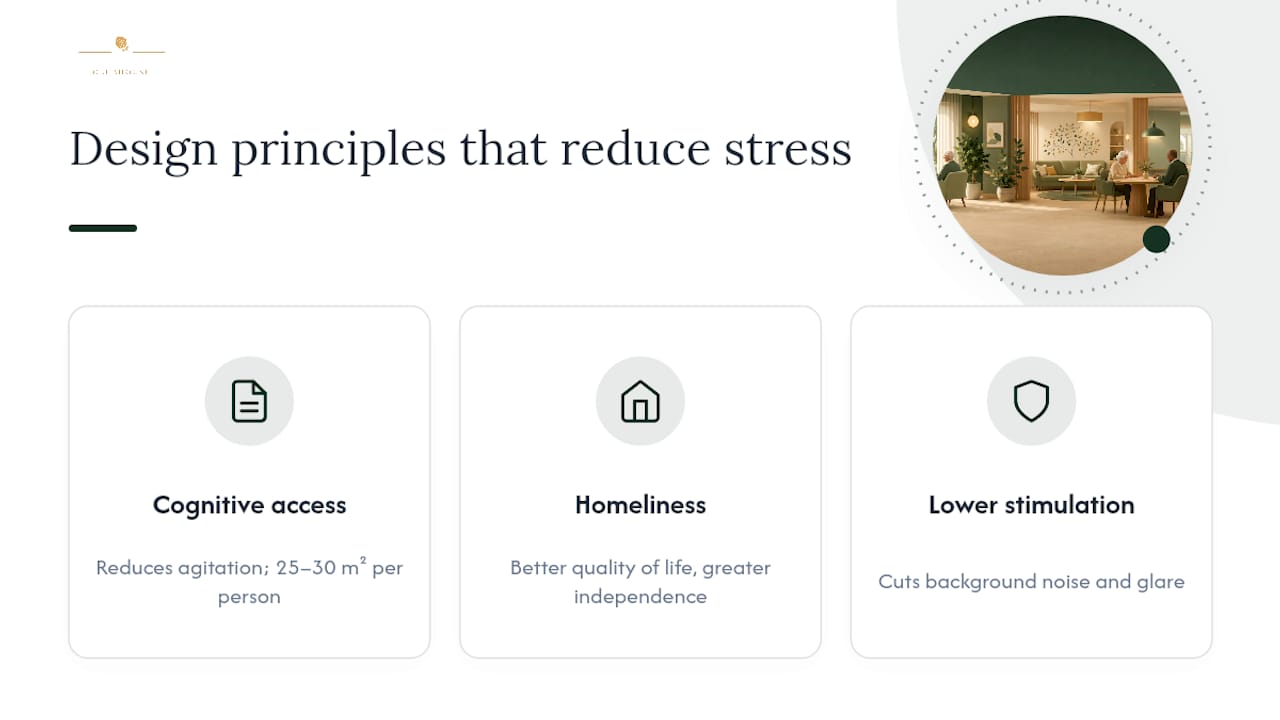
Familiarity and homeliness matter just as much. The ARIIA evidence summary reports that homelike interiors and personalised spaces are associated with better quality of life and greater independence, because they draw on memories that remain accessible even when short-term recall has faded.
Reducing unhelpful stimulation rounds out the picture. Dementia Australia's guidance highlights principles such as allowing people to see and be seen, unobtrusively minimising risk, and cutting background noise and glare. Fewer competing signals mean fewer opportunities for confusion or distress. Together, these principles explain why a centre that looks warm and calm on a first visit is very often making deliberate design choices, not just decorating for effect.
What to check room by room on a visit
Walking round a centre tells you far more than a brochure ever will. Use this as a working checklist, room by room.
- Entrance and arrival. Is access level, with no steps or awkward thresholds? Is there a clear, sheltered drop-off point right at the door? Does the entrance feel welcoming rather than clinical, with signage that's easy to read from a distance?
- Corridors and wayfinding. Do corridors loop back round rather than ending in confusing dead-ends? Are handrails fitted in a colour that contrasts with the wall? Is lighting even throughout, without sudden dark patches or glare from unshaded windows?
- Activity and dining spaces. Are chairs and tables arranged to encourage conversation rather than facing a wall? Is there a clear sense of purpose to the room, such as a dining table dressed for a meal or a lounge set up for cards and company? Is background noise kept low enough that people can hear one another?
- Quiet or rest rooms. Is there somewhere calm to retreat to, away from group activity, with dimmable lighting and a comfortable recliner? Is the route back to the main room and to toilets short and obvious?
- Accessible bathroom and shower. Practical guidance recommends at least one accessible bathroom for every ten people attending. Look for grab rails, slip-resistant flooring and enough space to preserve dignity and privacy during personal care.
- Outdoor access. Is there direct, secure access to a garden from the main activity space, ideally without needing a key or staff escort? Are there looping paths, seating at intervals and planting that changes with the seasons? Gardens and outdoor spaces are linked to real psychological and behavioural benefits, not just a pleasant view.
Pro Tip: Watch how a member moves from the lounge to the toilet during your visit. If they can find their own way without prompting, the wayfinding is working.
- Ask whether the garden is accessible in wet weather, not just on a dry, sunny afternoon
- Notice whether furniture is genuinely comfortable, or simply wipeable and practical
The details that make a centre feel like home, not a facility
Accessibility and safety get a centre through the door. What makes someone want to stay, and come back next week, is something warmer than a ramp or a handrail.
Participatory design research has shown that objects created together with people living with dementia, things like tactile handrail covers, textiles with embedded audio, or furnishings tied to a personal story, genuinely stimulate conversation and engagement. The Frontiers in Public Health study on spatial objects found that these multi-sensory prototypes were evaluated positively by both researchers and health professionals, precisely because they invite touch, storytelling and communication rather than passive observation.
At The Alderley Clubhouse, this thinking shapes every room. A working fireplace gives people somewhere to gather, just as they always have. A gramophone plays records our members know by heart, and a heated hostess trolley brings tea to the table the way it always used to be done.
These are not decorative flourishes. Familiar objects spark conversation and memory, and they quietly signal something important: this is not a day centre. It is a welcoming community space, warm and unhurried, where members feel at ease from the moment they walk in.
- Reminiscence corners with photographs or objects from earlier decades
- Scent cues, such as fresh baking, that trigger positive associations
- Deep, comfortable armchairs arranged for conversation rather than television-watching
Why staffing and routine matter as much as the building itself
The best-designed room in the world will not settle someone with dementia if the people around them are strangers every week. Layout and staffing work together, not separately.
Facilities that let staff see and be seen without hovering allow supervision that feels natural rather than intrusive, which reduces the defensive behaviours that overt monitoring can trigger. Small, consistent teams matter just as much as sightlines. A member who sees the same familiar faces each visit settles faster and communicates more openly than one greeted by rotating agency staff.
When you visit, ask to see or confirm:
- Staff dementia-care training records and qualifications
- Typical staff-to-member ratios during activities and mealtimes
- How consistent the team is week to week
- Safeguarding and infection control policies
- Request training certificates rather than a verbal assurance
- Ask how new starters are introduced to members
- Check the safeguarding policy is dated and reviewed within the last year
How to judge a centre during a single trial visit
One good visit tells you more than any website. Go in with questions ready and watch closely rather than just listening to the tour guide.
Ask directly: How many people attend on a typical day, and is attendance capped? What happens in a medical emergency? How are activities personalised to someone's interests rather than run as one generic programme for everyone? Can family visit unannounced?
Watch for red flags as you walk round: institutional strip lighting, cluttered corridors, background noise from a television left on for nobody, communal doors locked for no obvious reason, or staff who talk over members rather than to them.
- Arrive at the same time your relative would, to see a typical morning
- Spend at least two hours observing an activity session, not just a five-minute snapshot
- Stay through lunch to see how mealtimes are managed and how much choice is offered
- Ask for a short debrief with a member of staff afterwards, and note how well they know individual attendees by name
- Trust your own reaction as much as the checklist. If it feels calm and warm to you, it likely feels the same to your relative.
Adapting design for physical disabilities and sensory loss
Dementia rarely arrives alone. Many people attending a day centre also live with arthritis, reduced mobility, hearing loss or failing eyesight, and good design has to answer all of these at once, not just the memory-related needs.
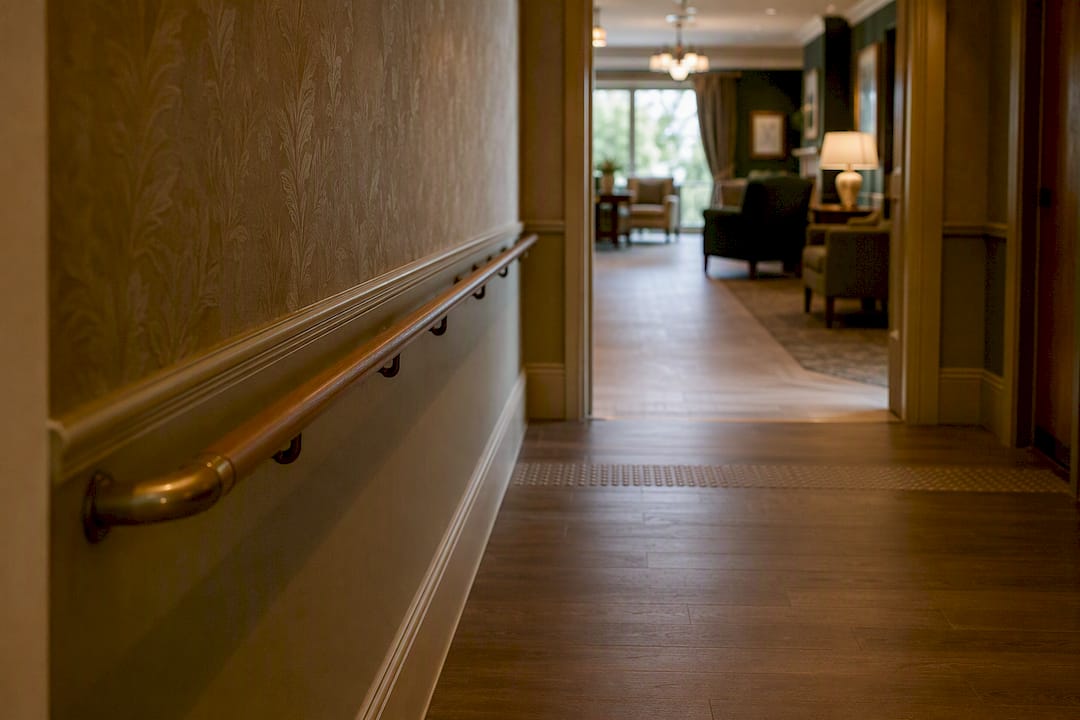
For physical disabilities, level access throughout the building is non-negotiable, alongside wide doorways that accommodate wheelchairs and walking frames, and seating with firm arms that make standing up easier. Handrails should run continuously along corridors rather than stopping and starting, since a gap in support is exactly where a fall is most likely.
For hearing loss, look for rooms with soft furnishings that absorb echo, since hard, clinical surfaces make speech difficult to follow even with a hearing aid. Some centres fit induction loop systems for group activities, and staff trained to face someone directly when speaking make a genuine difference to how included a person feels.
For vision loss, contrast becomes even more important than for cognitive accessibility alone. Door frames in a different tone from the wall, edges of steps picked out clearly, and good even lighting without glare all help someone navigate confidently. Tactile cues, such as a different floor texture at a doorway, give an extra layer of information that doesn't depend on sight at all.
The centres that get this right treat these adaptations as part of one coherent design, not a checklist bolted on separately for each condition.
Assistive technology and emergency systems built into the space
Good technology in a day centre setting is quiet rather than showy. It should support independence and safety without making the room feel medicalised.
Personal alarm pendants or wearable call buttons let a member summon help discreetly if they feel unwell or disorientated, without needing to find a member of staff. Emergency call points fitted at low level in bathrooms and quiet rooms serve the same purpose for anyone who cannot reach a standard height switch.
Motion-sensor lighting in corridors and toilets removes the risk of someone fumbling for a switch in the dark, particularly valuable for anyone with both dementia and failing eyesight. Door sensors linked to a staff station can flag if someone wanders towards an exit, allowing gentle intervention rather than a locked door that feels like confinement.
Hearing loop systems, mentioned above for sensory adaptation, count as assistive technology too, and are worth asking about specifically if your relative uses a hearing aid.
Ask any centre you're considering how these systems are tested and how often. A pendant alarm that nobody has checked in six months is not a safety feature. It's a false promise.
Keeping a dementia-friendly centre safe and welcoming over time
Design only works if it's maintained. A beautifully planned centre with peeling paint, worn flooring or broken handrails within a year has failed just as surely as one that was poorly designed to begin with.
Flooring needs particular attention, since slip-resistant surfaces gradually lose their grip with wear and cleaning products can affect that grip long before the flooring looks visibly worn. Ask how often flooring is inspected and replaced, not just cleaned.
Lighting fittings age too. Bulbs that shift towards a colder, harsher tone as they near the end of their life can undo careful glare control, so regular checks matter more than they might seem to at first glance. The same applies to handrail fixings and grab rails in bathrooms, which need periodic testing rather than a one-off installation and years of assumption.
Cleanliness carries a dignity dimension in dementia care that goes beyond hygiene alone. A centre that smells fresh and looks cared for signals respect for the people who spend their day there, and it also reduces the confusing sensory clutter that stale odours or visible grime can add to a room. Ask how often deep cleaning happens, and whether it's scheduled around activities rather than disrupting the calm, homely rhythm of the day.
What we look for in a premium dementia-friendly day centre
We look for the details that don't show up in a brochure: whether the fireplace is actually lit, whether staff know people by name before they've said it, whether the room smells of proper cooking rather than commercial cleaning fluid. Capped attendance and hospitality-led touches like these are what separate genuine person-centred care from a facility that has simply ticked the accessibility boxes.
Every feature in this guide, level access, an accessible shower room, secure parking, a dedicated drop-off point, is built into The Alderley Clubhouse. But we've always believed accessibility is the beginning of the conversation, not the end of it.
See these features in practice at The Alderley Clubhouse
Everything in this checklist, level access, an accessible shower room, secure parking and a dedicated drop-off point right at the door, is already built into The Alderley Clubhouse. What sets a visit here apart is what happens once you're through the door: deep armchairs arranged for conversation, a working fireplace to gather around, a gramophone playing records our members know by heart, and a heated hostess trolley bringing tea to the table just as it always did.
We keep daily attendance capped, so every member is recognised by name rather than lost in a crowd, and activities are personalised around individual interests rather than run from one generic timetable. You can see the full calendar and dining offer on our facilities and activities page. If you'd like to judge all of this for yourself, using exactly the checklist above, book a welcome tour or secure a day pass to see a typical day from arrival through to afternoon activities.
Sources
- Dementia Day Care Centres: A position paper (2023)
- Homing wellness and spatial objects in dementia long‑term care (Frontiers in Public Health)
- Designing dementia‑friendly care environments | Dementia Australia
- ARIIA evidence theme — Dementia care: dementia‑friendly environments
Ask any centre you're considering for their inspection reports or staff training records alongside these sources. Reading the evidence is useful; seeing it applied in person is what actually helps you decide.
This article is general information, not a substitute for advice from a qualified doctor. Consult a qualified healthcare professional about your own circumstances before acting on anything here.