

A dementia day programme is a structured daytime service offering social contact, meaningful activities, supervision and basic health monitoring for people living with dementia. Most sessions run for several hours and include a mix of activities, meals and rest, all designed around the person rather than a fixed clinical schedule.
For the person attending, it means company, purpose and a reason to get dressed and leave the house. For you as a carer, it means a few genuine hours to yourself, run an errand, see a friend, or simply sleep, without worry.
If you're weighing this up for a relative, here's where to start:
- Check local listings first. Search NHS and Alzheimer's Society directories for programmes near you before phoning anyone.
- Note transport needs early. Some services collect and drop off; others expect you to arrange lifts, so ask upfront.
- Book an introductory visit or call. A short conversation or trial session tells you more than any brochure.
Pro Tip: Ring during the working day rather than emailing. Day centre managers are far more forthcoming on the phone about staffing levels and how flexible they can be with a first visit.
Key Takeaways
Dementia day programmes work best when person‑centred staff continuity and tailored activities take priority over a fixed activity timetable.
| Point | Details |
|---|---|
| Start before crisis point | Introducing a programme early builds routine and trust. Most people need several weeks to settle in. |
| Match evidence to expectations | Research supports wellbeing, mood and respite gains, not a guaranteed effect on long‑term cognitive decline. |
| Ask structured questions | Use a numbered checklist covering staff ratios, training, safeguarding and fees before committing. |
| Check funding routes early | Contact your local authority for means‑tested support before assuming a private‑pay model is your only option. |
| Consider a hospitality‑led option | Clubhouse-group's Alderley Clubhouse offers capped daily membership, named recognition and chef‑prepared meals for families wanting a premium, dementia‑friendly alternative. |
Table of Contents
- What are the benefits of dementia day programs for families?
- What activities and services does a dementia day center offer?
- Who is suitable for a dementia day program?
- What does a typical day at a dementia day programme look like?
- Does the research support the benefits of dementia day programmes?
- How do you choose the right dementia day programme?
- Where can you find dementia day programmes near you?
- How do you prepare someone for their first day programme visit?
- What safety and staffing standards should dementia day services meet?
- What actually determines whether a day programme works for a family
- Experience a premium day programme built around routine and dignity
- Sources
What are the benefits of dementia day programs for families?
The benefits split two ways: what the person living with dementia gains, and what it does for you. Both matter, and neither should be treated as the lesser concern.
For the person attending, regular sessions offer social contact, cognitive stimulation and, very often, a lift in mood that carries through to the rest of the week. NHS guidance notes that structured activities, including things like Singing for the Brain, dance and reminiscence work, help reduce social isolation and support general wellbeing. That's not a small thing for someone whose world has often shrunk to a handful of rooms and a handful of faces.
For carers, the picture is just as significant. A realist synthesis of adult day programmes found that these services can support people to remain living at home for longer, partly through the wellbeing gains for the person with dementia, and partly through genuine respite for the carer. That respite isn't indulgent. Regular use of day services reduces the risk of caregiver burnout and helps sustain home‑based care over the longer term, which is precisely the outcome most families are hoping for when they start looking into this.
The practical, day‑to‑day benefits tend to show up quickly:
- A more settled daily routine, which often improves sleep at night.
- Reduced isolation, since regular contact with the same faces builds familiarity.
- A noticeable lift in mood after sessions involving music, movement or reminiscence.
- More natural conversation between you and your relative, because they have something new to talk about.
NIHR's evidence hub on day centres also points out something worth sitting with: outcomes vary quite a lot between individual centres. The benefit isn't automatic. It depends on how well a particular programme is run, which is exactly why the "how to choose" section further down matters as much as the decision to try one at all.
Pro Tip: Introduce a day programme while things are still manageable, not after a crisis forces the issue. Most people need several weeks of regular attendance to settle in and start benefiting properly, and that adjustment period is much easier when nobody's in a state of emergency.
What activities and services does a dementia day center offer?
Expect a blend of activity types rather than one single format repeated on a loop. Good programmes rotate through several categories across a week, so no two days feel identical.
Common activity types include:
- Music and singing sessions, which often reach people who've stopped engaging verbally.
- Reminiscence work, using old photographs, music or objects to spark memory and conversation.
- Arts and crafts, adapted to whatever level of dexterity someone still has.
- Gentle exercise, from seated stretching to short walks in a garden.
- Sensory sessions, particularly valuable for people in later stages of dementia.
- Cognitive stimulation groups, structured sessions using puzzles, categorisation tasks or word games.
Beyond activities, most programmes bundle in practical services: cooked meals, help with personal care where needed, transport to and from the venue, oversight of medication timings, and basic health checks such as blood pressure or hydration monitoring. A local authority day‑opportunity listing typically sets these out clearly, alongside opening hours and how to enquire.
The model varies a fair amount. A community day centre often runs larger group sessions with a rotating activity timetable. A memory‑focused group tends to concentrate specifically on cognitive stimulation therapy, run in smaller numbers with more individual attention. A hospitality‑led clubhouse model, the approach Clubhouse-group takes at the Alderley Clubhouse, builds the day around chef‑prepared meals and a calm, homelike setting, with activities chosen to match personal interests rather than filling a timetable slot.
Adaptation matters more than variety. Someone in early‑stage dementia might join a full cognitive stimulation group and enjoy the challenge. Someone further along benefits more from sensory activities, familiar music or simple tactile objects, which can ease anxiety and offer emotional connection even when words become harder to find.

Who is suitable for a dementia day program?
Day programmes generally suit people diagnosed with dementia at early to moderate stages, particularly those who respond well to routine and benefit from regular social contact. If your relative still enjoys company and conversation but is becoming isolated at home, this is often the right moment to look into it.
Providers typically carry out some form of assessment before admission:
- A clinical or social‑care assessment to understand support needs.
- A mobility and behaviour screening, partly for safety and partly to match activities appropriately.
- A funding or means‑tested eligibility check, where local authority support is being sought.
Some programmes aren't equipped for complex nursing needs or behaviours that require specialist secure care, and it's worth asking directly whether a service can accommodate higher needs rather than assuming. Many providers, including hospitality‑led models, adapt sessions and staffing ratios for people with more advanced dementia rather than turning them away, so don't rule out a service on assumption alone.
What does a typical day at a dementia day programme look like?
Structure without rigidity is the aim. A well‑run day flexes around the person, but a typical shape looks something like this:
- Morning arrival (9:00–10:00am): transport pickup or drop‑off, a warm welcome, tea or coffee, settling in.
- Mid‑morning activity block: a group session, music, gentle exercise or reminiscence, chosen for the day's mix of attendees.
- Lunch (around midday): a proper sit‑down meal, often the social high point of the day.
- Early afternoon rest: quiet time, a nap for those who need it, or a calmer one‑to‑one activity.
- Afternoon session: arts, sensory work or a second lighter activity block.
- Departure (mid to late afternoon): transport home, a handover note for family or carers on how the day went.
For someone in early‑stage dementia, that might mean a full cognitive stimulation session and genuine engagement in group conversation. For someone in the moderate stage, activities lean more towards reminiscence and structured routine. In later stages, sensory sessions, familiar music and one‑to‑one attention tend to work best, alongside more built‑in rest.
Meal times and transport windows are rarely as fixed as they look on paper. Good providers build in flexibility for personal care needs, a later pickup if someone's had a rough morning, or an extra break if the day's activity has been tiring. Ask about this flexibility directly when you visit.
Does the research support the benefits of dementia day programmes?
The evidence base is genuinely encouraging, but it comes with caveats worth understanding before you set expectations.
NHS guidance is clear that structured physical, mental and creative activities reduce social isolation and support mood and general wellbeing. That's a solid, government‑backed starting point. The realist synthesis published via PMC goes further, examining not just whether day programmes help but how and why. It concludes that these services can support people to age in place and improve carer wellbeing, while explicitly noting that outcomes depend heavily on how a programme is designed and delivered. Two centres offering "the same thing" on paper can produce very different results.
The strongest evidence points to consistent benefits for mood, social engagement and quality of life, alongside real support for family carers. What it does not show is a reliable, universal effect on long‑term cognitive decline. That distinction should shape how you set expectations from the outset.
NIHR's research evidence summary echoes this pattern, noting that day centres can maintain quality of life for older people while flagging meaningful variation between centres in how outcomes are measured and achieved. Group cognitive stimulation shows genuine promise, particularly in early‑stage dementia, but the wider literature on day programmes is a patchwork of different models, different populations and different ways of measuring "success," which makes broad claims about long‑term cognitive outcomes difficult to stand behind.
The practical implication is straightforward: treat a day programme as a way to support wellbeing, routine and respite, not as a treatment aimed at reversing decline. That's not a lesser goal. Steadier mood, better sleep, more social contact and a carer who isn't running on empty are all outcomes worth having in their own right.
For further reading, the NHS activities guidance, the PMC realist synthesis and the NIHR evidence hub referenced above are the three most useful starting points if you want to go deeper into the research yourself.
How do you choose the right dementia day programme?
This is where most families get it wrong, not through lack of care, but through not knowing what to ask. A polished website and a friendly manner tell you very little about how a programme actually runs day to day.
Start with a decision checklist covering the fundamentals:
- Is the approach genuinely person‑centred, or built around a fixed activity timetable regardless of who's in the room?
- Do staff have specific dementia training, not just general care qualifications?
- Are activities tailored to individual interests and remaining abilities?
- Is transport reliable and included, or an extra arrangement you'll need to sort yourself?
- Are mealtimes treated as a proper part of the day, or an afterthought between activities?
When you visit or phone, work through a structured set of questions rather than relying on general impressions:
- What is your staff‑to‑attendee ratio, and does it change for people with higher needs?
- What specific dementia training do staff complete, and how often is it refreshed?
- What happens in an emergency, medical or behavioural, and can you talk me through your procedure?
- Can I see a sample timetable for this week, not a generic brochure version?
- What safeguarding policies are in place, and when were they last reviewed?
- How is your fee structure set out, and are there additional charges for transport or specific activities?
- Will the same staff member be with my relative regularly, or does that change day to day?
Costs vary considerably depending on the model. Community and local authority day centres are often subsidised and may be free or low‑cost for those who meet means‑tested eligibility criteria, so it's worth contacting your local authority's adult social care team directly to check what support you qualify for. Charities sometimes offer subsidised places too. Premium, hospitality‑led providers charge a private day rate that reflects staffing ratios, food quality and facilities, and typically don't rely on local authority funding at all. A review of respite care costs and outcomes is a useful reference point if you're trying to weigh cost against outcome across different funding routes.
Watch for red flags. A programme that's overly activity‑driven, herding everyone through the same task regardless of interest or ability, is usually prioritising ease of management over the individual in front of them. Ask how staff handle someone who doesn't want to join in; the answer tells you a great deal. Poor or vague answers about safeguarding records are another warning sign, as is a rigid routine that never bends for someone having a difficult day.
Pro Tip: Ask to see today's actual attendance list with named staff against named attendees, not a generic staffing chart. If a provider can show you that Mrs Hughes has had the same key worker, Sarah, for the last six weeks, that's a far stronger sign of continuity than any policy document.
Where can you find dementia day programmes near you?
Several routes work well, and it's worth trying more than one rather than relying on a single search.
- Start with the NHS service finder and your GP surgery, both of which can point you towards registered local providers.
- Check Alzheimer's Society and other dementia charity directories, which list day services alongside carer support groups.
- Contact your local authority's adult social care team, who hold the fullest picture of subsidised and means‑tested options in your area.
- Search community directories for private and hospitality‑led providers that may not appear on statutory listings.
Before you phone, prepare a short summary: a diagnosis date, current medication, mobility level and any behaviours a provider should know about. This saves time on the call and helps them tell you quickly whether they can meet your relative's needs.
Once you've narrowed it down:
- Ask about transport availability before anything else, since it often decides whether a service is realistic day to day.
- Request a trial day rather than committing to a block booking straight away.
- Accompany your relative on the first visit if the provider allows it, particularly if they're anxious about new places.
Online listings are often thin on detail, an opening time, a phone number, a short description. Treat them as a starting point for a phone call, not the full picture. Council carer support pages often explain local assessment routes in more depth than a bare directory entry ever will.
How do you prepare someone for their first day programme visit?
Preparation reduces anxiety on both sides. Pack a small bag with anything familiar: a favourite jumper, a photograph or two, and a written note of food preferences and dislikes. A short life‑story sheet, a page covering their career, family and interests, helps staff strike up genuine conversation from day one rather than fumbling for small talk.
For the transition itself, shorter trial visits work better than diving straight into a full day. Keep the routine consistent: same drop‑off time, same person doing the handover if possible. If your relative is anxious, a familiar carer accompanying the first visit, even just for the first hour, often smooths things considerably. A small ritual afterwards, tea and a chat about their day, gives them a sense of closure and gives you a natural way to ask how it went.
Fatigue, overstimulation and confusion are the most common early hiccups. If a session seems to be too much, a quieter corner or an early pickup isn't a failure, it's a sensible adjustment. Academic research into transitions into day services consistently finds that a graded, patient introduction beats pushing through resistance, so don't be discouraged if the first visit is short.
Pro Tip: Bring recent, dated photographs rather than old family albums. Staff can use them to start conversations about what's happening right now in your relative's life, which builds a much stronger connection than reminiscing alone.
What safety and staffing standards should dementia day services meet?
Staffing quality is the single biggest variable between a good programme and a mediocre one. Look for dementia‑specific training as standard, not just general care certificates, and ask whether a nurse or clinical lead is available on‑site or on‑call. Continuity matters too: a service where your relative sees the same handful of staff regularly will settle them far faster than one with constant rotation.
On safety, ask directly about:
- How accidents and incidents are recorded and reported to families.
- Medication administration policy, including who's responsible and how errors are avoided.
- Emergency procedures for both medical events and behavioural crises.
- Transport safety standards, including driver checks and vehicle accessibility.
Regulation and inspection give you an independent check on all of this. In England, CQC inspection reports are publicly available and worth reading before you visit; a clean record with recent, specific inspection notes is a good sign, while a long gap since the last inspection or vague, generic feedback is worth asking about directly. Red flags in these records typically include repeated safeguarding concerns, understaffing findings, or unresolved action points from a previous inspection.
What actually determines whether a day programme works for a family
Most guidance on this topic treats "activities" as the main event, endless lists of what happens during the day. That's the wrong emphasis. The evidence, and frankly common sense, points somewhere else: continuity of relationship matters more than the content of the timetable.
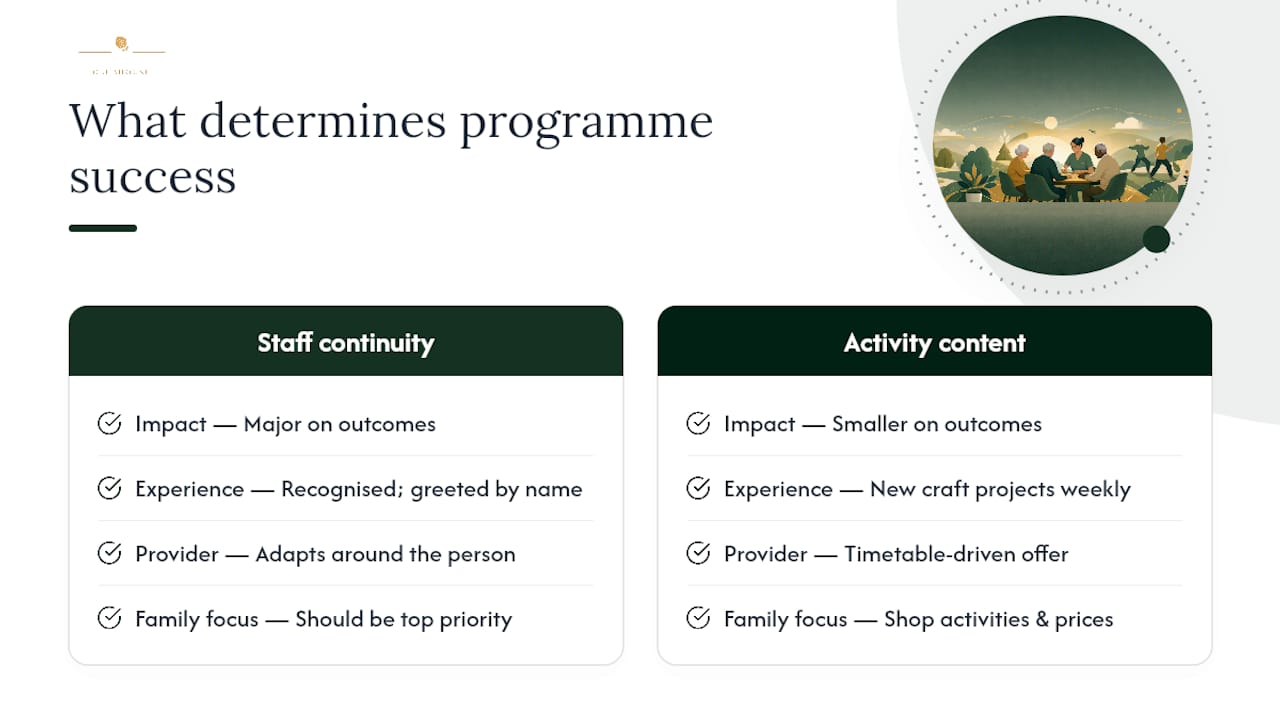
A person with dementia doesn't need a new craft project every week. They need to be recognised, greeted by name, remembered for who they were before diagnosis. The realist synthesis on adult day programmes makes this point indirectly by showing how much outcomes vary between programmes offering broadly similar activities. The difference isn't the craft table. It's whether staff genuinely know the person sitting at it.
Where conventional advice falls short is in treating day programmes purely as a service to book rather than a relationship to build. Families often shop for activities lists and price comparisons, then wonder why attendance stalls after a few sessions. What you should prioritise first isn't the fanciest timetable. It's staff continuity, a genuine welcome, and a provider willing to adapt around your relative rather than the other way round.
Experience a premium day programme built around routine and dignity
Everything in this guide, continuity of staff, genuinely tailored activities, a proper sit‑down meal, is exactly what Clubhouse-group has built into daily life at the Alderley Clubhouse. Membership is capped daily, so every attendee is greeted by name, not processed through a generic timetable, and activities are shaped around personal interests rather than filling a slot on a schedule.
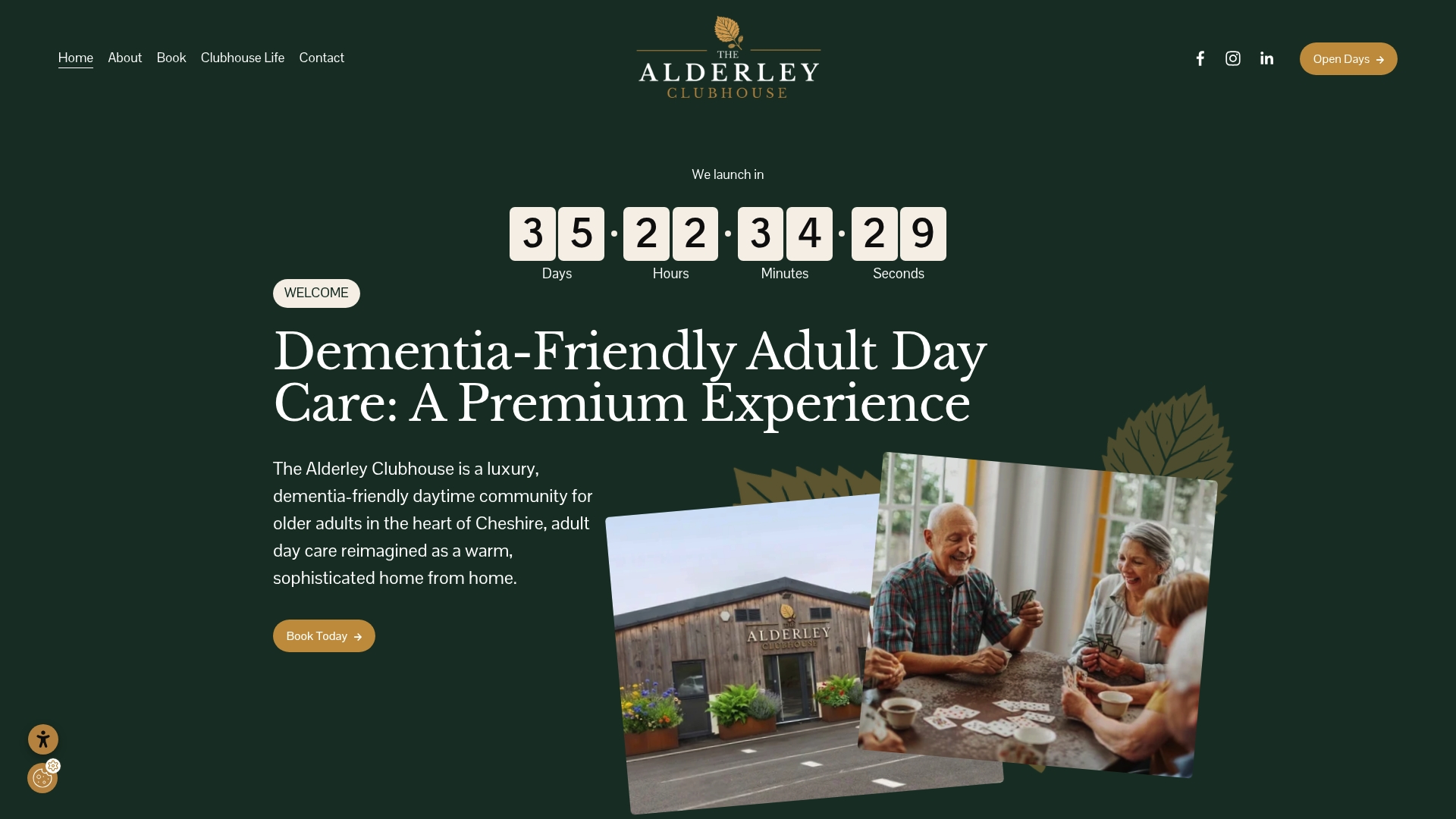
Where a standard community day centre works to a group programme and a private carer can be costly and inconsistent, the Alderley Clubhouse sits between the two: professional dementia‑trained staff, chef‑prepared meals, and a beautifully appointed, homelike setting in Cheshire, all without the clinical feel that puts many families off traditional day centres. You can see the full range of facilities and activities on offer before deciding whether it's the right fit for your relative.
If this sounds like the kind of routine and dignity you've been looking for, book a day pass or trial session and see how your relative settles in for themselves.
Sources
For deeper reading beyond this guide, these sources cover the practical, evidential and financial angles:
- Activities for dementia - NHS
- Adult day programs and their effects on individuals with dementia and their caregivers (realist synthesis) - PMC
- Research evidence on day centres for older people - NIHR ARC South London
- Day opportunities for adults with dementia - Kirklees Council
This article is general information, not a substitute for advice from a qualified doctor. Consult a qualified healthcare professional about your own circumstances before acting on anything here.