
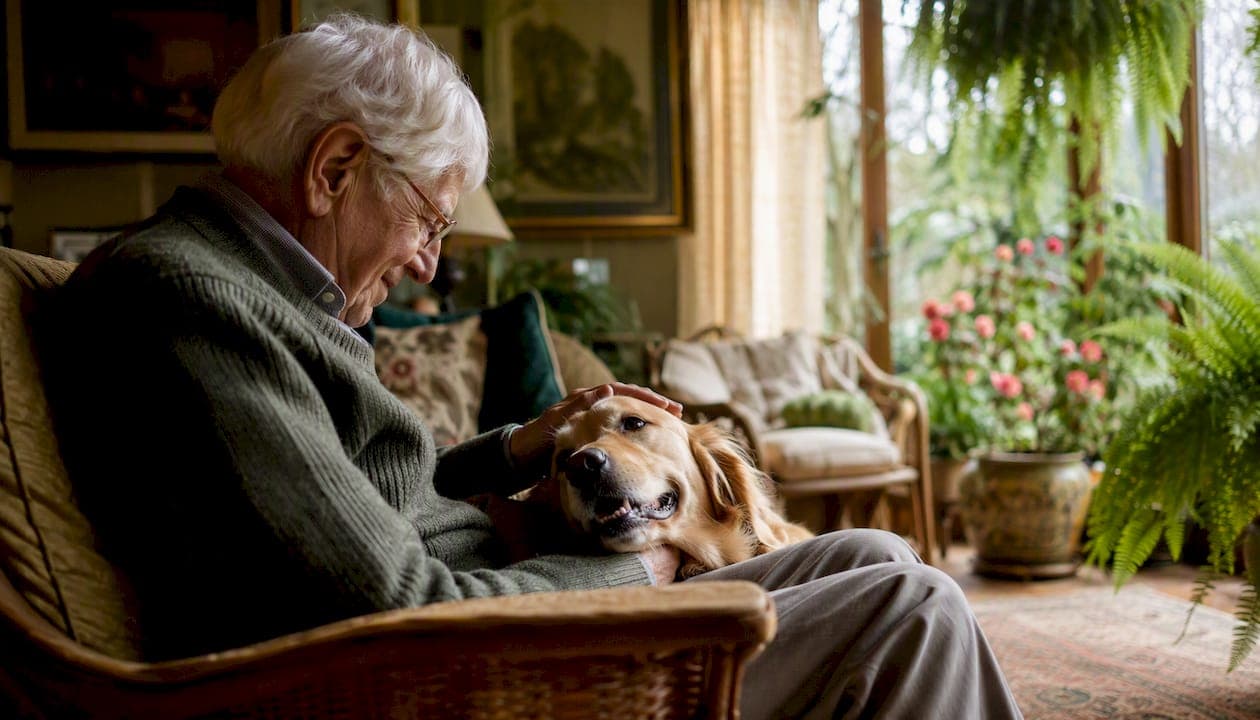
Animal-assisted therapy can meaningfully improve mood, reduce agitation, and encourage social engagement in people living with dementia. The evidence is clearest for psychological outcomes: a 2026 meta-analysis of 35 randomised controlled trials found that animal-assisted interventions improved anxiety, depression, and stress across adult populations, though the authors cautioned that substantial heterogeneity limits certainty. Effects on cognition are more modest and inconsistent. For carers weighing whether to try it, the short answer is: yes, with some care taken over who it suits and how sessions are arranged.
Three things to know before you read further:
- Who benefits most: people with a lifelong affinity for animals, particularly those in mild to moderate stages of dementia, tend to respond most positively.
- Safety first: all sessions should be supervised, with infection control and mobility checks in place before a first visit.
- How to start: in the UK, Pets As Therapy coordinates free volunteer visits to care homes and day centres, making it one of the easiest first steps for families.
Pro Tip: Before contacting any provider, ask your relative whether they have a favourite animal or a pet from their past. That single piece of information can shape the whole session and make the difference between a lukewarm response and genuine delight.
Key takeaways
Pet therapy can reliably improve mood, reduce agitation, and encourage social engagement in people living with dementia, with the strongest evidence coming from psychological outcomes in systematic reviews and meta-analyses.
| Point | Details |
|---|---|
| Psychological benefits are best supported | Meta-analysis of 35 RCTs found improvements in anxiety, depression, and stress; physical benefits were not clearly demonstrated. |
| Personalisation drives outcomes | Matching the animal and session style to individual preferences produces the largest and most consistent benefits. |
| Multiple formats are available in the UK | Pets As Therapy volunteer visits are free; robotic companions such as Joy For All are available at retail; paid clinical AAT is also an option. |
| Safety requires active management | Supervision, infection control, mobility checks, and animal welfare monitoring are non-negotiable for every session. |
| Start with a trial and track reactions | A mood diary and brief observational notes after each session give carers and care teams the evidence they need to adjust and improve. |
Families in Cheshire looking for a day-care setting where pet therapy is already part of the weekly programme are welcome to book a day pass at the Alderley Clubhouse and experience it first-hand.
Table of Contents
- What is animal-assisted therapy, and how does it differ from a friendly pet visit?
- What the research shows about pet therapy and dementia
- Who is most likely to benefit, and when should you be cautious?
- What does a pet therapy session actually look like?
- How to arrange pet therapy in the UK
- Risks, ethics, and animal welfare: what carers and providers must manage
- How we run pet therapy at The Alderley Clubhouse
- 10 practical tips for introducing pet therapy and getting the most from sessions
- What the evidence actually tells us, and what carers should do with it
- Sources
What is animal-assisted therapy, and how does it differ from a friendly pet visit?
The term "pet therapy" is widely used, but it covers several distinct approaches. Understanding the differences helps you ask the right questions when contacting a provider.
Animal-assisted therapy (AAT or AATx) is a goal-directed clinical intervention. The AVMA defines it as a structured programme delivered by a qualified health or human-service professional, with the animal as an integral part of treatment. A speech therapist using a dog to encourage conversation in a person with dementia is practising AAT. The professional sets measurable goals, documents progress, and adjusts the approach over time.
Animal-assisted activities (AAA) and animal-assisted support programmes (AASP) are less formal. A trained volunteer handler brings a well-assessed dog or cat to a care home for social visits. There are no clinical goals or outcome measures, but the emotional and social benefits can still be real and consistent.
Robotic companion pets occupy a separate category. Models such as PARO (a therapeutic robotic seal used in UK research and clinical settings) and Joy For All companion pets (available through UK retailers) replicate some of the calming effects of live animals without the logistical demands of feeding, vaccination, or transport. Dementia UK's Admiral Nurses note that robotic alternatives can offer similar engagement where live animals are impractical, and that animal interaction, in any form, often reconnects people with their identity and life history.
Key organisations to know in the UK:
- Pets As Therapy — the main national charity coordinating volunteer animal visits to hospitals, care homes, and community settings.
- Alzheimer's Society — provides guidance on dementia care approaches, including the role of animals, through its Dementia Connect service.
- Dementia UK — Admiral Nurses offer specialist advice to families on integrating animal interaction into care plans.
| Type | Who delivers it | Goal-directed? | Typical setting |
|---|---|---|---|
| AAT (clinical) | Qualified health professional | Yes | Clinic, care home, day centre |
| AAA / AASP | Trained volunteer handler | No | Care home, community, hospital |
| Robotic companion | Carer, staff, or family | No | Home, care home, day centre |
What the research shows about pet therapy and dementia
The evidence base is growing, though it is not yet definitive. Here is what the research currently supports, and where gaps remain.
Psychological benefits are the most consistent finding. The 2026 meta-analysis synthesising 35 RCTs with 2,391 participants found improvements in anxiety, depression, and stress following animal-assisted interventions. The authors were careful to note that heterogeneity across studies was substantial, meaning results varied considerably depending on how sessions were delivered, which species were involved, and how outcomes were measured. No clear benefits were found for physical outcomes such as pain or gait.
A 2026 review in Frontiers in Veterinary Science focused specifically on older adults and dementia, reporting varied but promising findings for mood, agitation, and engagement. Dog-assisted and robotic interventions were the most commonly studied formats. The authors called for larger, higher-quality trials before firm conclusions can be drawn.
Agitation and behaviour. A systematic review of dog-based AAT found that tailored interventions may reduce behavioural and psychological symptoms in people with dementia, including agitation and social withdrawal. The word "tailored" matters here: studies showing the largest effects tended to match the intervention to the person's prior preferences and familiarity with animals.
Robotic pets show promise too. A small quality-improvement study with 12 participants attending a day centre reported significant mood and behaviour improvements after repeated sessions with therapeutic interactive robotic pets, and a majority of participants showed some improvement on the MMSE after the intervention. The authors were clear about the limitations: 12 participants, no control group, and possible confounders. Treat it as an encouraging signal, not proof.
Cognition remains uncertain. A handful of small studies report modest improvements in cognitive measures, but the evidence is inconsistent and no systematic review has yet established a reliable cognitive benefit. Mood and engagement are where the strongest case lies.
| Outcome | Evidence strength | Typical study type |
|---|---|---|
| Mood / emotional wellbeing | Moderate (meta-analysis) | RCTs, observational |
| Agitation reduction | Moderate (systematic review) | RCTs, small trials |
| Social engagement | Moderate (review evidence) | Observational, feasibility |
| Cognition | Weak / inconsistent | Small trials, case series |
| Physical outcomes (pain, gait) | No clear benefit found | RCTs |
What the research tells us: animal-assisted interventions can improve psychological wellbeing in people living with dementia, but session design, species choice, and individual preference all shape how much benefit someone actually experiences.
Who is most likely to benefit, and when should you be cautious?
Not everyone with dementia will respond positively to animal interaction, and that is perfectly normal. Knowing who tends to benefit helps you make a confident decision rather than a hopeful guess.
Signs that pet therapy is likely to be a good fit:
- A lifelong love of animals, or a history of pet ownership.
- Positive reactions to animals in everyday life (smiling at a neighbour's dog, for example).
- Mild to moderate dementia, where the person can still engage meaningfully with their surroundings.
- A calm temperament during new experiences, or a preference for gentle, sensory activities.
- Willingness to be in the same room as an animal, even without direct contact.
When to pause and take advice first:
- Known allergies to animal dander or fur.
- A history of fear or anxiety around animals.
- Unmanaged fall risk or significant mobility difficulties that could be worsened by an animal moving unpredictably.
- Advanced dementia where the person may not register the animal's presence or may become distressed by unfamiliar stimuli.
- Skin conditions or open wounds that raise infection-control concerns.
The dog-based AAT systematic review found that matching the intervention to individual needs and preferences was one of the clearest predictors of a positive outcome. A person who was indifferent to animals throughout their life is unlikely to find sessions transformative, whereas someone who kept dogs for decades may light up the moment a friendly spaniel enters the room.
One practical consideration families often overlook: if your relative still lives at home with a pet, their dementia may eventually make caring for that animal difficult. Dementia UK advises that organisations such as the Cinnamon Trust can provide volunteer dog-walking, fostering during hospital stays, and long-term care planning for the pet, reducing the burden on family carers.
A quick checklist before contacting a provider:
- Has the person shown positive responses to animals recently or in the past?
- Are there any allergies, phobias, or skin conditions to flag?
- Is mobility supervised and safe in a room with a moving animal?
- Is there a staff member or carer who can stay throughout the session?
- Has consent (or best-interests consideration for those lacking capacity) been discussed?
What does a pet therapy session actually look like?
Sessions vary considerably depending on the setting and the type of intervention, but most follow a recognisable shape.
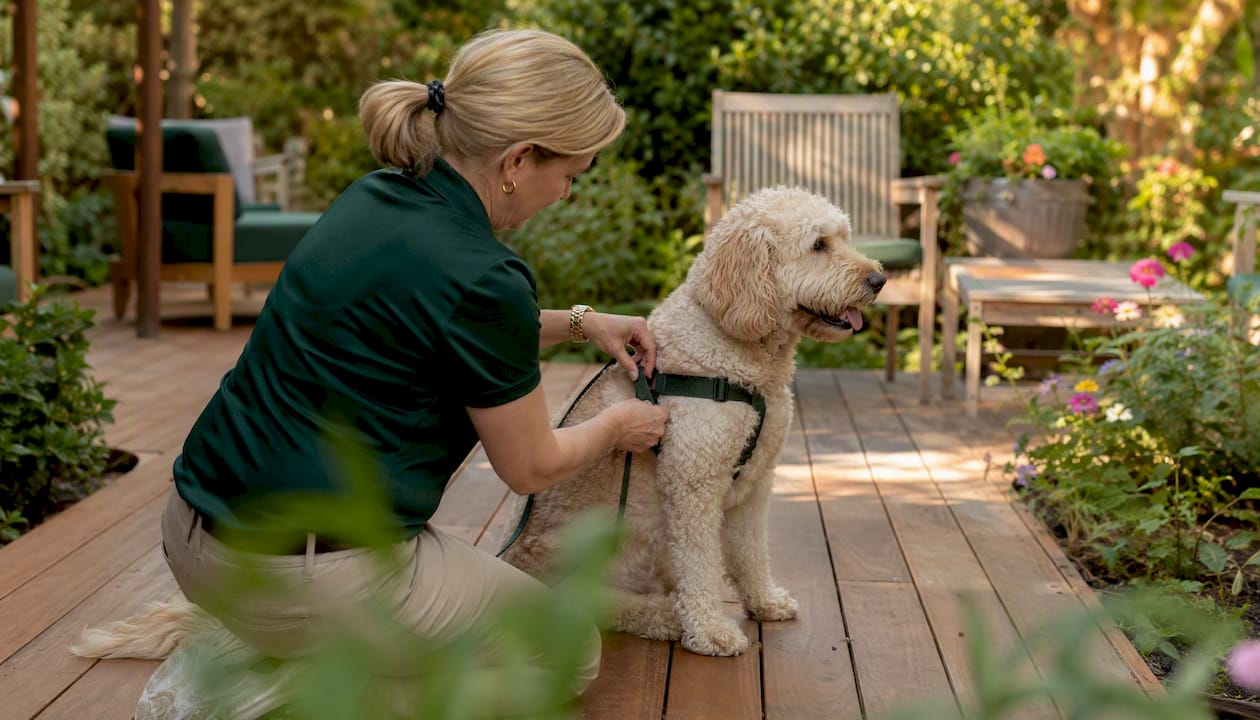
Duration and frequency. Trials have used sessions ranging from around 10 minutes for brief touch-team visits to 60–90 minutes for structured group programmes. For people with dementia, shorter and more frequent sessions tend to work better than long, infrequent ones. A weekly or twice-weekly visit of 20–45 minutes is a common starting point in day-centre settings.
A typical session structure:
- Arrival and settling: the handler and animal enter calmly, giving the person time to notice and respond at their own pace. No pressure to approach.
- Introduction and guided interaction: the handler introduces the animal by name, encourages gentle stroking or feeding a treat, and uses the animal as a prompt for conversation ("Have you ever had a dog like this?").
- Sustained engagement: the person interacts at their own level, whether that means holding the animal, simply watching, or talking about memories the visit has prompted.
- Calm-down and close: the handler gently signals the end of the session, gives the person time to say goodbye, and ensures they are settled before leaving.
- Handover: the handler or a staff member notes any reactions, positive or otherwise, for the care record.
Practical requirements every setting needs to address:
- Hand hygiene before and after contact, and no animal access to food preparation areas (following CDC infection-control guidance for animal interactions).
- Animals must be vaccinated, groomed, and assessed for temperament before visiting.
- Seating should be stable and at a comfortable height; avoid low chairs that make it difficult to rise if the animal moves suddenly.
- A trained handler must remain with the animal throughout. The animal is never left unsupervised with a person with dementia.
- Consent or best-interests documentation should be in place before the first session.
Pro Tip: A few minutes before the animal arrives, show your relative a photograph of the dog or cat they are about to meet. For someone with dementia, a gentle heads-up like this can reduce surprise and help them feel in control of the experience.
| Practical need | Why it matters |
|---|---|
| Handler certification | Confirms the animal is assessed and the handler is trained |
| Animal vaccination records | Reduces infection risk for immunocompromised individuals |
| Mobility assessment | Prevents falls if the animal moves unexpectedly |
| Consent / capacity check | Protects the person's right to choose or decline |
| Session notes | Allows carers to track reactions and adjust future visits |
How to arrange pet therapy in the UK
There are several practical routes for families in the UK, ranging from free charity visits to purchasing a robotic companion pet.
Volunteer visits through Pets As Therapy. Pets As Therapy is the most established route. The charity coordinates trained volunteer handlers and their assessed animals to visit care homes, hospitals, and community settings across the UK. Visits are typically free of charge. To arrange one, contact the charity directly or ask the care home or day centre to make the request on your behalf.
Through a care home or day centre. Many care homes already have visiting animal programmes in place. Ask the activities coordinator whether they have an existing relationship with a handler or charity, and whether sessions can be scheduled around your relative's routine. Adult day centres, including dementia-specific facilities, often run group AASP sessions as part of their weekly activity calendar.
Paid animal-assisted therapy programmes. Some occupational therapists and specialist practitioners offer structured AAT as a clinical service, with session fees varying by provider and location. These are goal-directed and documented, making them appropriate when there is a specific therapeutic aim, such as reducing a particular pattern of agitation.
Robotic companion pets. PARO is used in UK research and clinical settings and can be accessed through some NHS and care-home programmes. Joy For All companion pets (robotic cats and dogs) are available through UK retailers at a moderate one-off cost although prices vary. Neither requires ongoing maintenance costs for feeding or veterinary care, making them a practical option for home use or settings where live animals are not permitted.
Funding and support. Charity visits through Pets As Therapy carry no cost. For paid programmes, some local councils offer small grants for dementia care activities, and charitable funds such as those administered through the Alzheimer's Society may be able to signpost families to local support. Ask your GP, Admiral Nurse, or social worker whether any local funding is available.
Questions to ask any provider before agreeing to a trial:
- Is the handler trained and insured?
- Are the animals assessed for temperament and kept up to date with vaccinations?
- How will the session be documented and shared with the care team?
- What happens if the person becomes distressed during a visit?
- How is the animal's welfare monitored throughout?
Dementia UK's Admiral Nurses can advise on integrating animal interaction into an existing care plan and help families think through the practical and ethical questions before a first session.
Risks, ethics, and animal welfare: what carers and providers must manage
Pet therapy is generally safe, but it is not without risks. Being clear-eyed about them makes sessions better for everyone, including the animals.
Potential adverse reactions in people with dementia:
- Fear or anxiety triggered by an unfamiliar animal, particularly in someone who was not an animal lover.
- Overstimulation in a busy group session, leading to agitation rather than calm.
- Over-attachment to a visiting animal, which can cause distress when the session ends.
- Unintentional rough handling, which may result in a scratch or bite if the animal reacts.
- Falls, if the person moves suddenly to follow or reach for the animal.
- Infection risk, though this is low when standard hygiene protocols are followed.
These reactions appear infrequently in the literature, and most can be prevented with good session design. The key is supervision throughout, not just at the start.
Animal welfare is not optional. A therapy animal that is stressed, tired, or poorly matched to the environment will not deliver a good session, and may behave unpredictably. Handlers should:
- Allow the animal regular rest breaks away from the session.
- Monitor for signs of stress (flattened ears, tucked tail, excessive panting in dogs).
- Never force an animal to interact with someone who is handling it roughly.
- Keep visits to a duration the animal can manage comfortably.
- Ensure vaccination, grooming, and health checks are current.
Ethical considerations with robotic pets. Some families feel uncomfortable about giving a person with dementia a robotic animal without explaining that it is not real. There is no single right answer, but the general guidance from practitioners is to be honest when asked directly, while not volunteering the information in a way that removes the comfort the object provides. The goal is wellbeing, not deception.
Risk and control overview:
| Risk | Practical control |
|---|---|
| Allergic reaction | Pre-screen for allergies; use hypoallergenic species where possible |
| Falls | Supervised seating; mobility assessment before first session |
| Infection | Hand hygiene; animal vaccination records; no food-area access |
| Animal bite or scratch | Trained handler present; session ended if animal shows stress |
| Emotional distress at session end | Gradual close; familiar object or activity to transition to |
| Animal welfare | Rest breaks; stress monitoring; handler oversight throughout |
How we run pet therapy at The Alderley Clubhouse
At the Alderley Clubhouse, pet therapy is one of the most loved parts of our weekly programme. Our members enjoy regular visits from gentle, well-socialised dogs and cats, and our mini therapy ponies, who reliably draw a crowd the moment they arrive in the garden.

We take a relaxed, member-led approach. Nobody is ever asked to participate if they would rather watch from a comfortable chair. Some members want to stroke and chat; others simply enjoy the atmosphere a friendly animal brings to the room. Both responses are equally welcome.
Our visiting animals are supervised by their handlers throughout every session. Before any animal joins our programme, we confirm vaccination records, temperament assessments, and handler training. Our team carries out a brief consent and wellbeing check for each member before the session begins, and any reactions, positive or otherwise, are noted in the care record.
Sessions are woven into our weekly activity calendar alongside music, reminiscence, and gentle exercise, so members experience animal interaction as part of a varied, stimulating day rather than an isolated event. Our capped daily attendance means every member is known by name, and our team can tailor each session to individual preferences, whether that means bringing a particular dog a member has bonded with, or simply positioning a member's chair to give them the best view of the ponies.
What our operational approach includes:
- Handler training and insurance confirmed before any animal visits.
- Individual consent or best-interests documentation for each member.
- Infection-control protocols: hand hygiene stations available, animals kept away from food preparation areas.
- Post-session notes shared with the wider care team.
- Member choice to participate or observe, respected every time.
Families considering a day at the Clubhouse are welcome to book a welcome tour to see our facilities and activities in person, including how pet visits are integrated into the day.
Pro Tip: If your relative has a strong connection to a particular type of animal, mention it when you book. We do our best to match visits to individual preferences, and that personal touch makes sessions far more meaningful.
10 practical tips for introducing pet therapy and getting the most from sessions
-
Assess your relative's affinity for animals first. Look through old photographs, ask family members, or simply observe their reaction when they see a dog on a walk. Past preference is the strongest predictor of a positive response.
-
Start with a short observation session. For a first visit, aim for 15–20 minutes with no pressure to touch the animal. Watching from across the room is a perfectly valid form of engagement.
-
Brief the handler before they arrive. Share relevant details: the person's name, their history with animals, any words or phrases that might prompt a memory, and any behaviours to watch for.
-
Prepare the environment. Clear the space of trip hazards, ensure seating is stable, and have hand-hygiene supplies ready. A calm, familiar room works better than a busy communal area for a first session.
-
Check consent and capacity. For someone who lacks capacity to consent, a best-interests discussion with the care team should happen before the first visit, not after.
-
Use the animal as a conversation prompt. Questions like "Did you ever have a dog?" or "What would you call him?" can open up long-dormant memories and encourage sustained conversation.
-
Watch for signs of discomfort. Withdrawal, agitation, or attempts to move away are signals to end the session gently. Never persist with a visit if the person is distressed.
-
Keep a simple mood diary. Note the person's mood before and after each session, any words spoken, and any notable reactions. Even a brief observation log gives you something concrete to share with the care team.
-
Build sessions into a regular routine. Consistency matters. A weekly visit at the same time of day, with the same animal where possible, helps the person anticipate and look forward to the experience.
-
Evaluate and adjust. After four to six sessions, review your notes with the care team. If the person is not responding positively, try a different species, a smaller group, or a shorter duration before concluding that animal-assisted interaction is not for them.
Pro Tip: If your relative becomes anxious during a session, do not try to redirect their attention back to the animal. Instead, gently guide them to a familiar activity, a cup of tea, a favourite piece of music, and let the animal remain quietly in the background. Sometimes the presence alone is enough, without any direct interaction.
What the evidence actually tells us, and what carers should do with it
The research on pet therapy and dementia is genuinely encouraging, but it is easy to overstate. Most trials are small, many lack control groups, and the heterogeneity across studies means that a finding from one setting does not automatically transfer to another. Carers deserve honesty about that, not a promise that a weekly dog visit will slow cognitive decline.
What the evidence does support, clearly and consistently, is that animal interaction tends to lift mood, reduce agitation in the short term, and prompt social engagement in people who have a prior affinity for animals. Those are not small things. For a family watching a relative withdraw into silence, a session that produces ten minutes of animated conversation about a childhood dog is genuinely meaningful, even if it does not show up on a cognitive scale.
The conventional advice in this space tends to focus on whether pet therapy "works" as if it were a drug with a single measurable effect. The more useful question is: works for whom, in what format, and how often? The systematic review evidence points clearly toward personalised, tailored sessions as the ones that produce the best outcomes. A generic group visit with an unfamiliar animal is a very different thing from a one-to-one session with a breed the person has loved all their life.
My honest view is that carers should trial it early, track reactions carefully, and not wait for a perfect evidence base before trying something that is low-risk, low-cost, and often genuinely joyful. The Pets As Therapy route in the UK makes a first session easy to arrange. Start there, observe what happens, and let the person's response guide what comes next.
This article is general information, not a substitute for advice from a qualified doctor. Consult a qualified healthcare professional about your own circumstances before acting on anything here.
Sources
- Animal-assisted therapy on psychological and physical outcomes: a meta-analysis of randomised controlled trials
- Effectiveness of the dog therapy for patients with dementia - a systematic review
- Animals and dementia - Dementia UK
- Animal-assisted interventions for older adults and dementia — Frontiers in Veterinary Science
- Animal-assisted interventions definitions — AVMA