
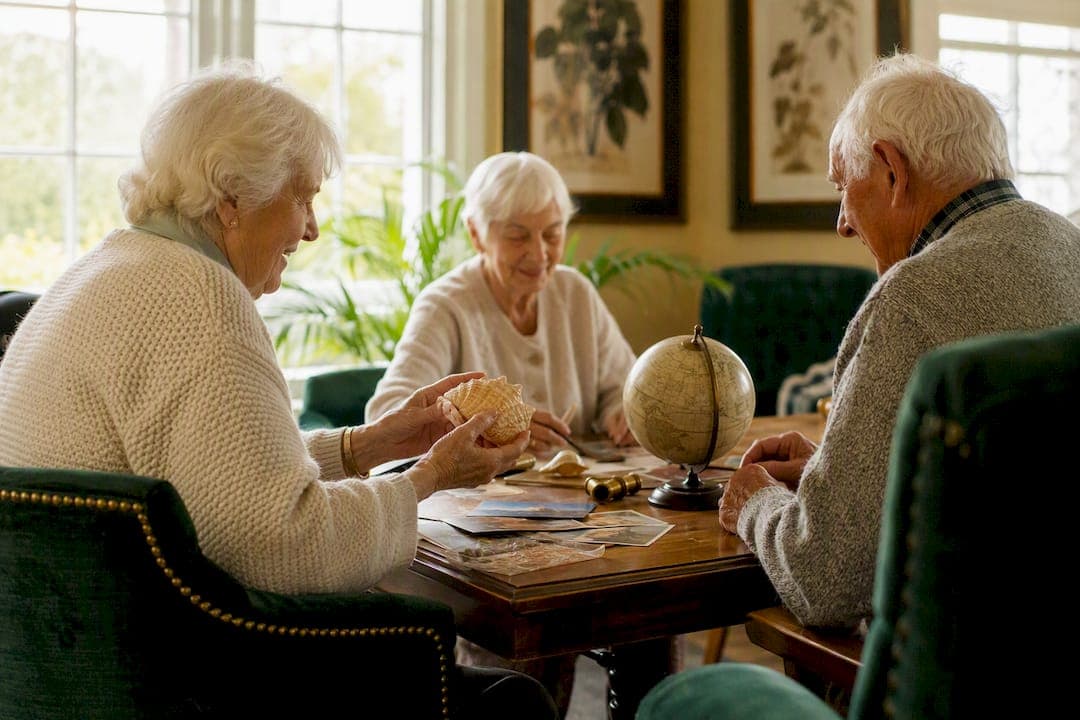
Cognitive stimulation therapy is an evidence-based group programme, and it's the only non-drug therapy that NICE and SCIE recommend for people living with mild to moderate dementia. It works through structured, themed sessions rather than drills or worksheets, and it has consistently shown benefits for memory, communication and mood in clinical trials.
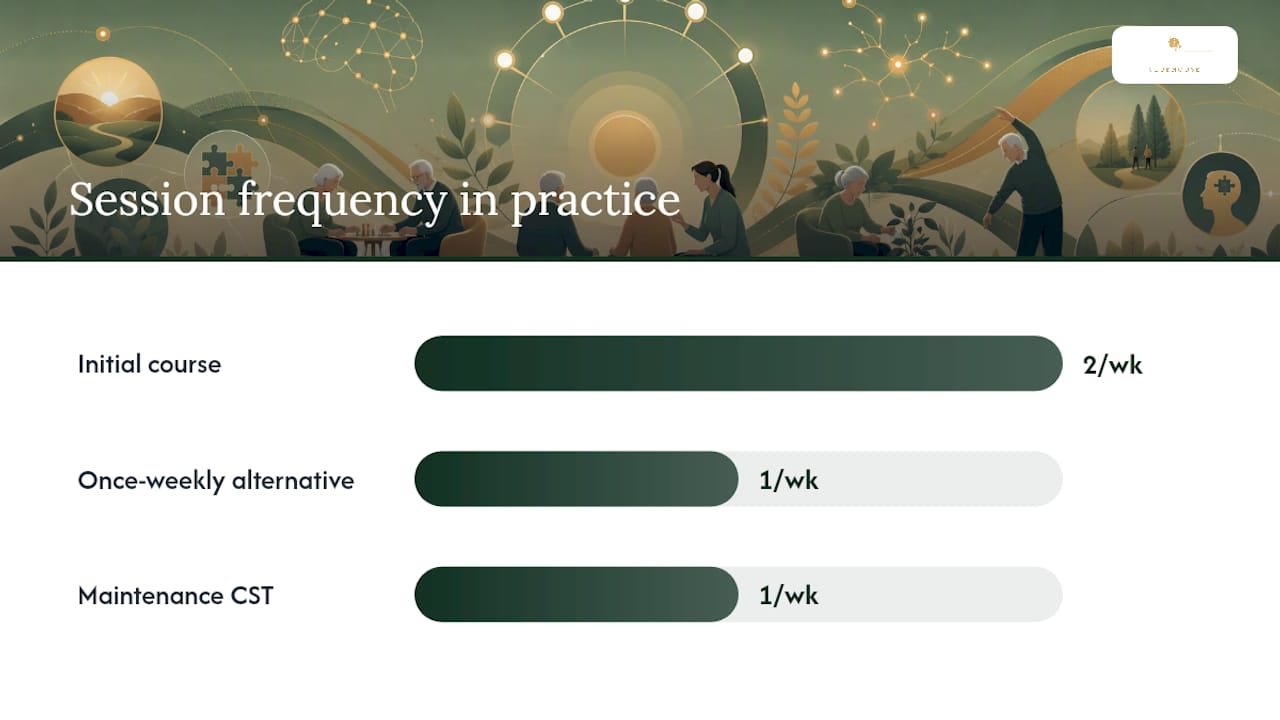
The original protocol runs for 14 sessions of 45 minutes each delivered twice weekly over seven weeks in small groups. NICE guideline NG97 endorses it specifically for cognitive symptoms in mild to moderate dementia, and systematic reviews (including the Cochrane-style update by Woods and colleagues) back this up with consistent evidence.
Here's who it's designed for and where you'll find it:
- Who benefits: people with mild to moderate dementia who can take part in group conversation
- Typical settings: memory clinic groups, care homes, community day centres and specialist adult day clubs
- Ongoing support: Maintenance CST (MCST), usually weekly follow-up sessions helps sustain the gains made during the initial course
Key Takeaways
Cognitive stimulation therapy is the only NICE and SCIE-recommended non-drug therapy for mild to moderate dementia, and it works best delivered twice weekly, in small groups, by trained facilitators following the original manual.
| Point | Details |
|---|---|
| Evidence is solid but short-term | Reviews show small-to-moderate cognitive gains and real communication improvements, though long-term data is limited. |
| Stick to the original protocol | 14 sessions of 45 minutes, twice weekly, delivered by manual-trained facilitators, gets closest to trial results. |
| Plan for Maintenance CST | Weekly follow-up sessions after the initial course help sustain quality-of-life gains. |
| Ask providers the right questions | Frequency, group size and facilitator training tell you more than a leaflet ever will. |
| Clubhouse embeds CST into daily life | The Alderley Clubhouse delivers CST through Ayla-certified staff woven into a hospitality-led day, not a standalone clinical session. |
Table of Contents
- What does the evidence say about cognitive stimulation therapy?
- What is cognitive stimulation therapy and how does it differ from other approaches?
- Who is CST suitable for and when should it start?
- How is cognitive stimulation therapy delivered in practice?
- What activities happen in a CST session?
- How do providers and family carers implement CST well?
- How do you find and access a CST group?
- What about consent, safety and monitoring during sessions?
- How does CST look in a premium day-club setting?
- A day-club alternative worth knowing about
- Where to read more about the evidence and training
- Frequently asked questions
- Sources
What does the evidence say about cognitive stimulation therapy?
The short answer: it works, but modestly and mostly in the short term. Systematic reviews and meta-analyses report small-to-moderate benefits for global cognition, alongside improvements in communication and social interaction that families and carers often notice before any test score changes. That distinction matters for how you judge success: a spouse saying "she seems more herself again" is a real outcome, even if it doesn't show up neatly on a cognitive scale.
A meta-analysis focused specifically on trials using the original 14-session CST protocol found significant beneficial effects on global cognition, language and self-reported quality of life. This is one reason clinicians tend to favour the manualised version over looser, improvised adaptations. Trials have also found that the cognitive gains from CST can be comparable in scale to some anti-dementia medications in early studies, and in some trial samples, combining CST with cholinesterase inhibitors produced greater improvements than medication alone.
In numbers: trial-based economic evaluations estimate the initial 14-session course costs roughly £238 to £241 per person, with Maintenance CST running at around £634 per person over six months in trial settings. The PSSRU-led analysis concluded CST offers good value for money against the size of benefit it produces.
Here's how the main evidence sources stack up:
| Evidence source | What it found | What it means in practice |
|---|---|---|
| Cochrane-style systematic review | Small-to-moderate short-term gains in global cognition; clinically relevant communication improvements | Supports CST as a first-line psychosocial option |
| Original-protocol meta-analysis | Significant effects on cognition, language and quality of life | Backs delivering the manualised 14-session version where possible |
| NHS/PSSRU cost-effectiveness review | Modest per-person cost; favourable value against benefit gained | Justifies funding and commissioning decisions |
| Maintenance CST trials | Sustained quality-of-life gains; cognitive gains more variable | Supports continuing sessions beyond the initial course |
The main caveat worth holding onto: most of this evidence covers the short to medium term. Long-term follow-up data is thinner, and the quality of results varies depending on how faithfully a group sticks to the training manual versus running a looser, home-grown version. That's not a reason to dismiss CST. It's a reason to ask, when you're looking at a group or programme, whether it follows the original protocol or a diluted version of it.
What is cognitive stimulation therapy and how does it differ from other approaches?
Cognitive stimulation therapy is a manualised psychosocial programme. It uses themed, social activities such as reminiscence, word games, music and practical tasks to gently stimulate thinking and conversation, all delivered in a small group setting with consistent routines. That word "manualised" matters: it means facilitators follow a structured guide rather than improvising, which is part of why the evidence base is so consistent across different trial sites.
CST is often confused with cognitive training or cognitive rehabilitation, but the three are quite different in aim and method. Cognitive training typically drills a specific skill, like memory recall exercises repeated on a schedule. Cognitive rehabilitation focuses on compensatory strategies for a particular functional problem, such as using a diary system to manage a specific memory lapse. CST does neither. It prioritises social engagement, personhood and enjoyment, using cognitive activity as the vehicle rather than the goal itself.
A handful of principles run through every well-delivered CST session:
- Routine: sessions follow a predictable rhythm, which reduces anxiety for people with dementia
- Multi-sensory stimulation: activities engage sight, sound, touch and sometimes taste or smell, not just verbal recall
- Opinion-led discussion: facilitators ask what someone thinks or remembers, never what the "correct" answer is
- Person-centred pacing: the group moves at the pace of its quietest or slowest member, not its quickest
- Positive reinforcement: every contribution is welcomed, and mistakes are simply never highlighted
Pro Tip: Treat every activity as a bridge into conversation, not a test of memory. If someone can't name the year, ask them what they remember about that decade instead. The goal is engagement, not a correct answer.
Who is CST suitable for and when should it start?
CST is designed for people with mild to moderate dementia, generally those who can still follow and take part in a group conversation, even if it's with some support. Clinicians typically use tools like the MMSE or ACE-III to gauge where someone sits on that scale, though the more practical test is simpler: can this person sit with others, respond to a question, and enjoy being part of a group?
You'll find CST running in several settings, and the right one often depends on what someone already enjoys:
- Memory clinics and NHS groups, usually run shortly after diagnosis
- Care homes, where it's built into a resident's weekly activity schedule
- Community groups, often hosted by local charities or day centres
- Premium day clubs, where CST principles are woven into a wider hospitality-led programme rather than run as a standalone clinical session
Timing matters more than people realise. The trial literature suggests benefits tend to be larger when someone starts in the milder stages of dementia, partly because group participation and verbal engagement are easier to sustain. CST isn't usually appropriate for people with severe dementia, active delirium, or significant uncorrected sensory impairment (untreated hearing or sight loss can make group participation frustrating rather than enjoyable). In those cases, one-to-one adaptations or simpler sensory activities tend to work better until the underlying issue is addressed.
How is cognitive stimulation therapy delivered in practice?
The original group protocol runs for 14 sessions of 45 minutes, delivered twice weekly over seven weeks. That frequency isn't arbitrary. Trial evidence suggests that higher session frequency and earlier participation stage tend to produce larger benefits, which is why twice-weekly delivery has stuck as the gold standard rather than a once-a-week alternative.
Once the initial course finishes, many programmes move into Maintenance CST (MCST): typically weekly follow-up sessions that continue the same themed, social format. Trial evidence on MCST shows it can sustain the quality-of-life gains made during the initial course, even where further cognitive improvement plateaus. Think of MCST less as "more treatment" and more as keeping a good habit going.
Delivery format also varies, and each comes with trade-offs:
| Delivery mode | Strength | Limitation |
|---|---|---|
| In-person group | Strongest social stimulation; matches trial evidence most closely | Requires transport, group scheduling and space |
| One-to-one | Highly tailored to the individual's interests and pace | Loses the peer interaction that drives much of CST's benefit |
| Digital/remote | Can extend reach where in-person groups aren't feasible | Needs careful facilitation to retain social connection; not suited to everyone |
Whichever format is chosen, fidelity to the training manual is what the evidence keeps coming back to. Facilitators trained through the International CST Centre at UCL, or an equivalent recognised programme, are far more likely to reproduce the outcomes seen in trials than a group run from a rough idea of what CST involves.
- Twice-weekly frequency outperforms once-weekly in trial data
- MCST sustains quality-of-life gains after the initial course ends
- Trained, manual-adherent facilitators get closer to trial-level outcomes than improvised sessions
What activities happen in a CST session?
A typical CST session opens with a five-to-ten minute warm-up, usually something light like a song or a current-affairs chat, before moving into the main themed activity and closing with a short summary that reinforces what was discussed. The structure sounds simple, and that's rather the point: predictability lowers anxiety and lets people focus on the conversation rather than working out what's expected of them.
Common activities include:
- Discussing today's news or a notable date in history
- Word association games and simple wordplay
- Music and sing-alongs, often using songs from someone's younger years
- Practical, hands-on tasks like baking, gardening or sorting objects by category
- Picture-based prompts and orientation boards showing the day, season or weather
A sample 45-minute session might look like this:
| Time | Activity | Purpose |
|---|---|---|
| five to ten minutes | Warm-up song or physical stretch | Settles the group and signals the session has begun |
| — | Orientation discussion (day, date, weather, news) | Grounds participants without testing them directly |
| — | Main themed activity (e.g. childhood games, food, current affairs) | Delivers the core cognitive and social stimulation |
| — | Summary and closing song | Reinforces the session and ends on a positive note |
Across a full 14-session course, themes typically rotate through areas like childhood, food, current affairs, physical games, number games, faces and scenes, and word association, giving variety without ever breaking the underlying routine. Adaptations matter here: for someone with a hearing impairment, visual prompts take priority over verbal cues; for low literacy, picture and object-based activities work better than word puzzles; and for a culturally diverse group, songs and reminiscence themes should reflect the group's own background rather than a single default set of references.
How do providers and family carers implement CST well?
Running CST properly takes more than good intentions. Facilitator training is the foundation. At the Clubhouse, every member of the care team is certified through Ayla, an award-winning dementia therapy training programme, specifically to deliver CST, and most well-run programmes recommend co-facilitation with at least two staff members for a group of around eight participants.
Session logistics deserve just as much thought as the activities themselves:
| Requirement | Why it matters |
|---|---|
| Quiet, familiar space | Reduces distraction and supports orientation |
| Consistent weekly slot | Builds routine, which lowers anxiety for participants |
| Simple record-keeping | Tracks attendance, engagement and any concerns raised |
| Refreshments built into the routine | Extends the social element beyond the formal activity |
Outcome measurement matters too, though it doesn't need to be clinical to be useful. Scales like the MMSE or MoCA, the QoL-AD quality-of-life measure, or simpler engagement and communication ratings can be recorded before the course starts and again after the 14 sessions finish.
A practical starting checklist:
- Confirm facilitator training and co-facilitation cover before the first session
- Book a consistent space and time slot for all 14 sessions
- Set a baseline measure (even something informal) before session one
- Plan the transition into Maintenance CST before the initial course ends, rather than leaving it as an afterthought
How do you find and access a CST group?
Access usually starts with a conversation, not a form. Most people find CST through one of a handful of routes:
- Ask at a memory clinic appointment. Many diagnostic memory services run their own CST groups or can point you towards a local one.
- Speak to a GP. They can refer into NHS-run groups where available, though provision varies by area.
- Contact Alzheimer's Society or Age UK. Both signpost to local CST and MCST provision, including community and charity-run sessions.
- Ask a care home directly. Many run CST as part of their weekly activity schedule for residents.
- Look at private, premium day-club providers. These often integrate CST principles into a wider daily programme rather than a single weekly session.
Cost snapshot: trial-based cost evaluations put the initial CST course at roughly £238 to £241 per person, with Maintenance CST costing around £634 per person over six months in trial conditions. NHS provision is typically free at the point of access; private day-club programmes charge per session or via a membership package, so ask providers directly what's included.
Waiting times vary enormously depending on where you live, and demand for NHS memory service groups often outstrips supply. When contacting a provider, whether NHS or private, it's worth asking specifically: how often do sessions run, how large is the group, and is the facilitator trained to deliver the original manualised protocol? The answers to those three questions tell you more about likely benefit than almost anything else on a leaflet.
What about consent, safety and monitoring during sessions?
Good CST starts before anyone sits down in the group. Capacity and consent should be assessed properly, documented clearly, and where someone can't consent for themselves, a legal proxy or next of kin should be involved in the decision to take part.
Basic health screening matters too. Before someone joins a session, it's worth checking for delirium, undiagnosed pain, infection, or uncorrected sensory impairment, any of which can make a person seem far more confused or withdrawn than they actually are day to day.
During sessions, facilitators need to watch for simple signs of distress: agitation, withdrawal, repeated attempts to leave, or visible frustration. These aren't failures of the programme, they're signals to adapt.
Pro Tip: If someone becomes distressed during a group activity, the answer usually isn't to push through. Step them aside for a one-to-one chat about the same topic at their own pace, then decide together whether to rejoin the group.
- Document consent clearly and involve proxies where capacity is limited
- Screen for delirium, pain, infection and sensory issues before group attendance
- Watch for distress signals and be ready to shift to one-to-one support without hesitation
How does CST look in a premium day-club setting?
Consider a typical Tuesday afternoon at a hospitality-led day club, where the CST activity isn't a bolt-on but a natural part of the day. A group of six to eight members with mild to moderate dementia gathers after lunch for a themed conversation session, this week's theme being "seaside holidays." The session runs the standard 45 minutes, guided by two Ayla-certified staff members, with tea and homemade cake served partway through as part of the routine rather than as a separate event.

| Element | Detail |
|---|---|
| Participant profile | small groups, mild to moderate dementia |
| Session theme | Seaside holidays (reminiscence and picture prompts) |
| Facilitation | Two Ayla-certified staff members |
| Observed benefit | Increased verbal participation, visible enjoyment, spontaneous storytelling between members |
What makes this work isn't a clinical trick. It's that the environment itself supports engagement: small group size, familiar faces, a beautifully appointed room, and refreshments that feel like a treat rather than a task on a schedule. Members aren't told they're "doing therapy." They're having a conversation about the seaside, and the cognitive stimulation happens because they're genuinely enjoying themselves.
Why this feels like company, not a clinic
I've come to think the biggest misunderstanding about CST is that people expect it to look like a class, with a whiteboard and a right answer. In practice, the best sessions I've seen described in the evidence and in well-run programmes look far more like a good afternoon with friends who happen to be talking about their childhood or last summer's holiday. That's not a lowering of standards. It's the entire mechanism. Every member of our care team is Ayla-certified specifically because that sociable, unhurried atmosphere is what the research keeps pointing to as the active ingredient, not the activity sheet itself.
A day-club alternative worth knowing about
If you're weighing up an NHS memory service group, a care home activity slot, or a community charity session, the Alderley Clubhouse offers a different route to the same goal: real, evidence-aligned CST delivered by trained staff, but wrapped inside a full day of hospitality rather than a single weekly appointment.
Every member of the Clubhouse team is Ayla-certified to deliver CST, and sessions are woven into the natural rhythm of the day, themed conversation over lunch, a shared activity in the afternoon, familiar routines throughout, rather than treated as a separate clinical block. That matters if the person you're caring for finds a formal "session" harder to settle into than a relaxed afternoon with company. You can see how the facilities and activity calendar work day to day, and if you'd like to see it in person before committing to anything, you can book a welcome tour at a time that suits you.
Where to read more about the evidence and training
- The International CST Centre at UCL holds the official manual, training pathways and international adaptations
- The Cochrane-style systematic review is the most thorough summary of the trial evidence to date
- The NHS England and PSSRU cost-effectiveness summary covers funding, cost and value-for-money data
- TEWV NHS's guidance page explains NICE's guideline position in plain terms
Frequently asked questions
Is cognitive stimulation therapy only for people with early-stage dementia? No, but it's most effective for mild to moderate dementia. People need to be able to take part in group conversation, even with support, which is why it's less suited to more advanced or severe stages.
How is CST different from general "brain training" apps or puzzles? Brain training apps typically drill an isolated skill in front of a screen, alone. CST is a social, group-based activity led by a trained facilitator, and the social interaction itself is considered central to why it works, not incidental to it.
Can CST be combined with dementia medication? Yes. Trial evidence suggests combining CST with cholinesterase inhibitors can produce greater improvements on some outcomes than medication alone, so the two are often used together rather than as alternatives.
How soon might someone notice benefits from CST? Families often notice changes in mood and social engagement within the first few weeks of the 14-session course, while measurable cognitive changes tend to show up nearer the end of the programme or shortly after.
What happens after the initial 14 sessions finish? Many programmes move participants into Maintenance CST, typically weekly sessions that continue the same format and have been shown to help sustain quality-of-life improvements over time.
This article is general information, not a substitute for advice from a qualified doctor. Consult a qualified healthcare professional about your own circumstances before acting on anything here.
Sources
- Original CST protocol description (manual and trials summary)
- Cochrane-style systematic review update on cognitive stimulation
- Systematic review and meta-analysis of the original CST protocol (UCL discovery)
- CST: summary of evidence on cost-effectiveness (NHS England / PSSRU summary)
- Cognitive stimulation therapy — TEWV NHS