
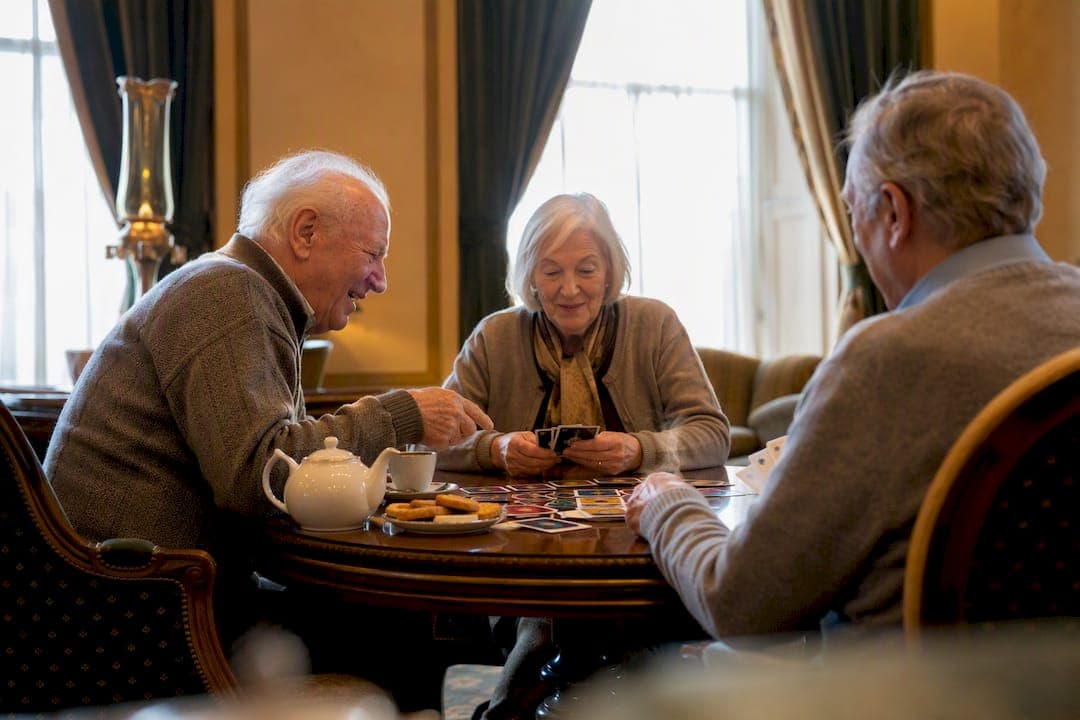
The best dementia friendly games are simple board games, card and matching games, jigsaws, reminiscence quizzes and a handful of well-designed apps, chosen for the person's stage rather than their old skill level. Together, they offer three things that matter most: social connection, a lift in mood, and gentle cognitive stimulation. NICE recommends Cognitive Stimulation Therapy as the only non-drug therapy for mild to moderate dementia, and games like these sit comfortably alongside it. A systematic review and meta-analysis found traditional board games measurably slowed cognitive decline in older adults.
Categories worth trying straight away:
- Simple board games (Ludo, Snakes & Ladders, adapted Chess or GO)
- Card and matching games
- Jigsaws and puzzles sized to ability
- Reminiscence and photo-based quizzes
- Dementia-first apps designed for calm, frustration-free play
At The Alderley Clubhouse, we build our whole activity day around this idea. Choose well and the game itself almost becomes secondary to the laughter it produces.
Key Takeaways
The most effective dementia friendly games prioritise dignity and social connection over winning, using large pieces, no scoring, and stage-matched rules to reduce frustration.
| Point | Details |
|---|---|
| Match the game to the stage | Choose GO or Chess early, dominoes or jigsaws mid-stage, and sensory decks later on. |
| Prioritise design features | Look for large pieces, high contrast, short rounds and no visible scoring. |
| Drop the scoreboard | Removing "winners and losers" protects dignity and reduces resistance to play. |
| Rotate games regularly | Avoid repeating the same activity too often to prevent a boredom effect. |
| Prepare the environment first | Good lighting, quiet seating and a snack nearby matter as much as the game itself. |
Table of Contents
- Why games help with dementia: what the evidence actually shows
- Choosing the right type of game for each stage of dementia
- Setting up a game session that avoids frustration
- Games to try at each stage, with simple adaptations
- Digital games and apps built with dementia in mind
- How a dementia day club runs game sessions in practice
- What most guides get wrong about dementia friendly games
- Sources
Why games help with dementia: what the evidence actually shows
The strongest evidence sits with traditional board games. A 2023 systematic review and meta-analysis pooling multiple studies found measurable improvements on the Montreal Cognitive Assessment and Mini-Mental State Examination, the two standard screening tools clinicians use to track cognitive change. Mahjong showed particular benefit for executive function (planning and decision-making), while Chess improved quality-of-life scores.
Games won't reverse dementia, and no reputable study claims they do. What the research consistently shows is slower decline, better mood, and stronger social ties, particularly when introduced in the early to mid stages.
The NHS recommends stimulating activities including puzzles and games as part of living well with dementia, but is careful to frame this as support, not treatment. Evidence for later stages is thinner and more mixed. This matters practically: the emotional and social payoff, feeling included, feeling capable, sharing a laugh, tends to outweigh any measurable cognitive gain, especially once dementia progresses. Chase connection first. The cognitive benefit, where it comes, is a welcome bonus.
Choosing the right type of game for each stage of dementia
Not every game suits every stage, and forcing a mismatch is the fastest way to create frustration for everyone involved. Board games with structured strategy, such as GO or Chess, work best early on, when someone can still hold a sequence of moves in mind. Card and matching games and simpler board games like dominoes suit the middle stages well, when short-term memory has faded but pattern recognition often remains intact. Reminiscence-based activities, photo quizzes, tactile sorting, sensory decks, tend to serve later stages best, because they don't depend on working memory at all.
Whatever the stage, look for these design features:
- Large, chunky counters and pieces that are easy to grip and see
- High-contrast colours between pieces and the board
- No visible scoring or "winners and losers"
- Short rounds that end before attention drifts
- Clear, uncluttered boards without busy patterns
These aren't cosmetic preferences. Large pieces and strong contrast compensate for the visual-perceptual changes common in dementia, where depth perception and colour discrimination often decline. Removing scoreboards protects dignity. Nobody wants to feel like they are losing, repeatedly, in front of family. The Alzheimer's Society's own game range follows exactly this design brief for good reason.
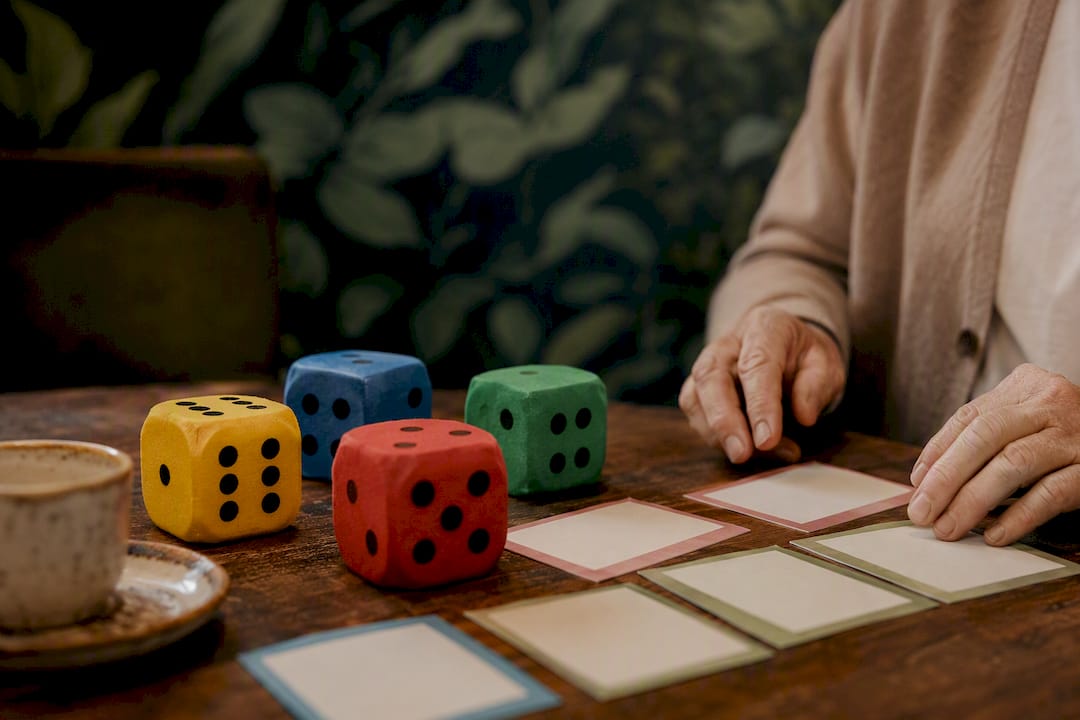
Pro Tip: If a board game has fiddly card holders or small dice, swap them for oversized dice and lay cards flat on the table. The rules don't need to change, just the physical friction.
Setting up a game session that avoids frustration
Preparation matters more than the game itself. Before you start, run through a quick mental checklist:
- Gauge current interest – has this person mentioned cards, puzzles, or a particular game recently?
- Check attention span – ten focused minutes beats forty distracted ones.
- Recall old hobbies – a former bridge player often responds well to simplified card games.
- Note sensory needs – confirm hearing aids are in and glasses are clean before you begin.
Once you're set up, adapt freely. Drop the scoring, play as a team rather than opponents, shorten rounds, and use visual prompts like laminated instruction cards instead of verbal explanations, which can be harder to retain. Environment counts too: a quiet room with good lighting, seating that faces each other rather than side-by-side, and a mid-morning or early-afternoon slot when energy and alertness tend to peak.
Pro Tip: Keep a drink and a small snack nearby before you start. Thirst and hunger show up as restlessness and irritability long before anyone mentions feeling unwell.

Games to try at each stage, with simple adaptations
Match the game to where someone is now, not where they were five years ago. Here's a stage-by-stage shortlist that works well in practice.
- Early stage: GO or Chess, played with a patient partner and relaxed rules, builds attention and planning.
- Early stage: Structured board games like Scrabble, simplified to word-building only, keep language skills active.
- Mid stage: Snakes & Ladders and Ludo, with enlarged pieces, support turn-taking and simple counting.
- Mid stage: Dominoes and matching card sets strengthen pattern recognition without demanding memory.
- Mid stage: Jigsaws with 20 to 50 large pieces build focus and offer a visible sense of achievement.
- Later stage: Music-based quizzes and picture bingo lean on long-preserved emotional memory.
- Later stage: Tactile sensory decks and reminiscence card sets keep sessions short and conversation-led.
| Stage | Game examples | Main benefit |
|---|---|---|
| Early | GO, Chess, Scrabble | Attention, planning, language |
| Mid | Snakes & Ladders, Dominoes, jigsaws | Turn-taking, pattern recognition, focus |
| Later | Music quizzes, picture bingo, sensory decks | Reminiscence, mood, connection |
A pilot randomised controlled trial found people with mild-to-moderate dementia could still learn GO with weekly instruction over 15 weeks, with measurable gains in attention and working memory. That's a useful reminder not to write off more complex games too early.
Digital games and apps built with dementia in mind
A genuinely dementia-friendly app avoids anything that feels like failure. Look for:
- No visible "wrong answer" messages or harsh buzzers
- Gentle, invisible hints rather than timed pressure
- Large buttons and simple, uncluttered screens
- Offline mode, so a poor connection never interrupts play
- Reminiscence content: old photographs, music, familiar places
Memory Lane Games is a widely used example, built around exactly this brief, with large-format quizzes and a reminiscence library drawn from decades past. Caregiver reports collected by the developer suggest that many carers feel more relaxed during sessions, though these reports come from the app's own trials and pilots and should be viewed as encouraging rather than conclusive.
Set the tablet up somewhere well-lit, turn on guided access to prevent accidental app-switching, and always sit alongside during the first few sessions.
How a dementia day club runs game sessions in practice
At The Alderley Clubhouse, games are never an afterthought bolted onto the day. Our care team is fully qualified to deliver Cognitive Stimulation Therapy, and games form part of a wider programme of physical, creative, cognitive and social activities running through each structured day.
What families can expect from a professionally run session:
- Trained staff who adapt each game in real time to the person's stage and mood
- A calm, purpose-built, dementia-friendly building with secure parking and step-free access
- A full day, 9:30am to 4:30pm, a full hour longer than most local day care
- Breakfast, a cooked two-course lunch and afternoon tea built around the day's activities
- Attendance capped at 35 members daily, so every face and every preference is known
That last point matters more than it might sound. Staff who know someone was a keen bridge player thirty years ago will quietly bring out cards rather than a jigsaw, and that small act of recognition is often what makes the day feel worthwhile.
What most guides get wrong about dementia friendly games
Most advice on this topic treats games as brain training in disguise, as though the point is to slow decline on a spreadsheet somewhere. The research doesn't really support that framing, and neither does experience. The 2023 meta-analysis shows real cognitive gains, yes, but the more consistent finding across the evidence is that games work because of connection, not competition.
Where I think caregivers go wrong most often is clinging to games their loved one used to be good at, rather than games suited to who they are now. Letting go of the old rulebook, literally, is often the kindest adaptation you can make. Simplify first. Drop the scoring second. Worry about cognitive benefit last, because it tends to follow naturally once someone feels safe enough to actually enjoy themselves.
If you take one thing from this guide, let it be this: watch for engagement, not accuracy. A person humming along to a music quiz, wrong answers and all, is getting more benefit than someone correctly completing a jigsaw in silence.
— Scott @ The Clubhouse
This article is general information, not a substitute for advice from a qualified doctor. Consult a qualified healthcare professional about your own circumstances before acting on anything here.
Sources
- Can traditional board games prevent or slow down cognitive impairment? A systematic review and meta‑analysis
- Pilot randomized controlled trial of the GO game intervention on cognitive function
- Activities for dementia — NHS