
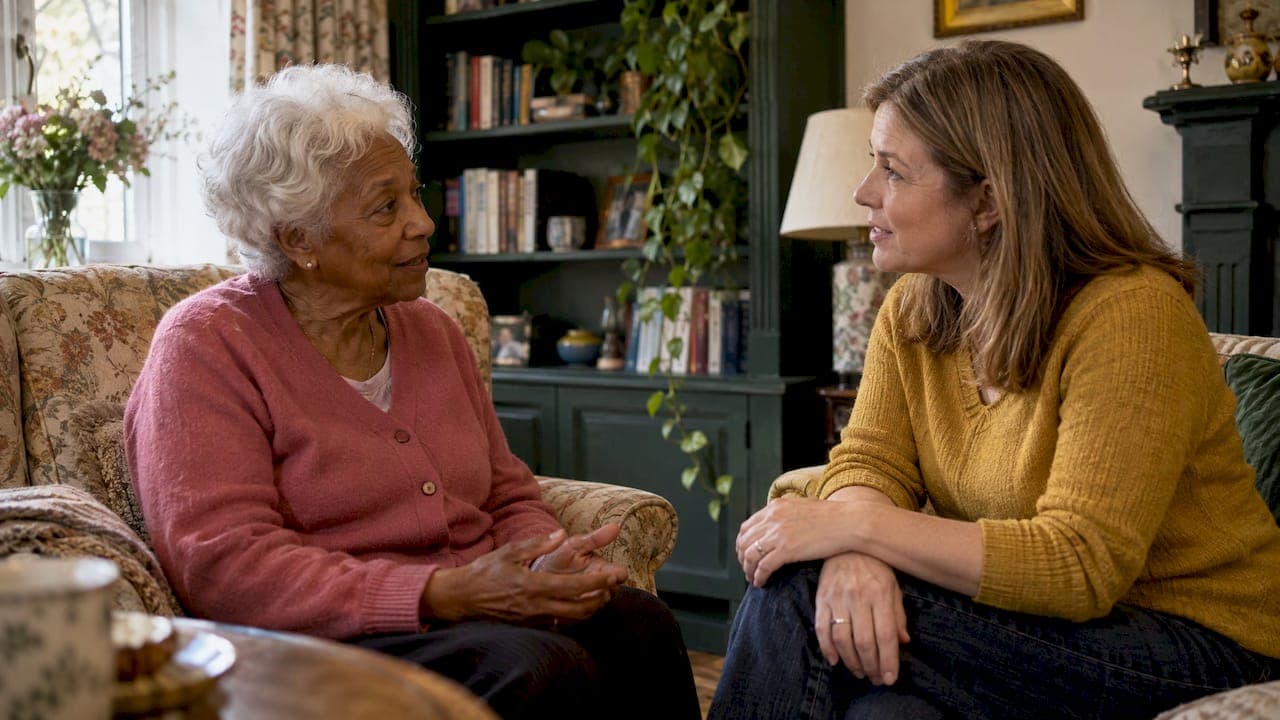
Caring for an elderly parent usually starts quietly: a missed appointment, a fridge that is emptier than it should be, a parent who seems a little less like themselves. The best approach is to talk early, ask the council for an assessment, keep their days familiar, safe and sociable, and build in regular breaks for yourself before you reach exhaustion. This guide walks through each step, with UK sources and phone numbers you can use today.
Key Takeaways
- Your parent can ask their local council for a free needs assessment, and you can ask for your own carer's assessment too. Neither depends on income or savings.
- Familiar routines, small safety changes and a purpose in the day matter more than grand gestures.
- Regular activity and company help your parent, and a good day service helps you rest as well.
- Early signs of carer burnout are common and fixable. Ask for help before a crisis, not after.
- Daytime respite can be part of a steady routine, not just an emergency measure.
Table of Contents
- Start by finding out what help is really needed
- Looking after yourself is part of the job
- Keep routines familiar and the home safe
- Keep them active, connected and engaged
- Caring for a spouse with dementia
- Breaks that actually work: respite and day care
- What a good day looks like at The Alderley Clubhouse
- Choosing day care for your parent
- Come and see for yourself
- FAQ
- Sources
Start by finding out what help is really needed
Before you change anything, spend a few weeks simply noticing. Is your parent managing meals, medication, washing and getting out of the house? Are bills being opened? Are they lonelier than they admit? A written list of what you see makes the next conversations much easier.
Then talk, gently and without a plan already in your pocket. Many parents grieve the loss of independence more than the tasks themselves. Ask what they find hardest, what they want to keep doing, and what they would rather not give up. Offer choices, not instructions. "Would it help if someone came in on Tuesdays?" lands better than "You can't manage."
Ask the council for a needs assessment
Age UK explains that the person you care for is entitled to a needs assessment from their local council, whatever their income or savings, and that you can ask for one on their behalf with their permission. The assessor will usually visit the home and talk about everyday tasks, what your parent wants to achieve, their health, their living arrangements and your views as their carer.
The Alzheimer's Society adds that assessments must be free, but social care itself is usually means-tested. Some small aids and adaptations, such as shower chairs, small ramps, stair rails and higher toilet seats, cannot be means-tested and are provided free. Bigger work like stairlifts or concrete ramps may be chargeable depending on assessed needs and local policy.
If you live in Cheshire East, including Macclesfield, Wilmslow, Knutsford or Alderley Edge, you would start with Cheshire East Council's adult social care team. Your parent's GP surgery can also point you in the right direction.
Looking after yourself is part of the job
You are entitled to support too. Under the Care Act 2014, where it appears a carer may need support, the council must assess them. The Local Government Association's summary says eligibility depends on whether caring significantly affects your wellbeing, and that this is a lower threshold than the one used for the person being cared for. Councils must also provide an information and advice service for carers.
The NHS says anyone over 18 can ask for a free carer's assessment. It might lead to replacement care so you can take a break, help with housework and shopping, or local support groups. Age UK suggests contacting the local council to arrange it. We have also written a plain-English guide to two free assessments that can unlock respite funding.
Signs you are running on empty
Carer fatigue rarely arrives all at once. One carer-support organisation lists physical exhaustion, irritability, sleep problems, anxiety, guilt and aches or headaches among the warning signs, and recommends seeing your GP and asking for extra help. A GP quoted in the press says one or two such symptoms could be a sign you need a break, and that you need not have all of them.
If this sounds familiar, our guides on carer burnout signs and what to do next and family caregiver burnout go into more detail.
Some basics from NHS guidance for carers: aim for at least 150 minutes of physical activity a week, muscle-strengthening and balance work twice a week, a varied diet, 6 to 8 glasses of fluid a day, and no regular drinking above 14 units of alcohol a week. They sound small, and they are the first things to slip.

Keep routines familiar and the home safe
Familiar routines are reassuring, particularly for a parent with memory problems. Keep mealtimes, wake-up times and favourite programmes steady where you can.
The NHS suggests helping a person with dementia keep their skills by letting them join in with everyday tasks, such as shopping, laying the table, gardening or walking the dog. Labels and signs around the home can help them remember where things are. Doing things with your parent, rather than for them, protects dignity as well as ability.
A few practical safety checks:
- Clear walkways of rugs, cables and clutter.
- Check lighting on stairs, in the bathroom and on the route to the toilet at night.
- Ask the council about free minor aids such as rails and shower seats.
- Keep a list of medicines and appointments somewhere visible.
- Agree who has a spare key and who will check in each day.
Our practical guide to dementia safety at home covers room-by-room changes in more depth.
Keep them active, connected and engaged
Being busy and in company is good for mood and for the body. NHS guidelines say adults aged 65 and over should be physically active every day, do strength, balance and flexibility activities on at least two days a week, and aim for at least 150 minutes of moderate activity a week while reducing time spent sitting.
The Alzheimer's Society notes that balance and flexibility exercises help keep muscles and joints moving, can help people stay independent for longer and can lower the risk of falls. It also advises talking to a health professional before starting anything new if your parent has other health conditions, and stopping any activity that causes pain, dizziness or breathlessness, as set out in its physical activity guide. For ideas on gentle movement, this page on balance exercises for seniors is a handy starting point.

Company matters just as much. The Alzheimer's Society says singing groups, music, art, drama, dance, reading and writing can create a sense of togetherness and belonging for people with dementia. You can call its support line on 0333 150 3456 to find out what is happening locally. If you want quick ideas for home, try our five personalised dementia activities.
Caring for a spouse with dementia
If the person you care for is your husband, wife or partner, the change can feel different. Dementia UK's Admiral Nurses explain that a spouse may start to feel more like a carer than a partner, and that roles shifting can bring distress, arguments and resentment. Their advice is to say yes when people offer help, address sources of tension, join a support group and keep up your own friendships and hobbies.
The NHS adds that you can register as a carer with your GP, ask for a carer's assessment, check benefit eligibility and find training courses. Helplines you can call:
| Service | Number |
|---|---|
| Alzheimer's Society Dementia Connect | 0333 150 3456 |
| Dementia UK Admiral Nurse Helpline | 0800 888 6678 |
| Carers UK | 0800 808 7777 |
| Age UK Advice Line | 0800 678 1602 |
| Independent Age | 0800 319 6789 |
| Dementia Carers Count | 0800 652 1102 |
The NHS page on looking after someone with dementia lists these services.

Breaks that actually work: respite and day care
A break is not a luxury. The NHS says even an hour from family or friends can help, whether that means sitting with your parent or taking them to a memory café.
For longer breaks, the main options are:
- Sitting services, where a trained volunteer keeps your parent company for a few hours. The NHS says these are often free or carry a small charge.
- Day care centres, which give people who find it hard to get out a chance to socialise, make friends and take part in activities. The NHS notes some offer hairdressing, foot care and assisted bathing, and transport may be provided for a charge.
- Care at home, where a paid carer visits or stays.
- Short stays away from home.
If you want the council to fund a day centre visit or homecare, the NHS says your parent will need a care needs assessment. For council-funded respite both of you should be assessed, and councils will only fund respite for people assessed as needing it. All of this is set out on the NHS carers' breaks and respite page. Many families also choose to pay privately for a service that fits their parent's personality and their own working week.
Our overviews of respite care options in the UK, carers' respite day care and alternatives to a care home help you compare.
What a good day looks like at The Alderley Clubhouse
Our view on daytime care
We believe a parent should look forward to their day, and a carer should be able to exhale during it. Too often day care is built around the clock and the checklist. We wanted something that feels more like a private members' clubhouse than a service.
That is why we run from 9:30am to 4:30pm, Monday to Friday, a full hour longer than most local provision. It is long enough for you to work a proper shift, rest, or simply catch up on life. We cap attendance at 35 members a day so everyone is known by name, and our care team is trained to deliver Cognitive Stimulation Therapy, the only non-drug therapy recommended by NICE for mild to moderate dementia.
Every day includes breakfast, a cooked two-course lunch, afternoon tea and a hydration station that is open all day, plus physical, creative, cognitive and social activities, weekly live entertainment, and visiting hairdressing and chiropody. The building is purpose-designed, dementia-friendly and fully accessible, with secure parking and a drop-off point at the door.
We think this is what good respite looks like: your parent is engaged and cared for, and you do not have to feel guilty about taking the time.
Scott @ The Clubhouse
Choosing day care for your parent
Whatever service you consider, visit with your parent if you can and look at a few things:
- Hours. Do they cover your working day and travel?
- People. How many members attend each day, and are staff trained in dementia care?
- Programme. Is there a mix of movement, creativity, thinking and company?
- Food and drink. Are meals fresh and are drinks always offered?
- Building. Is it accessible, easy to find your way around and easy to park at?
- Updates. Will you hear how the day went?
For a sense of what a full day can look like, see our printable adult day care schedule. If mealtimes are a worry, our piece on dementia dining challenges may help.
Come and see for yourself
At The Alderley Clubhouse in Nether Alderley, a day pass is £120 including VAT, and our 10-Session Pass gives you ten days for the price of nine. You can book through our day passes page. If you would like your parent to try a day first, Be Our Guest is our complimentary taster day, and you can also book a welcome tour to look around at your own pace. Families can follow the day through our FamilyNet app.
FAQ
How do I know when my parent needs more help?
Look for changes in routine: unopened post, weight loss, missed medication, bruises from falls, or withdrawal from friends. One sign is not a crisis, but a pattern is a reason to talk and to ask the council for a needs assessment. Your parent's GP can also advise.
Do I have to pay for a carer's assessment?
No. The NHS says anyone over 18 can ask for a free carer's assessment, and Age UK says the person you care for is entitled to a needs assessment whatever their income or savings. Whether the council then pays for services depends on the assessment and, for social care, usually a financial check.
What are the symptoms of caregiver fatigue?
Common signs include exhaustion, irritability, poor sleep, anxiety, guilt, loneliness and aches or headaches. You do not need all of them. If you notice one or two, speak to your GP and ask about support, such as a carers' service or a break.
Can I keep caring at home and still get time off?
Yes. Many families combine care at home with sitting services, a few days a week at a day service, and help from family. Regular daytime respite can make caring at home sustainable for longer.
Sources
- Age UK: Advice for carers
- Alzheimer's Society: Keeping safe and independent at home
- Local Government Association: The Care Act 2014 and unpaid carers
- Eldering: Spotting the warning signs of carer burnout
- Devon Live: People working in care roles urged to check for internal signs
- NHS England: Healthy caring
- NHS: Looking after someone with dementia
- NHS: Physical activity guidelines for older adults
- Alzheimer's Society: Physical activity, movement and exercise
- Balance Training for Seniors: Safe Exercises to Prevent Falls
- Dementia UK: How dementia can affect relationships and roles
- NHS: Carers' breaks and respite care