
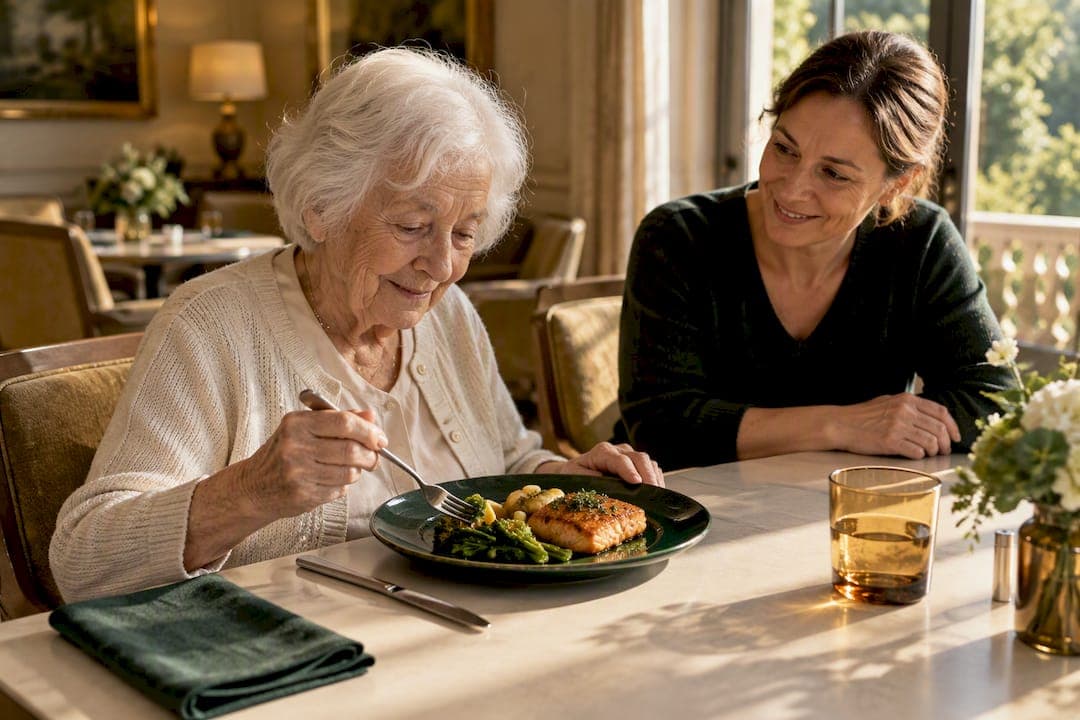
If mealtimes have become a struggle, start here: check for signs of swallowing difficulty, simplify the plate and the table, offer small familiar portions little and often, and stay close by to supervise. Most dining problems respond well to gentle, practical changes, but choking episodes or rapid weight loss need prompt review from a GP or IDDSI-trained speech and language therapist. We see this daily at The Alderley Clubhouse, and the good news is that dignity and safety usually go hand in hand.
TL;DR:
- More than half of people with dementia at home cannot manage mealtimes without assistance, reflecting the condition's impact rather than caregiver failure.
- Visual-spatial issues and executive dysfunction commonly cause difficulties in judging portions and planning eating, especially when environmental cues are poor.
- Environmental adjustments like contrasting tableware, supported sitting, and routine feeding significantly improve safety and engagement during meals.
- Prompting with single-step instructions and mirroring actions boost independence and reduce frustration for individuals with cognitive and motor planning challenges.
- Early signs of swallowing problems, such as coughing or a wet voice, require urgent GP review to prevent malnutrition and aspiration risks.
Table of Contents
- Why dementia dining challenges happen: causes and warning signs
- Making mealtimes calmer: environment and communication that work
- Food and menu adaptations that actually help
- Recognising and managing choking and swallowing risk
- Monitoring intake, weight and hydration at home
- Who can help: professionals and proven support approaches
- A dementia-friendly day service in practice: The Alderley Clubhouse
- A caregiver's honest reflection on dignity and small wins
- How The Alderley Clubhouse supports safe, sociable mealtimes
- Sources
- FAQ
Why dementia dining challenges happen: causes and warning signs
Eating is one of the most complicated things any of us do, even though it never feels that way until something goes wrong. It calls on memory, vision, coordination, appetite regulation and the senses of taste and smell, all working together without us noticing. Dementia can disrupt any one of these systems, which is why dining difficulties look so different from person to person.
Visual-spatial problems make it hard to judge where the plate ends and the tablecloth begins, especially when colours are similar. Executive dysfunction affects planning, so a person might stare at a full plate without knowing where to start. Apraxia disrupts the physical sequence of using cutlery, even when strength and coordination are otherwise fine. Add in changes to taste and smell, plus apathy that dulls the motivation to eat at all, and you can see why a once-easy task becomes exhausting.
Nearly 60% of people living with dementia at home cannot routinely manage mealtimes without help, whether that means prompting, physical assistance, or full support. That figure alone tells you this is not a personal failing on your part, or theirs. It is a predictable part of the condition, and it usually responds well to the right adjustments.
Some signs point to something more serious than confusion at the table. Watch for:
- Coughing during or straight after eating or drinking
- A wet, gurgly voice after swallowing
- Meals that take far longer than they used to, or food left untouched
- Repeated chest infections with no obvious cause
- Any episode of choking, however brief
The first few signs on that list often respond to home adjustments. Coughing on every meal, a wet voice, or a choking episode should prompt a same-week conversation with your GP, not a wait-and-see approach.
Making mealtimes calmer: environment and communication that work
Small changes to the room and your own approach often achieve more than any amount of coaxing. A scoping review of mealtime interventions found that environmental changes, hands-on assistance and trained support work best when combined, rather than relying on just one fix.
Get the room right first.
Bright, even lighting helps enormously, and so does contrast. A white plate on a white tablecloth is genuinely difficult for someone with visual-spatial changes to see clearly, so choose a coloured plate against a plain, contrasting surface. Clear the table of anything that is not part of the meal: no condiment bottles, no post, no clutter competing for attention. Turn the television or radio off. Background noise that we barely register can be a serious distraction for someone whose brain is already working hard just to eat.
Think about posture before you think about food.
An upright, supported seating position with feet flat on the floor makes swallowing safer and easier. A slumped or reclined position increases the risk of food or drink going the wrong way. If grip or coordination has changed, adaptive cutlery with thicker handles and non-slip plates can restore genuine independence rather than just make things tidier.
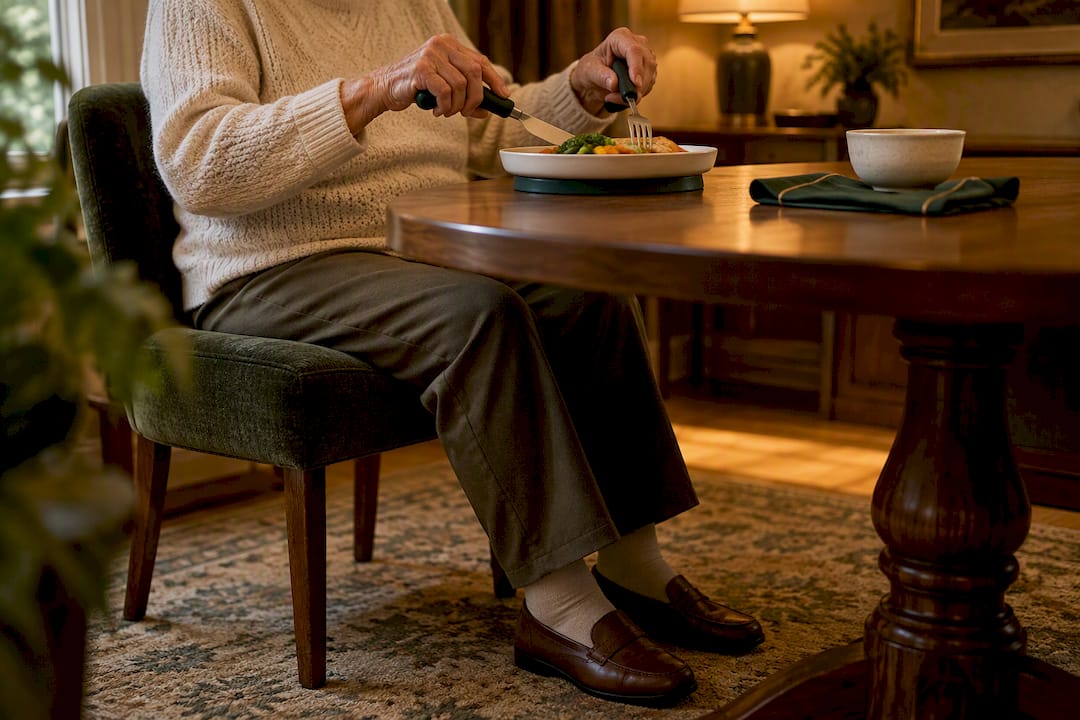
Keep to a routine, and eat together where you can.
Regular mealtimes, at the same time each day, help someone anticipate and prepare for eating even when memory is unreliable. Serving one course at a time, rather than a full plate with three components, reduces the planning demand hugely. Sharing the meal yourself, even just a cup of tea while they eat, taps into the social side of dining that keeps people engaged for longer.
Communicate in single steps.
Rather than "eat your dinner", try "pick up your fork" and wait. One instruction at a time, modelled by your own actions if needed, works far better than a string of prompts. This is the essence of an asset-based approach to mealtime management: you are supporting what the person can still do, not taking the task away from them because it is faster.
Before each meal, run through this quick checklist:
- Is the room quiet, with no television or radio on?
- Is the plate a colour that stands out against the table?
- Is the person sitting upright with good support?
- Is only one course on the table at a time?
- Are you ready to prompt gently, one step at a time, without rushing?
Pro Tip: If someone has stopped initiating eating, try picking up your own fork first and taking a bite. Mirroring is a powerful, wordless prompt that often works when verbal instructions do not.
Food and menu adaptations that actually help
There is no single "dementia diet" that fixes eating problems. The Alzheimer's Society is clear that the priority is an individual approach built around what a person still enjoys, not a rigid meal plan copied from a leaflet.
Finger foods solve two problems at once: they remove the need for cutlery coordination, and they let someone eat at their own pace without feeling watched. Good options include:
- Cheese cubes, sausage rolls, or sandwich fingers
- Soft fruit pieces such as banana or melon
- Mini quiches or fish cakes that can be picked up whole
- Cheese and crackers, or a boiled egg cut into wedges
Small, frequent meals often work better than three large ones, particularly when appetite has dropped or fatigue sets in halfway through a plate. Five or six smaller sittings across the day, including calorie-dense snacks like full-fat yoghurt, cheese, or a milky pudding, can maintain intake without the pressure of a big meal.
If swallowing has become unpredictable, texture modification may be necessary, and this is where the International Dysphagia Diet Standardisation Initiative (IDDSI) matters. IDDSI sets out standardised levels, from thin liquids through to minced and moist or pureed foods, so that every carer, chef and clinician is describing the same texture in the same words. Changing texture without proper guidance can go wrong in either direction, so a speech and language therapist assessment should come before any long-term change to consistency.
Familiar food does more than fill a stomach. Serving dishes tied to a person's culture, region or personal history can trigger appetite and positive memory in a way that an unfamiliar "healthy" alternative never will. A Sunday roast, a particular curry, or a childhood pudding recipe often succeeds where a clinically balanced but unfamiliar meal fails.
Hydration deserves the same attention as food. Offer drinks in small, easy-to-hold cups, little and often through the day rather than three big glasses. Some people find very cold or very warm drinks more stimulating than lukewarm ones, and flavoured water or weak juice can be more appealing than plain water if plain water has become unappetising.
Recognising and managing choking and swallowing risk
Swallowing problems, known clinically as dysphagia, are common enough in dementia that caregivers should treat certain warning signs as urgent rather than something to monitor quietly.
Seek same-day medical advice if you notice:
- Choking, or a red or blue face during a meal
- Persistent coughing on every mouthful, not just occasionally
- Sudden, unexplained weight loss over a short period
- Food or liquid coming back up through the nose
- A change in breathing pattern during or after eating
Dysphagia is common enough in dementia care settings that unrecognised swallowing problems are a recognised driver of malnutrition and aspiration pneumonia, according to a scoping review of mealtime interventions. Treating a persistent cough at meals as background noise, rather than a signal, is one of the most common and avoidable mistakes caregivers make.
Until you get a professional assessment, some simple precautions reduce risk immediately. Keep the person fully upright during and for at least twenty minutes after eating. Offer smaller mouthfuls than usual, and pace the meal rather than letting them rush. Avoid mixed textures, such as cereal with milk or soup with solid chunks in it, if you suspect any swallowing difficulty, since these are notoriously hard to manage safely.
In the UK, your GP is the right first port of call, and they can refer to a community speech and language therapist for a formal swallowing assessment. A dietitian usually works alongside them to make sure any texture changes still deliver enough calories and nutrients, since modified diets can accidentally reduce intake if not managed carefully. An SLT assessment typically involves watching someone eat and drink different consistencies, sometimes using the IDDSI framework to recommend a specific texture level, along with practical strategies like head position or pacing.
Monitoring intake, weight and hydration at home
A simple, low-effort tracking system catches decline weeks before it becomes obvious, and it gives your GP something concrete to work from rather than a general impression.
- Keep a short meal log. Note roughly how much was eaten at each meal (all, half, a few mouthfuls) for a week or two, rather than trying to log every single day forever.
- Weigh weekly, same time, same clothing. A single reading tells you little; a trend over four to six weeks tells you a great deal.
- Tally fluids loosely. You do not need exact millilitres, just a rough sense of whether cups offered are actually finished.
- Watch for red flags alongside the numbers, including falls, repeated infections, or a sudden drop in mobility or alertness.
- Escalate promptly if weight loss reaches roughly 5% in a month or 10% over six months, both recognised thresholds for concern that warrant a GP review.
When you do see your GP, bring the log, the weight trend, and specific notes on any choking or coughing episodes rather than a general "they're not eating well". This concrete evidence speeds up referral decisions considerably. If home cooking has become unmanageable, home-delivered meal services or a structured day service can bridge the gap while you arrange further support, and a short two-week trial of simplified meals with weekly weigh-ins often reveals whether home adjustments are enough or whether formal assessment is needed sooner.
Who can help: professionals and proven support approaches
You do not have to solve dining difficulties alone, and trying to is often where caregivers burn out fastest. Several professionals bring genuinely different expertise:
- Speech and language therapist (SLT): assesses swallowing safety and recommends texture levels using frameworks like IDDSI.
- Dietitian: builds a nutrition plan that keeps calorie and nutrient intake adequate, especially after texture changes.
- Occupational therapist (OT): recommends adaptive cutlery, plates and seating suited to the specific physical difficulty.
- Community nursing team: monitors weight, hydration and general health between GP appointments.
The strongest evidence favours combining these approaches rather than picking one, reflecting the role of customer service in hospitality principles that enhance dementia-friendly mealtime experiences. The scoping review of mealtime interventions found that environmental changes, hands-on assistance and staff training together outperform any single fix on its own, and that training focused on communication and person-centred assistance, not just mechanical feeding technique, improves both intake and staff attitudes.
When arranging an assessment, ask providers directly: how do you assess swallowing risk, what training does your staff receive, and how do you adapt the environment as needs change over time? Good providers will have clear, specific answers rather than vague reassurance. A well-designed dining space, with the right lighting, layout and noise control, makes a measurable difference before any clinical intervention even begins.
A dementia-friendly day service in practice: The Alderley Clubhouse
The research on dining difficulties is consistent: structure, trained support and a calm environment work better together than any single fix. The Alderley Clubhouse in Nether Alderley, Cheshire, was built around exactly that principle.
Days run from 9:30am to 4:30pm, Monday to Friday, a full hour longer than most local day services offer. That extra time matters at mealtimes especially, since rushing is one of the biggest triggers for distress and swallowing difficulty. Each day includes breakfast on arrival, a cooked two-course lunch, traditional afternoon tea and an all-day hydration station, so fluids and calorie-dense food are always within easy reach rather than confined to three fixed sittings. Our care team is fully trained to deliver Cognitive Stimulation Therapy, the only non-drug therapy recommended by NICE for mild to moderate dementia, and attendance is capped at 35 members each day so every guest is known by name, including their preferences and any swallowing precautions.
Adaptations happen at the individual level, not as a blanket policy. Seating is arranged around what helps each person, hydration is offered continuously rather than at set times, and activities are woven around the dining routine rather than competing with it.
If you are considering a day service, whether ours or another, these are worth asking on a visit:
- What qualifications does the mealtime support team hold, and is CST training among them?
- What does a typical lunchtime routine actually look like, step by step?
- How are swallowing risks identified and managed day to day?
- Can you see a sample weekly menu, and how are dietary needs accommodated?
- What is the staff-to-guest ratio during mealtimes specifically?
A welcome tour is the most honest way to get these answers, since you can watch a real lunchtime rather than take a description of one.
A caregiver's honest reflection on dignity and small wins
The hardest part of supporting someone through dining difficulties is not the practical adjustments. It is accepting that safety and independence sometimes pull in opposite directions, and that there is rarely a perfect answer that satisfies both completely.
What I would say to any caregiver feeling that tension is this: celebrate the small wins properly. A meal finished without prompting, three days without a cough, a favourite dish that gets eaten when nothing else has worked that week, these are genuine progress, not just relief. Realistic goals matter more than ambitious ones here. You are not aiming to restore how mealtimes looked five years ago. You are aiming for calm, safe, and enjoyable, on today's terms.
Trust your instincts when something feels wrong, and act on it quickly rather than waiting to see if it improves alone. Asking for help early is not admitting defeat. It is the single most protective thing a caregiver can do.
— Scott @ The Clubhouse
How The Alderley Clubhouse supports safe, sociable mealtimes
The Alderley Clubhouse gives family carers a break from managing every mealtime alone, without handing that responsibility to a clinical setting that can feel institutional. Days run 9:30am to 4:30pm, Monday to Friday, with breakfast on arrival, a cooked two-course lunch, traditional afternoon tea and an all-day hydration station built in, all supported by a care team trained in Cognitive Stimulation Therapy.
Attendance is capped at 35 members a day, so mealtimes stay calm rather than crowded, and every guest is known by name rather than treated as one of many. This is one option among several worth considering, and the best way to judge whether it fits your situation is to see a real day for yourself. You can view the Day Pass Membership details, including the 10-Session Pass, on our booking page, or book a welcome tour to watch how a lunchtime actually runs before deciding anything.
Sources
- Supporting Mealtime Participation Among People Living With Dementia at Home: Challenges and Strategies for Caregivers
- A Biopsychosocial Model of Mealtime Management in Persons with Dementia
- Improving eating experience in dementia | Alzheimer’s Society
- IDDSI framework
This article is general information, not a substitute for advice from a qualified doctor. Consult a qualified healthcare professional about your own circumstances before acting on anything here.
FAQ
What are odd behaviours linked to dementia dining challenges?
Common behaviours include playing with food instead of eating it, refusing familiar meals, eating very slowly or very quickly, and forgetting they have already eaten. These usually stem from the same cognitive and sensory changes that cause other dementia dining challenges, such as visual-spatial confusion or reduced appetite recognition, rather than deliberate awkwardness.
Is forgetting names a common symptom alongside eating problems?
Yes, memory loss including forgetting names is a hallmark early symptom of dementia, and it often develops alongside, not because of, mealtime difficulties. Both stem from the same underlying changes in the brain, though eating problems tend to become more noticeable as executive function and motor planning decline further.
What is the "90 second rule" for dementia mealtimes?
There is no single, universally agreed clinical standard called the "pause rule" in dementia care guidance. Some caregivers use the phrase informally to mean waiting a reasonable amount of time after a prompt before repeating or rephrasing an instruction, giving the person time to process without feeling rushed.
Can certain foods make dementia symptoms worse?
No single food causes dementia, but diets high in processed and sugary foods are generally linked to poorer brain health over time, while a varied, nutrient-rich diet supports overall wellbeing. For someone already living with dementia, the priority shifts to individual preference and adequate intake rather than restricting specific foods.
How much does The Alderley Clubhouse cost?
For current prices and membership options, please see our website's booking page. Full details, including how to book a Day Pass Membership, are available on our website.