

Most adult day care schedules follow the same rhythm: arrival and breakfast, a morning activity session, a shared lunch, a quiet rest period, then afternoon creativity or entertainment before home time. Every day is built around four pillars: physical, cognitive, social and creative activity, adjusted for each person's energy and needs. Exact times shift from centre to centre, but that underlying structure barely changes.
TL;DR:
- Most adult day care centers structure their schedule around four activity pillars: physical, cognitive, social, and creative, tailored to individual needs.
- The typical day includes staggered arrival, morning activities when energy peaks, a shared lunch with rest, followed by quieter or individual sessions, then creative or social activities.
- Activities are designed to be purposeful and adaptable for dementia and mobility limits, with shorter blocks and personalized cues for both conditions.
- Practical considerations such as hours, meals, transportation, staffing qualifications, and trial visits are crucial to ensure suitability and quality care.
- Flexibility and attentive care are vital; staff should adjust the schedule based on each person’s mood and energy, rather than rigidly following a timetable.
Table of Contents
- Adult day care schedule: an hour-by-hour example
- The four activity pillars behind every good schedule
- Adapting the schedule for dementia and mobility limits
- What to check before you book: hours, meals, transport and staffing
- Two templates you can copy and adapt
- How we run a day at The Alderley Clubhouse
- Trial days at The Alderley Clubhouse
- Where to read more
- The gap between a nice-sounding timetable and a day that actually works
- Sources
Adult day care schedule: an hour-by-hour example
If you're planning a visit or trying to picture what your relative's day will actually involve, a sample timetable is more useful than a vague description. Here's how a typical day tends to unfold, drawn from common patterns across day centres.
9:00am to 10:00am, arrival and breakfast Members arrive in a steady trickle rather than all at once, which matters more than it sounds. A rushed, crowded entrance can unsettle someone living with dementia, so most centres stagger drop-offs and use this window for breakfast, a warm drink and quiet catch-up. Staff use these first minutes to check in on mood and sleep, which shapes how the rest of the day gets paced for that person.
10:00am to 11:15am, morning activity This is usually the most active slot of the day, when energy and concentration are at their best. Centres commonly reserve mornings for more active or cognitive tasks and afternoons for quieter or creative pursuits, with designated rest periods built in to prevent overstimulation. Typical options include:
- Chair-based exercise or gentle walking groups
- Quizzes, word games or reminiscence sessions
- Seated ball games or simple circuit stations for those with better mobility
11:30am to 1:00pm, transition, lunch and rest Lunch is often the social high point of the day. A shared, sit-down meal gives people a natural reason to talk, and staff typically flag dietary needs (diabetic, soft-textured, allergen-free) well ahead of time. After eating, most schedules build in a genuine rest period, not just a lull between activities. This matters: fatigue creeps up fast in older adults, and a proper pause here prevents afternoon activities turning into a struggle.
1:00pm to 2:00pm, quiet time or one-to-one sessions Early afternoon is frequently used for lower-key pursuits: a film, a puzzle, or time in a quiet lounge. Some members use this slot for one-to-one therapy sessions, chiropody or hairdressing appointments, since it avoids clashing with group activities.
2:00pm to 3:30pm, creative or social activity Energy typically rebuilds a little after rest, so this window often hosts crafts, music, singing, gentle dancing or visiting entertainers. Typical hour-by-hour models consistently place creative and entertainment sessions here, after lunch and before the wind-down.

3:30pm to 4:00pm, afternoon tea A snack and hot drink signals the day is winding towards home time. It's also a natural moment for families to be updated if they're collecting in person.

4:00pm to 4:30pm, departure Coats, bags and any medication notes get sorted here, alongside a quick handover to whoever's collecting. Some centres run slightly later hours, and a few blend medical-model elements, fixed medication administration windows or scheduled therapy slots, into this same structure. If your relative needs either, it's worth asking directly how the centre times them.
The four activity pillars behind every good schedule
A well-built day isn't a random string of activities. It rests on four pillars: physical, cognitive, social and creative, each doing a different job for wellbeing.
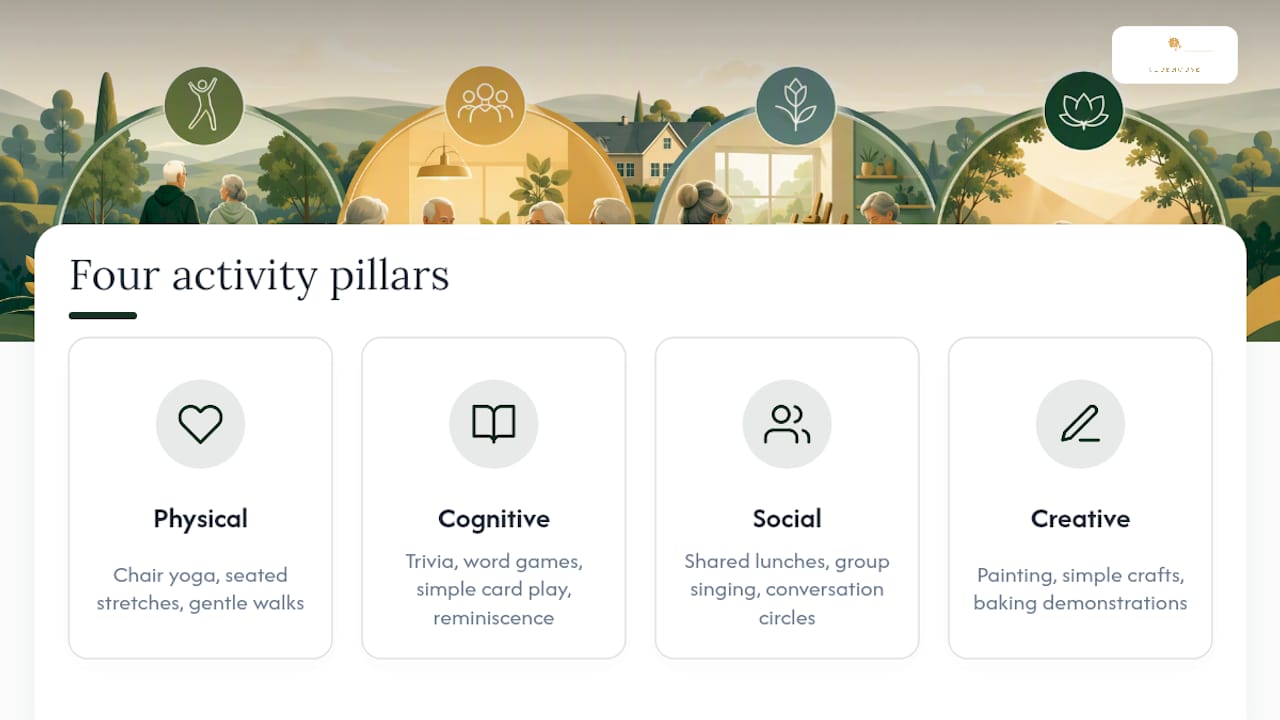
Physical activity keeps joints mobile and mood lifted. Chair yoga, seated stretching, gentle walking laps and simple ball games all count, and each can be adapted for someone using a wheelchair or frame.
Cognitive activity keeps the mind engaged without tipping into frustration. Trivia, word association, simple card games and reminiscence sessions using old photographs or music all work well, and can be simplified for shorter attention spans.
Social activity is often the reason people look forward to the day at all. Shared lunches, group singing and small conversation circles matter as much as any structured task.
Creative activity gives people a low-pressure way to express themselves. Painting, simple crafts, baking demonstrations and sing-alongs tend to suit a wide range of abilities.
Age UK frames the goal well: these should be designed as purposeful experiences rather than time-fillers, something to look forward to, not just something to get through.
Pro Tip: Uptake rises sharply when staff invite someone by name rather than posting a general notice on a board. Personal invitations and small-group options lift participation and comfort far more than passive signage ever does.
Adapting the schedule for dementia and mobility limits
The structure above is a starting point, not a fixed template. Good centres flex it constantly.
For dementia, that usually means shorter activity blocks, simpler instructions and more frequent, shorter rests rather than one long pause after lunch. Cognitive Stimulation Therapy, the only non-drug therapy recommended by NICE for mild to moderate dementia, often features here, alongside reminiscence work using familiar music or objects. Worth asking staff directly whether this is offered and how often.
For mobility limits, look for:
- Chair-based versions of every physical activity, not just token adjustments
- Verbal and visual cueing to help with transitions between rooms or activities
- Smaller group sizes when someone finds busy, noisy spaces overwhelming
If your relative needs a specific therapy slot or a strict medication window, coordinate this with the centre before the first visit rather than on the day itself.
What to check before you book: hours, meals, transport and staffing
A few practical questions cut through most of the guesswork.
- Hours and transport: opening hours vary widely between centres, so confirm start and finish times and whether door-to-door transport is genuinely included or an extra cost.
- Meals: ask what's provided as standard, breakfast, a cooked lunch, afternoon tea, and how dietary needs and allergies are accommodated.
- Staffing: check qualifications, staff-to-member ratios and whether staff are trained in dementia-specific approaches, not just general care.
- Practicalities: ask about attendance caps, trial-day availability, the cancellation or illness policy, and what you should bring on the first visit.
A short checklist of questions aimed specifically at small-group day care providers can save you a wasted trial visit.
Two templates you can copy and adapt
Print these, tweak the times, and try them for a week before deciding what's working.
Daily template
- Arrival and breakfast (30 to 60 minutes)
- Morning movement or cognitive activity (60 to 75 minutes)
- Lunch and rest (60 to 90 minutes)
- Quiet time or one-to-one session (45 to 60 minutes)
- Afternoon creative or social activity (60 to 90 minutes)
- Afternoon tea and departure (30 to 60 minutes)
Weekly pillar rotation
- Monday: physical focus, gentle exercise class
- Tuesday: cognitive focus, quizzes and reminiscence
- Wednesday: creative focus, arts and crafts
- Thursday: social focus, group lunch outing or visitor session
- Friday: mixed, lighter pace to close the week
A good weekly calendar balances all four pillars rather than repeating the same activity type daily, and ties sessions to seasonal events where possible to lift interest. After a trial week, ask your relative two simple questions: what they enjoyed most, and what felt too long or too tiring. Involving family in a few chosen activities also helps the routine stick beyond the centre itself.
How we run a day at The Alderley Clubhouse
Our own days at Nether Alderley follow this same logic, stretched a little longer than most local provision. Members arrive from 9:30am to breakfast and an all-day hydration station, move through morning activity, sit down together for a cooked two-course lunch, then ease into traditional afternoon tea before departure at 4:30pm. We cap attendance at 35 members a day, so nobody gets lost in a crowd.
Our care team is trained in Cognitive Stimulation Therapy, and the day's rhythm includes live entertainment, visiting hairdressing and chiropody, all folded into the same structure described above rather than bolted on as extras.
Trial days at The Alderley Clubhouse
A day pass is available and includes the full timetable described above: breakfast on arrival, morning activity, a cooked two-course lunch, afternoon tea and the hydration station running throughout. Families wanting to try more than once before committing can inquire about multi-session passes that offer savings over single days.
Booking a trial day is straightforward: get in touch, tell us a little about your relative's needs and preferences, and we'll talk through what a first visit looks like, including transport and what to bring. Some families find a small, hospitality-led day club suits their relative better than a larger, more institutional setting, particularly where dementia support and personal attention matter more than sheer scale. If that sounds like what you're after, visit the Alderley Clubhouse page to check availability and arrange a trial day.
Where to read more
For further detail on programme design and what to expect, Sense's day services and Age UK's day centre guidance are both worth a read.
The gap between a nice-sounding timetable and a day that actually works
Most adult day care brochures show you a tidy grid of activities and call it a schedule. What they don't show you is how much judgement sits behind that grid, the decision to skip the planned quiz because someone's had a bad night's sleep, the extra ten minutes at lunch because rushing causes anxiety, the quiet nod from a staff member that says today needs a gentler pace.
A printed timetable is a starting point, not a contract. The centres that get this right treat the schedule as a framework to be read against the person in front of them each morning, not a script to push through regardless. That's the real skill in this work, and it's largely invisible unless you spend a day actually watching it happen.
If you're comparing centres, ask less about what's on the timetable and more about what happens when someone doesn't want to follow it. The answer tells you far more about the quality of care than any activity list ever will.
— Scott @ The Clubhouse
Sources
- Sense — day services (support for adults)
- Age UK — day centres
- Fields Senior Living — assisted living activity calendar ideas
- AgingCare — spending the day at an adult day centre
- EatHealthy365 — what a daily adult day care schedule is like