
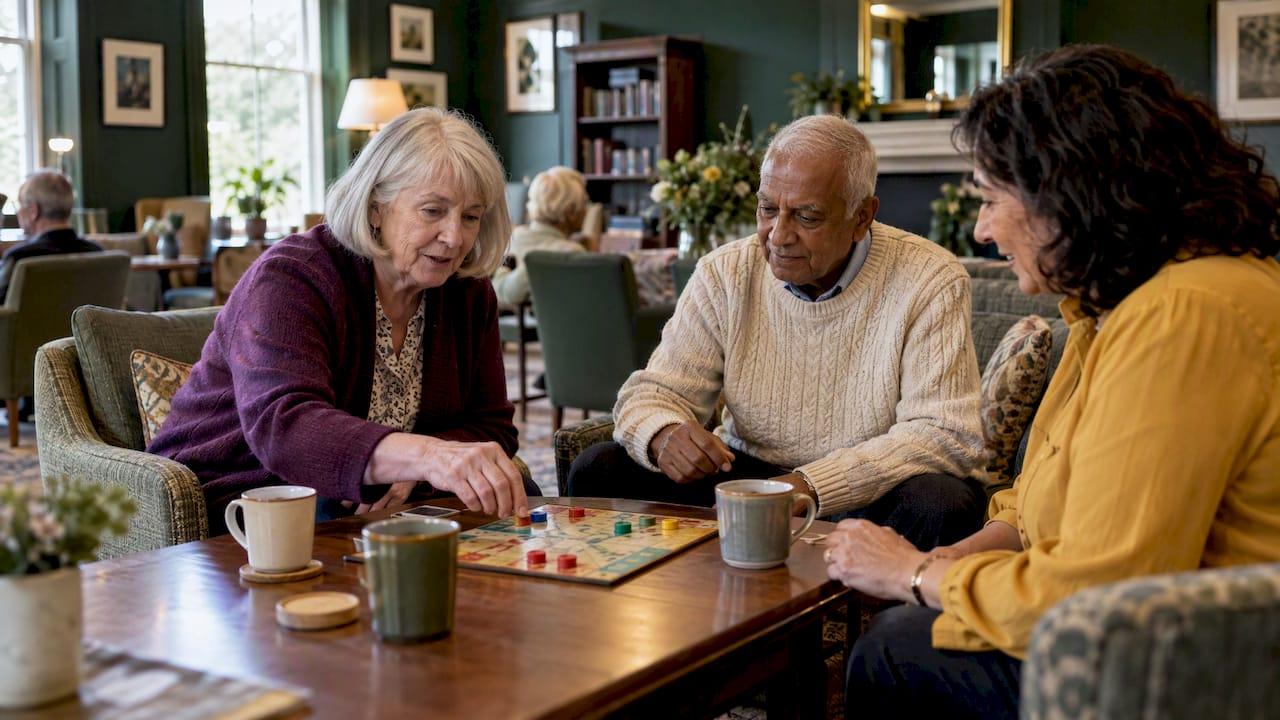
If someone you love needs more support but is not ready for a care home, you have more choices than you may think. In the UK these include help at home, sheltered or extra-care housing, Shared Lives and adult day care. Many families get the best result by combining two or more of them. Below, we explain what each option involves, who it tends to suit, and how to pay for it. We also describe how daytime care can keep someone living at home, with their carer rested and supported.
Key Takeaways
- A care home is one choice among several. Home care, extra-care housing, Shared Lives and day care can all offer support without a permanent move.
- Options work best in combination. Daytime care a few days a week, with family or paid help at home on the other days, suits many households.
- Day care gives an older person company, activity and a good meal, and gives the family carer time to rest, work or sleep.
- Your council can assess both the person's needs and the carer's needs. Ask for both, whatever you plan to pay for privately.
- At The Alderley Clubhouse, you can try a complimentary taster day before you decide anything.
Table of Contents
- Why families look beyond the care home
- The main alternatives at a glance
- Help at home
- Sheltered and extra-care housing
- Shared Lives
- Adult day care
- Respite: care for the carer
- How to pay: assessments and funding
- How to choose: questions to ask yourself
- Our perspective: a day out can change what home care needs to do
- Try a day with us
- Frequently asked questions
- Sources
Why families look beyond the care home
Most of us picture the same thing when we hear "care home": a permanent move, a new room, a new routine. For some people that is exactly right. For many others it is more than they need today.
The reasons we hear from families are simple. Mum is safe at home but lonely. Dad is managing the house but his memory is slipping and the days are long. A husband caring for his wife is exhausted and has not had a free afternoon in months. None of these situations call for a permanent move. They call for the right kind of help, at the right time of day.
That is why it helps to think about what the person actually needs: company, supervision, personal care, meals, stimulation, or a break for the person caring for them. Then you can match the option to the need, rather than starting from the most intensive solution.
The main alternatives at a glance
| Option | Where the person lives | What it offers | Often suits |
|---|---|---|---|
| Help at home (home care) | Own home | Visits from a paid carer for personal care, meals, shopping | People who are mostly independent but need regular help |
| Adult day care | Own home or family home | A full day of company, activities and meals, away from home | People who are lonely, living with mild to moderate dementia, or cared for by family |
| Sheltered housing | A smaller home within a scheme | Scheme manager, emergency alarm, communal areas | People who want independence with reassurance |
| Extra-care housing | A self-contained flat | On-site care and support that can increase over time | People who need more help but want their own front door |
| Shared Lives | With an approved carer, or visiting them | Family-style support in a real home | Adults who prefer a home setting to an institution |
| Short respite breaks | Varies | A planned break for the carer | Family carers who need regular rest |
The sections below take each in turn.

Help at home
The NHS housing options guide lists adapting your home or getting help from a paid carer as the first alternatives to moving. It is also usually the most familiar. A carer calls in at agreed times to help with washing, dressing, meals or medication, or to keep someone company.
Home care keeps routines and surroundings intact, which matters a great deal for someone with memory problems. The limits are worth knowing, too. Visits are often short, and in between them the person may be alone. For someone who is isolated, a visit of 30 minutes does not fill a long day.
That gap is where daytime care fits so well. A few days a week out of the house, in good company, can turn a lonely week into a sociable one. Small health checks are easy to overlook while you are sorting out larger decisions, such as safe ear care for older people. Hearing difficulties can make conversation and group activities harder, so they are worth raising.
Sheltered and extra-care housing
If the home itself has become the problem, because of stairs, upkeep or isolation, a move to housing with support may help without being a move to a care home.
Sheltered housing is for people who can live independently. Age UK says it commonly includes a scheme manager, a 24-hour emergency alarm, communal areas and social activities for residents, in a smaller, easier-to-manage home.
Extra-care housing sits in between. Age UK describes it as more supportive than sheltered housing but more independent than a care home, with self-contained flats, usually 24-hour staff and help with things like washing, dressing and medication. The NHS adds that meals, personal care and domestic support may be available on site, that communal facilities are usual, and that care is not necessarily needed on the day you move in. Support can then grow as needs change.
For couples whose needs differ, this can be a gentle option: both stay together, and one receives more help than the other.

Shared Lives
Shared Lives is less well known, and it surprises many families. According to the NHS, a scheme matches an adult who needs support with an approved carer who shares their family and community life. The person might move in with the carer, visit during the day, or combine daytime and overnight stays.
It suits people who want the feel of a household rather than a service. It is arranged through local schemes, so availability depends on where you live. Your council can tell you what is nearby.
Adult day care
Adult day care is the option that most often keeps a family together at home. In England, day care takes place outside the home. Age UK explains that it ranges from social contact and activities with a meal through to specialist dementia care, and that it can give carers respite. Some centres serve older people with an eligible need, while others are open to anyone.
What do the days look like? The NHS says day centres may offer tea dances, singing, games, arts and crafts, hairdressing, foot care and assisted bathing, and that transport is often available but may be charged for. NICE guidance points the same way. It recommends regular, clearly described and inclusive group and one-to-one activities, such as community singing, arts and crafts, tailored walking and hobbies, which bring people together and give them a sense of connection and purpose.
The benefit is practical as well as emotional. A person who has spent the week mostly at home comes back with something to talk about. The person caring for them has had a real break. We have written more on this in our guide to what adult day care is and the benefits of adult day care.
Cognitive Stimulation Therapy for dementia
For people with mild to moderate dementia, the quality of the programme matters. Cognitive Stimulation Therapy (CST) is a structured group programme. NHS England describes it as 14 relaxed, themed 45-minute sessions, held twice a week for seven weeks. They use orientation, songs, discussion, word games and practical activities. A weekly maintenance programme of 24 sessions may follow. It is intended to support memory, thinking, language and reported quality of life.
If your relative lives with dementia, ask any day service whether its staff are trained to deliver CST, and how they use it. Our checklist on checking CQC and CST before booking walks through the questions to ask.
Respite: care for the carer
Sometimes the "alternative to a care home" is really an alternative to a crisis. Family carers often reach breaking point long before the person they care for needs full-time care.
The NHS carers' breaks guide lists several ways to get a break: a day-centre place, paid homecare, a short care-home stay, friends and family, respite holidays and sitting services. Homecare can be regular, for example one day a week so you can work or simply have a day off. Age UK adds that respite can be regular or occasional, and can mean a sitter, a replacement care worker or a short stay in a home.
A regular day of day care is often the gentlest version. It is predictable, the person returns home each evening, and the carer can plan around it. Our guides to respite care options in the UK and daytime respite for carers go into more detail.
How to pay: assessments and funding
Cost is usually the next question. Here is how the NHS and councils describe it.
- Ask for a care-needs assessment. For council-funded day-centre visits or homecare, the person receiving care generally needs one from the local council.
- Ask for a carer's assessment. The NHS says council-funded respite requires both assessments.
- Expect a financial assessment. Bexley Council's charging policy shows the principle: it decides what a person can afford, including whether they pay the full cost, receive council support or share the cost. Each council publishes its own policy.
- Consider a personal budget or direct payment. Following an assessment, a person can ask the council to arrange services, take a direct payment to arrange support themselves, or use a mix of the two. This example is from North Somerset, and other councils set out the same ideas in their own guidance.
Many families also pay privately, because they want a particular kind of provision or do not want to wait. If you are in Cheshire East, your council or local carers' centre can explain what is available locally. We explain the assessments in more detail in our guide to two free assessments for respite funding.
How to choose: questions to ask yourself
No option is right for everyone. These questions help narrow things down.
- What is the main problem? Loneliness, safety, memory, personal care and carer exhaustion all point to different answers.
- How much does familiar surroundings matter? For many people with dementia, staying in the home they know is a priority.
- What happens between visits? Home care visits can leave long gaps. Ask what fills them.
- Who else needs support? If the main carer is tired or working, the plan needs to work for them too.
- Will needs change? Look for options that can grow, such as extra-care housing, or that you can add to, such as extra days of day care.
- Can you try before you commit? A taster visit tells you more than a brochure.
Our article on choosing a dementia day centre gives five steps for working through the last point in particular.
Our perspective: a day out can change what home care needs to do
We opened The Alderley Clubhouse because we kept meeting families who were caught between two options. Home alone felt too little. A care home felt too much. What they wanted was somewhere warm, dignified and sociable for the daytime, then home in the evening.
So we built a place around that. It is a private daytime community for adults aged 50 and over, and we welcome people living with mild to moderate dementia, people who feel lonely or isolated, and family carers who need dependable time to themselves. Our days run from 9:30am to 4:30pm, Monday to Friday. We have deliberately kept them an hour longer than most local provision, because a short day rarely gives a carer a proper break.

Our team is fully qualified and trained to deliver Cognitive Stimulation Therapy. The building is purpose-designed, dementia-friendly and fully accessible, with secure parking and a drop-off point at the door. We cap attendance at 35 members a day, so everyone is known by name. Members start with breakfast on arrival, then enjoy a cooked two-course lunch, traditional afternoon tea and a hydration station open all day. In between there is a full programme of physical, creative, cognitive and social activities, weekly live entertainment, and visiting hairdressing and chiropody.
We do not see ourselves as a replacement for home care, housing or family. We see ourselves as the part of the week that makes the rest of it easier. If you want to see how we run an ordinary day, our adult day care timetable shows one.
— Scott @ The Clubhouse
Try a day with us
If daytime care sounds like a fit, the easiest first step is to visit. Our complimentary taster day lets your relative spend a day with us, with no charge, so you can both see how it feels. You can also come to an open day to meet the team and look around.
When you are ready to book, day passes are £120 per day including VAT. A 10-Session Pass gives you ten days for the price of nine. There is no subscription, so you book only the days you need. Our FamilyNet app keeps families updated during the day. You can find out more about The Alderley Clubhouse on our website.
Frequently asked questions
Is there a free alternative to a care home?
Some support is funded by the council after a care-needs assessment and a financial assessment, depending on the person's needs and finances. Depending on the outcome, the person may pay in full, receive council support or share the cost. Ask your local council for an assessment, and ask a carers' centre what is available in your area.
Can someone with dementia stay at home instead of moving into a care home?
Many people can, with the right mix of support. Home care, family help and a regular day-care place can all play a part. For mild to moderate dementia, a day service that offers Cognitive Stimulation Therapy gives structure and social contact. Speak to your GP or memory service if you are unsure what level of support is needed.
What is the difference between sheltered and extra-care housing?
Sheltered housing is for people who live independently, with a scheme manager, an alarm and communal areas. Extra-care housing offers self-contained flats with more on-site care, usually round-the-clock staff, and support that can increase as needs change. Extra care sits between sheltered housing and a care home.
How can I get a break from caring without putting my relative in a care home?
A day-centre place, paid homecare, a sitting service or help from family and friends can all give you time out. Day care is often the most regular, because your relative returns home each evening. Ask your council for a carer's assessment to see whether you qualify for support.
Can I try The Alderley Clubhouse before committing?
Yes. We offer a complimentary taster day, and you can book it through our website. Many families use it to see how their relative settles in before booking a day pass or a 10-Session Pass.
Sources
- Housing options for older people, NHS
- Shared Lives schemes, NHS
- Housing options, Age UK
- Finding help at home, Age UK
- Carers' breaks and respite care, NHS
- Older people: independence and mental wellbeing, NICE
- Cognitive Stimulation Therapy summary of evidence, NHS England
- Adult social care charging policy 2025/26, London Borough of Bexley
- Direct payments guidance, North Somerset Council