

Respite care is temporary replacement care that gives unpaid family carers a planned or emergency break from looking after a relative. The quickest way to unlock funded options is to request a carer's assessment and a care needs assessment straight away. Both are free, both are your legal right, and both open the door to council funding, NHS support, or a personal budget you can spend how you choose.
TL;DR:
- The fastest way to access funded respite care is through two free assessments: a carer's assessment and a care needs assessment, which can lead to different funding options including NHS support and personal budgets.
- Respite care options vary widely, from day centres and visiting homecare to live-in arrangements and short residential stays, with choice depending on the recipient's needs and preferences.
- Booking respite care early, planning at least six to eight weeks ahead, and requesting detailed quotes can help prevent last-minute crises and ensure availability.
- NHS Continuing Healthcare covers respite fully for those with a primary health need and is not means-tested, while council funding depends on financial means and care needs assessments.
- Routine, familiar environments with trained staff and structured activities are especially crucial for dementia respite, with evidence supporting benefits across carer relief and delayed institutionalization.
Table of Contents
- What is respite care and how do you get assessed?
- Which type of respite care suits your situation?
- How do you arrange respite care without last-minute panic?
- Who pays for respite care, and what does it typically cost?
- Choosing dementia-friendly respite: what actually helps
- What if you need respite care right now?
- Your practical checklist before you call anyone
- Do you qualify? Respite care eligibility explained
- The real benefits of respite care, for carers and for the person cared for
- The honest challenges and drawbacks of respite care
- How respite fits into your wider care plan
- Your legal rights around respite care
- A daytime community, not a waiting room
- Book a trial day at The Alderley Clubhouse
- Sources
What is respite care and how do you get assessed?
Getting council-funded respite normally starts with two free assessments, not one. A carer's assessment looks at your own wellbeing, your ability to keep caring, and what support would help you specifically. A separate care needs assessment looks at the person you look after, and the two together shape the local authority's care plan and any personal budget attached to it.
Contact your council's adult social care team directly to request both. You don't need a diagnosis or a crisis to ask, and you're entitled to a carer's assessment regardless of whether the person you care for already has a care package.
Timelines vary by council, but it helps to know what's realistic:
- Carer's and needs assessments: typically a few weeks from referral to a decision
- CHC checklist (for NHS-funded respite): usually two to four weeks
- Full CHC assessment where the checklist is positive: often 28 to 42 days
Ask at the first phone call whether a CHC checklist can run alongside your social care assessment. Doing both in parallel, rather than one after the other, is the single biggest time saver we see families miss. Our respite care options guide walks through what each assessment actually asks.
Which type of respite care suits your situation?
Respite isn't one thing. It's a spectrum of options, and matching the right one to your relative's needs (and your own diary) matters more than picking the "best" one in general.
- Day centres and adult day programmes run structured sessions, often 9am to 4pm or later, combining meals, activities, and social contact. They suit people who benefit from routine and company but don't need overnight cover.
- Visiting homecare brings a carer into the home for set hours, often with a one-hour minimum per visit. Good for shorter breaks or topping up existing support.
- Live-in respite places a carer in the home around the clock. It suits people with higher needs or complex routines who'd find a change of environment unsettling.
- Short residential stays in a care home give a genuine full break, but settling-in time and continuity of care vary hugely between homes.
- Sitting and befriending services, often run by local charities, cover shorter windows so you can attend appointments or simply leave the house.
- Respite holidays, sometimes charity-subsidised, combine a break for the carer with organised activity for the person cared for.
Our guide to dementia day programmes goes deeper into what a good day actually looks like for someone living with dementia.
How do you arrange respite care without last-minute panic?
Booking respite well means sequencing things properly, not just calling the first provider that comes up in a search.
- Request both assessments first. This determines what's funded before you commit money.
- Run a CHC checklist in parallel. Don't wait for social care to finish before starting this; they can happen alongside each other.
- Shortlist two or three CQC-rated providers and ask each for an itemised quote, not a headline rate.
- Book residential respite six to eight weeks ahead where possible; good homes fill respite beds quickly, especially around school holidays and Christmas.
- Use a personal budget or direct payment, if awarded, to choose your own provider rather than accepting whatever the council brokers by default.
Providers will typically ask for a summary of medical conditions, current medication, mobility needs, and any behavioural or dementia-specific considerations before confirming a booking.
Pro Tip: Ask every provider in writing what happens if you need to cancel or extend at short notice. Cancellation terms cause more family stress than the actual cost of care.
Who pays for respite care, and what does it typically cost?
Funding comes from four main routes, usually in this order of investigation: council-funded social care, NHS Continuing Healthcare, charitable grants, and self-funding.
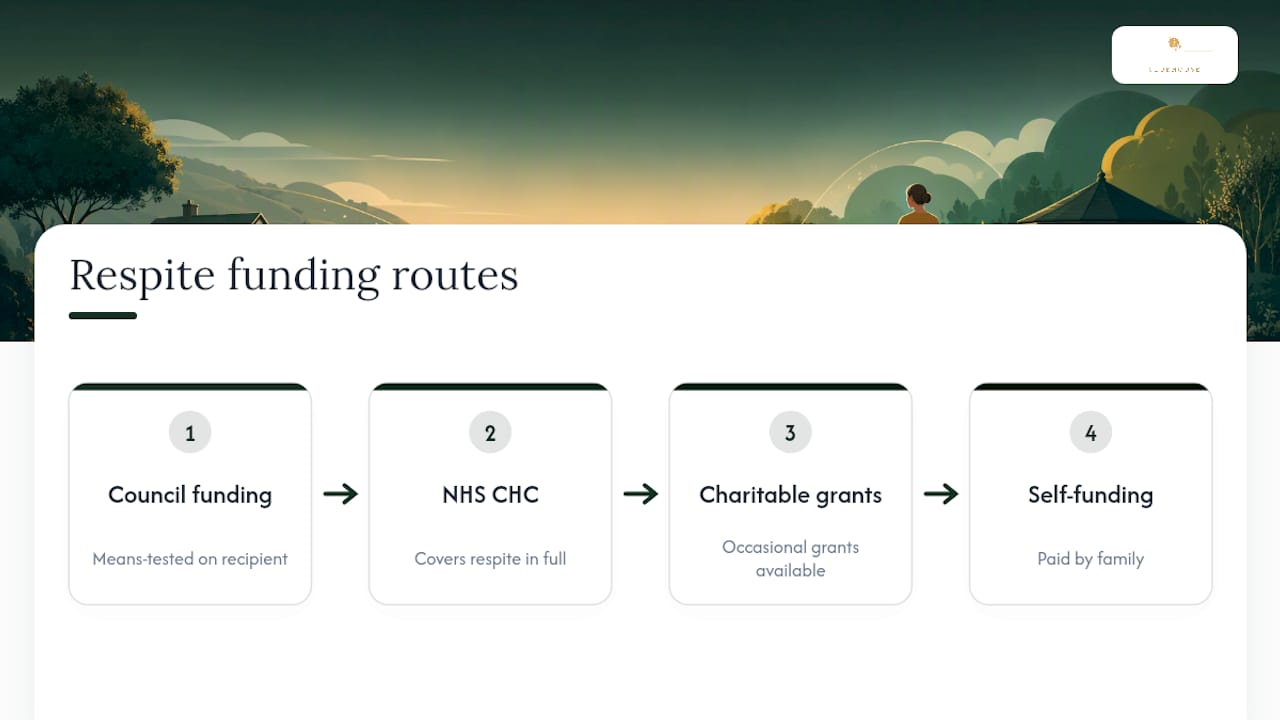
NHS Continuing Healthcare (CHC) covers respite in full where the person has a primary health need, and crucially, it isn't means-tested. This is the funding route families most often overlook, assuming (wrongly) that all social care funding depends on savings.
Council funding does depend on a means test, and it assesses the finances of the person receiving care, not the carer's. Thresholds vary by nation within the UK, so check your specific council's current limits directly.
On cost, the numbers are worth knowing before you call anyone: residential respite averages £1,377 per week across the UK, visiting homecare averages around £32 per hour, and live-in respite commonly exceeds £1,500 per week where waking-night support is needed.
Short stays often cost proportionally more than permanent placements, because homes price in the admin and settling-in overhead of a brief booking. Charities occasionally offer grants toward respite costs, so it's worth asking local carer support organisations before assuming you must self-fund entirely.
Choosing dementia-friendly respite: what actually helps
Routine and familiar faces matter enormously for someone living with dementia. A change of environment that feels chaotic or unfamiliar can trigger distress that outlasts the respite break itself, which is why trained staff and a predictable structure matter more here than in general respite.
Cognitive Stimulation Therapy (CST) is the only non-drug intervention NICE recommends for mild to moderate dementia, typically delivered as 14 sessions over seven weeks. Some day programmes incorporate CST-style group activity into their regular calendar rather than running it as a standalone clinical course.
The evidence is genuinely encouraging, with caveats. Realist reviews show well-delivered day programmes can reduce carer burden and help delay care-home admission, though outcomes vary depending on how consistently the programme runs. Separately, CST delivery itself varies in fidelity across services, even where it's offered.
- Ask whether CST is delivered from the manual by trained, supervised facilitators
- Ask how staff handle agitation or "sundowning" in the afternoon
- Ask what a typical day actually looks like, hour by hour
Pro Tip: Don't accept "we do dementia activities" as an answer. Ask specifically whether staff are trained in CST and how often sessions run.
What if you need respite care right now?
Start with your council's adult social care duty line for daytime emergencies, or NHS 111 if the situation involves an urgent health concern. Councils hold some emergency respite capacity, though availability varies by area and time of year.
- Ring adult social care's duty team first; explain it's urgent
- Ask local Age UK or carer support charities about short-notice sitting services
- Private agencies can sometimes place emergency cover within 24 to 48 hours, at a premium
Getting assessed early, before a crisis hits, is what actually reduces how often you end up relying on emergency options in the first place.
Your practical checklist before you call anyone
Getting organised before you pick up the phone saves repeating yourself five times to five different people.
- Gather documents first: GP details, current medications, existing care plan, and financial information if self-funding.
- Ask providers about training, CQC rating, and their complaints process before booking anything.
- Request a written care plan, not a verbal summary, for any placement lasting more than a day.
- Watch for red flags: vague pricing, no written plan, or refusal to accept direct payments should all give you pause.
Do you qualify? Respite care eligibility explained
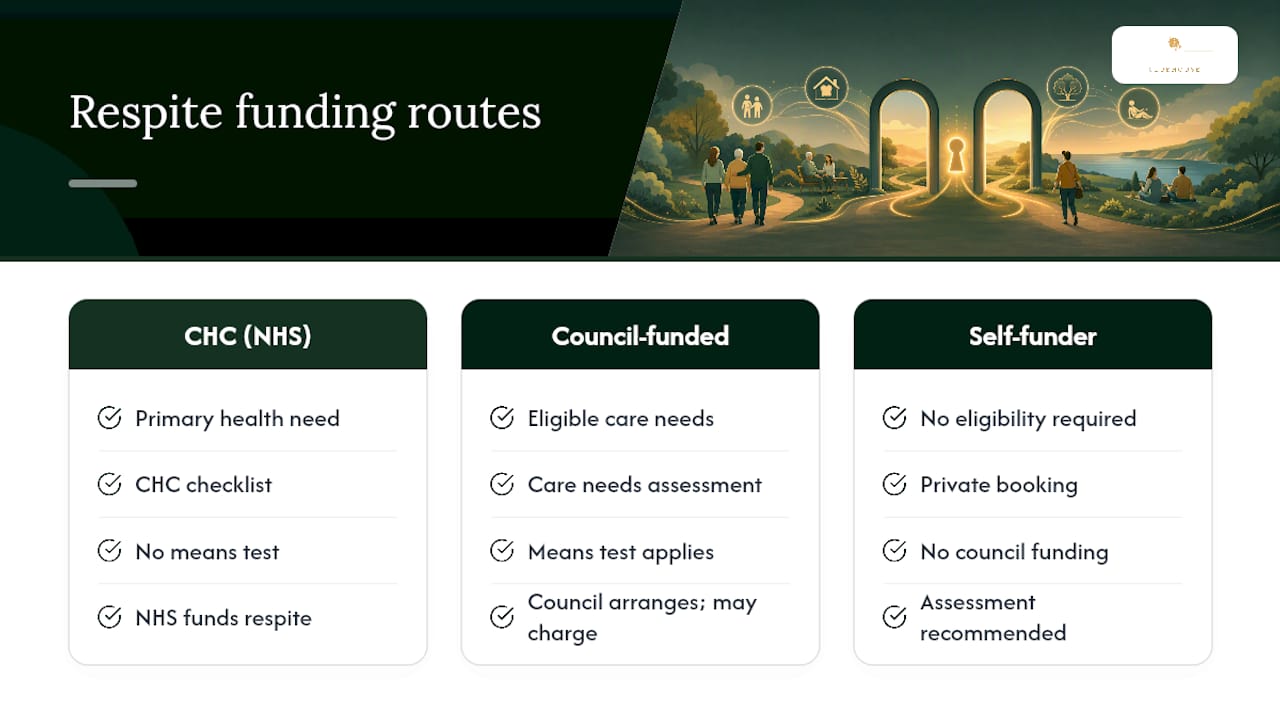
There's no single national eligibility test for respite care itself. Eligibility flows from the two assessments: if the carer's assessment identifies eligible need for support, and the care needs assessment confirms the cared-for person has needs the council must meet under the Care Act 2014, respite becomes part of the resulting care plan.
For NHS-funded respite via Continuing Healthcare, eligibility hinges on whether the person has a primary health need, assessed against a national framework rather than a financial means test. This is a clinical judgement, not a savings threshold, which is exactly why it's worth requesting a CHC checklist even for families who assume they'll have to self-fund.
For council-funded respite, eligibility depends on two separate tests running together: a needs test (does the person have eligible care needs under national eligibility criteria) and a means test (can they afford to contribute, based on savings and income). Passing the needs test doesn't guarantee free care. It guarantees the council must arrange it, though you may be asked to contribute financially depending on your relative's means.
Self-funders don't need to pass any eligibility test at all; they can book privately whenever they choose, though it's still worth requesting an assessment first, since it costs nothing and might reveal funding you'd otherwise miss.
Age itself isn't an eligibility criterion. Younger disabled adults and people with progressive conditions access the same statutory assessment routes as older adults, and the same CHC principles apply regardless of age where a primary health need exists.
The real benefits of respite care, for carers and for the person cared for
The case for respite usually gets made in terms of carer relief, and that's real, but it undersells what a good break can do for the person receiving care too.
For carers, planned time away from caring duties reduces the cumulative exhaustion that builds when caring runs without a break for months or years. It protects your own health, your other relationships, and your ability to keep working if you're juggling both. It also gives you space to think clearly about longer-term decisions, which is genuinely difficult to do while running on empty.
For the person cared for, a well-run respite placement isn't just downtime. Structured day programmes with social contact and trained facilitation appear to reduce agitation and support carers to sustain work or other commitments, particularly for people living with dementia. Meeting new people, trying different activities, and experiencing a change of pace can be genuinely stimulating rather than disruptive, when the environment is calm and familiar routines are respected.
Respite also acts as an early warning system. A short stay in a residential setting, or a few days at a day programme, often surfaces needs a carer hasn't noticed at home, simply because a fresh set of trained eyes is watching. That information feeds directly back into future care planning, which is one reason social workers tend to encourage families to try respite before a crisis forces the decision.
The honest challenges and drawbacks of respite care
Respite isn't a universally smooth experience, and it's worth knowing where the friction typically shows up before you commit.
Cost is the most immediate barrier for families who don't qualify for council or NHS funding. Even where funding exists, waiting for assessments can feel painfully slow when you're already exhausted, and short-notice availability for residential stays is often limited, especially around holidays.
Some people cared for resist respite outright, particularly with dementia, where a change of environment can cause temporary confusion or distress even in a good-quality setting. This settling-in friction usually passes, but it can make the first booking feel like it's backfired, and carers sometimes abandon respite after one difficult experience rather than trying a different provider or format.
Quality varies significantly between providers, and a CQC rating alone doesn't guarantee the day-to-day experience will suit your relative's temperament. Guilt is a genuinely common barrier too; many carers describe feeling they're abandoning their relative by booking a break, even when every professional involved encourages them to do it.
How respite fits into your wider care plan
Respite works best when it's treated as one component of an ongoing care plan, not a one-off fix reached for only in emergencies. Once you've had a carer's assessment and a care needs assessment, respite typically gets written into the resulting care plan as a recurring entitlement, reviewed periodically rather than requested from scratch every time.
This matters for benefit continuity too. Carer's Allowance rules generally permit up to four weeks of respite within any 26-week period without affecting entitlement, though Attendance Allowance or PIP for the person cared for can stop after 28 days in a care home, so it's worth checking the specific rules for longer residential stays.
Regular respite also acts as a bridge toward whatever comes next, whether that's increased homecare, a move to assisted living, or eventually permanent residential care. Trying different formats, day programmes, short residential stays, live-in cover, while things are still manageable gives you real information about what your relative responds well to, rather than making that decision blind during a future crisis. Councils often build reviews into the care plan specifically to revisit whether current arrangements still fit, so it's worth treating each review as a genuine opportunity to adjust rather than a box-ticking exercise.
Your legal rights around respite care
The Care Act 2014 gives carers in England a statutory right to a free carer's assessment, regardless of income, and this right exists independently of whether the cared-for person accepts an assessment themselves. Councils cannot lawfully refuse to assess you because they suspect you won't be eligible for funded support; the assessment itself is a right, separate from any funding decision that follows it.
Where NHS Continuing Healthcare is being considered, there's a formal national framework governing the checklist and full assessment process, including statutory expectations around timelines. Fast-Track CHC exists for end-of-life cases and carries a 48-hour target, which matters enormously for families facing a rapidly changing situation.
If you disagree with a council's eligibility decision or a CHC ruling, both processes carry formal appeal routes, and it's worth requesting the decision in writing so you have something concrete to challenge. Direct payments, where awarded, are a legal entitlement to spend your personal budget on care of your own choosing, rather than being locked into whatever the council brokers by default; providers cannot simply refuse to work with direct payments as a blanket policy without good reason.
A daytime community, not a waiting room
We built The Alderley Clubhouse around a simple belief: a good day matters as much as a safe one. Structured activity, proper meals, and clinically informed therapies across an extended day give carers predictable hours and give attendees something to genuinely look forward to. If that sounds like what your family needs, we'd love to show you a trial day.
— Scott @ The Clubhouse
Book a trial day at The Alderley Clubhouse
Council waiting lists and CHC assessments take weeks; a trial day at The Alderley Clubhouse takes a phone call. Some local day services run a standard six-hour day, and some run longer, with meals and hydration provided throughout the day.

Care teams at some services deliver Cognitive Stimulation Therapy, the only non-drug therapy NICE recommends for mild to moderate dementia, alongside a full programme of physical, creative, cognitive and social activities, weekly live entertainment, and visiting hairdressing and chiropody. Some adult day services operate in dementia-friendly, accessible buildings with secure parking and drop-off points, and limit attendance to ensure personalised attention.
Please consult the provider's website or contact them directly for current pricing and pass options. While you wait on assessment outcomes, private day passes let you start straight away, and if funding does come through later, you'll already know whether the fit is right. Bring any existing assessment paperwork along on your first visit; it helps our team understand your relative's needs from day one. Explore The Alderley Clubhouse and arrange a trial day to see whether it suits your family before committing further.
This article is general information, not a substitute for advice from a qualified doctor. Consult a qualified healthcare professional about your own circumstances before acting on anything here.
Sources
- Realist review of adult day programmes and dementia (PMC)
- Lottie: Care home costs & care fees UK average for 2026