

A social calendar for dementia is a structured day club programme of social, cognitive and recreational activities designed for people with mild to moderate dementia. It commonly includes Cognitive Stimulation Therapy, the approach recommended by NICE for people at this stage. This guide covers what a good programme looks like, what the evidence says, and how to trial one with confidence.
TL;DR:
- Structured social programs should include named, varied sessions like Cognitive Stimulation Therapy, reminiscence, music, and gentle activities, with consistent groups for effectiveness.
- Staff delivering CST must be specifically trained, and groups should be closed with a clear weekly plan and personalized to individual preferences.
- A trial day should start with short visits, involve familiar items, and observe genuine engagement, with the option for staff to adjust activities based on mood and fatigue.
- Programs must adapt as dementia progresses, reducing complexity and increasing sensory or emotional activities, with regular reviews to match changing abilities.
- Effective programs build in multiple ways for different abilities, emphasizing flexibility, small group sizes, and staff who know each member well for better engagement.
Table of Contents
- What a social calendar looks like: sample day and activity types
- Evidence and benefits: what NICE and research say about structured social programmes and CST
- How to choose a paid day-care that runs a genuine social calendar
- Preparing the person and running a successful trial day
- Adapting the social calendar as dementia progresses
- Engaging people with different abilities and preferences
- What longer-term outcomes tell us about social calendars
- Real experiences: what participation actually looks like
- Risks and activities that need extra care
- A carer's brief perspective on choosing a day club
- The Alderley Clubhouse: how our social calendar and booking work
- Where to read next
- Sources
- FAQ
What a social calendar looks like: sample day and activity types
A genuine social calendar has a rhythm to it. Mornings tend to carry the cognitive work, when concentration is at its best, while afternoons ease off into gentler, sociable pursuits. A typical day at a day club might run something like this: arrival and breakfast, a morning cognitive or reminiscence session, a mid-morning break, a craft or physical activity before lunch, a cooked lunch, a quieter afternoon activity, then tea and some live entertainment before home time.
The best programmes mix several categories of activity across the week rather than repeating the same session:
- Cognitive Stimulation Therapy (CST), run in small closed groups with consistent members and themed topics.
- Reminiscence and music sessions, often built around familiar songs or objects that spark conversation; see our tips on starting communication through music.
- Chair-based exercise or gentle movement, kept low-impact and adapted to mobility.
- Arts, crafts and sensory activities, which give quieter members a way to engage without needing to talk.
- Outings, visiting entertainers or seasonal events, spaced through the week for variety.
Many settings also use reality-orientation boards, showing the day, date, season and weather, as simple, low-pressure anchors that help members feel settled. When you visit a provider, look past the printed timetable and check the logistics: how members get there and home, what meals are actually served, whether the building is genuinely accessible, and whether groups stay small enough for staff to know each person by name.
Pro Tip: Ask to see a week's worth of activity plans, not just one day. A single good session tells you little; a varied week tells you whether the calendar is real.
Evidence and benefits: what NICE and research say about structured social programmes and CST
The strongest evidence behind social calendars sits with Cognitive Stimulation Therapy. NICE guideline NG97 recommends offering group CST to people with mild to moderate dementia, typically delivered as 14 sessions of around 45 minutes each.
Systematic reviews summarised in the evidence base behind that guideline point to a consistent pattern, with meta-analytic evidence showing benefits for cognition and quality of life, though results for everyday activities of daily living are more mixed. Trials vary in size and quality, so the fair reading is that structured cognitive stimulation helps thinking and wellbeing, not that it changes every aspect of daily function.
Beyond cognition, the social side matters just as much. Alzheimer's Society reports that day service attendees commonly describe better wellbeing from the social side of these programmes:
- Making friends and having somewhere to belong each week.
- Picking up hobbies they had let go.
- Feeling supported by staff who know their needs well.
None of this means every activity suits every person, or that gains are guaranteed. It means a well-run programme, built around consistent groups and varied sessions, gives someone with mild to moderate dementia a realistic chance of feeling more engaged and less isolated.
How to choose a paid day-care that runs a genuine social calendar
Not every provider that advertises "activities" is running anything close to a structured programme. Before booking, work through this checklist.
- Check staff training. Ask whether staff are trained to deliver CST specifically, not just general activity facilitation.
- Ask about group format. A proper CST group is closed, meaning the same members attend each week, usually six to eight people with two staff, according to NHS descriptions of the therapy.
- Request a written weekly plan. A real provider can show you named sessions and rough timings, not vague descriptions like "activities all day".
- Ask how personalisation works. Find out how they capture likes, dislikes and communication needs before someone's first day.
- Confirm safeguarding and inspection status. In care settings, ask whether the provider is registered and inspected, and what that covers.
- Check the practical details. Transport, meal provision, day length and how staff handle distress or a bad day all affect whether it will actually work for your relative.
Watch for red flags: no fixed group, no written outline, reluctance to let you observe a session, or staff who cannot describe how they would settle someone who becomes anxious.
Pro Tip: If a provider hesitates when you ask to sit in on part of a session, treat that as your answer. Confident providers welcome the visit.
Preparing the person and running a successful trial day
A trial day works best when staff already know something about the person before they arrive. Alzheimer's Society guidance on replacement care recommends gradual visits and involving the person in the decision wherever possible, alongside checking practicals like transport and meals in advance.
A one-page profile helps enormously here, covering:
- Routines, likes and dislikes, and anything that tends to cause distress.
- Communication preferences, including hearing or sight needs.
- A few familiar topics, songs or objects that reliably bring comfort.
Start with a half day if you can, and consider staying for the first session if that eases the transition. Bring one or two familiar items along.
During the trial, watch for genuine engagement rather than polite attendance, how quickly staff notice and respond to mood changes, whether mealtimes are properly supported, and whether your relative seems tired but content rather than overwhelmed at pickup.
Pro Tip: Debrief the same evening while details are fresh, then decide: repeat the trial, book regular sessions, or look elsewhere.
Adapting the social calendar as dementia progresses
A social calendar that works well in the earlier stages of mild dementia will not stay right forever, and good providers adjust rather than assume one format fits every year. In mild dementia, longer conversation-based sessions and more complex craft or cognitive tasks tend to suit well, since concentration and verbal recall are often stronger.
As dementia moves into the moderate stage, sessions usually need to shorten, with more repetition and simpler instructions. Music, sensory activities and reminiscence often take a larger share of the week, since these rely less on working memory and more on emotional and sensory response. Staff should also be adjusting pace within a single session, not just across the calendar, slowing down or switching activity if someone loses focus.
The practical sign of good adaptation is flexibility without disruption: the same familiar group, room and routine, but the content inside each session quietly shifting to match ability. Ask providers directly how they review and adjust programmes as a person's needs change, and how often. A provider who reviews care plans only once a year is unlikely to be making the small, regular adjustments that actually matter day to day.

Engaging people with different abilities and preferences
A single room full of people with dementia rarely has uniform ability or interest, so a strong social calendar builds in more than one way to take part in the same session. In a CST group, for example, one member might answer verbally while another points to a picture or simply nods along, and both are participating fully.
Good facilitators offer:
- Multiple entry points into an activity, such as a discussion topic that also has an object to hold or a picture to look at.
- Quieter roles within a group task, so someone who finds conversation tiring can still be involved.
- A mix of individual attention and group activity across the day, rather than constant group pressure.
Sensory sessions, gentle gardening tasks and simple games tend to work particularly well for mixed-ability groups, since they allow someone to join in at their own level without needing to keep pace with others. Staff who know each member well can also step in quietly, offering a simpler version of a task rather than letting someone disengage. This is one reason group size matters so much: a facilitator managing fifteen or more people cannot realistically read the room in the way one managing six or seven can.
What longer-term outcomes tell us about social calendars
Short trial days are a useful first check, but carers naturally want to know whether the benefits of regular attendance hold up over weeks and months rather than just on a good day. The evidence base behind NICE's CST recommendation draws on trials tracking participants across a full course of sessions, and the pattern that emerges is fairly consistent: measurable gains in cognition and quality of life that hold across the programme, though not every trial is large enough to draw firm conclusions from, and effects on everyday practical tasks are less clear-cut.
What this means in practice is that regular, consistent attendance seems to matter more than any single stand-out session. A person who attends the same group weekly, with the same faces and a familiar structure, appears to get more benefit than sporadic attendance would suggest. That squares with what Alzheimer's Society hears from day service attendees, many of whom describe the friendships and sense of belonging built over repeated visits as being as valuable as any individual activity.
The honest caveat is that dementia is progressive, so "outcomes" should be judged against a realistic baseline rather than expecting improvement to continue indefinitely. The more meaningful measure for most families is whether wellbeing and engagement are holding steady, or declining more slowly than they might have without regular social contact.

Real experiences: what participation actually looks like
Case examples from day services tend to follow a recognisable shape. A person arrives anxious or reluctant on day one, often more worried by the change of routine than by the activities themselves. By the second or third visit, once the room, staff and group are familiar, that anxiety usually eases, and families often describe a person coming home more talkative or in better spirits than before they started attending.
The challenges are just as real as the benefits, and worth naming honestly. Some people take several sessions to settle, and a single bad day should not be read as failure. Certain personalities resist group settings altogether, no matter how well run the programme is, and a smaller, quieter option or one-to-one activity may suit them better. Families sometimes also notice that a person is more tired on club days, which is not necessarily a bad sign: a full day of social contact and activity is genuinely more effort than a quiet day at home, and some tiredness afterwards is common rather than concerning.
What tends to separate a positive experience from a difficult one is less about the programme's content and more about fit: whether the pace, group size and staff approach suit that particular person. This is exactly why a trial period matters so much, and why judging a single visit too harshly, in either direction, rarely gives the full picture.
Risks and activities that need extra care
Most activities on a well-run social calendar carry low risk, but a few needs thought before someone joins in. Physical sessions such as chair-based exercise should be adapted to existing mobility issues, heart conditions or recent falls, and a good provider will ask about these before including someone in movement-based activities.
Sensory activities are generally gentle, but strong scents, very loud music or highly stimulating environments can occasionally cause agitation in people with moderate dementia, particularly those sensitive to noise or crowding. Outings and trips carry their own considerations around mobility, toileting access and the person's tolerance for unfamiliar environments, so these should be optional rather than automatic.
Reminiscence sessions, while usually positive, can occasionally surface distressing memories, so staff need the skill to redirect gently rather than push a topic. The same caveat that applies to physical exercise applies here in spirit: any activity with the potential to raise distress, whether physical or emotional, should have a clear plan for staff to step back or adapt on the day. Ask providers directly how they screen for these risks before someone's first session, and how they handle it if an activity does not suit someone partway through. A provider with no clear answer to either question has probably not thought it through properly.
A carer's brief perspective on choosing a day club
Choosing a day club came down to small, unglamorous details for us: whether staff greeted people by name, whether activities were actually happening when we walked in unannounced, and whether the pace felt calm rather than rushed.
Give the transition time. A good provider will not expect instant enthusiasm on day one.
Watching how staff spoke to members, rather than about them, told us more than any brochure could. Balance the wellbeing signs you can see against your own need for reliable respite. Both matter.
— Scott @ The Clubhouse
The Alderley Clubhouse: how our social calendar and booking work
The Alderley Clubhouse runs a dementia-friendly daytime community for adults aged 50 and over, including people living with mild to moderate dementia. Our care team is trained to deliver Cognitive Stimulation Therapy, and we cap attendance at 35 members each day, so staff genuinely know everyone by name.
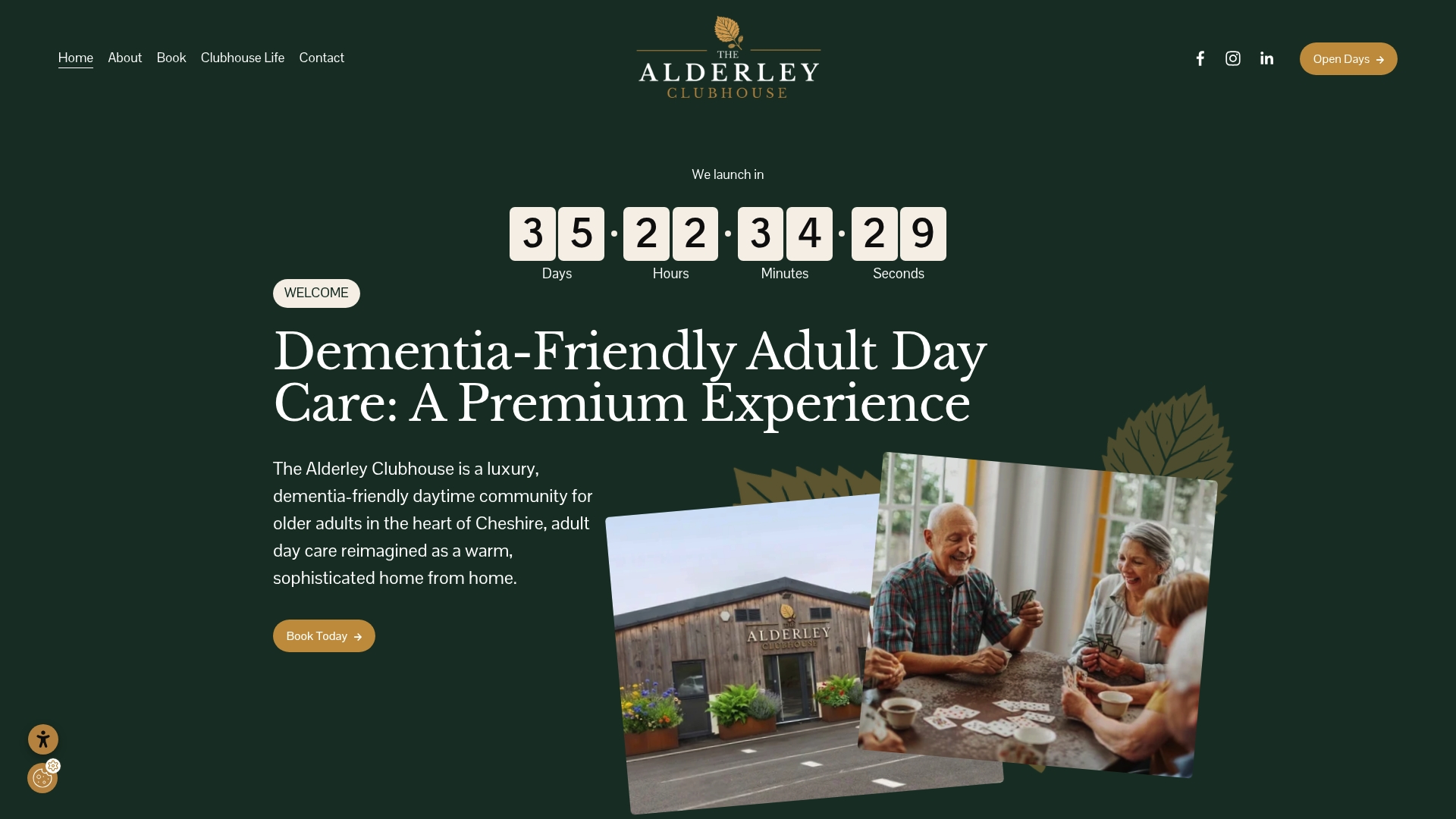
Days run from 9:30am to 4:30pm, Monday to Friday, a full hour longer than most local provision. Every day includes:
- Breakfast on arrival, a cooked two-course lunch and traditional afternoon tea.
- An all-day hydration station and a full programme of physical, creative, cognitive and social activities.
- Weekly live entertainment plus visiting hairdressing and chiropody.
The building is purpose-designed and fully accessible, with secure parking and a drop-off point at the door. A Day Pass is available, with multi-session passes offering booking flexibility; current prices are on the Clubhouse's booking page. If you would like to see how it works before committing, you can book a welcome tour or go straight to booking a Day Pass.
Where to read next
For the guidance behind this article, see NICE's dementia guideline, Alzheimer's Society's day service pages and their guidance on replacement care. For facilities and booking, visit The Alderley Clubhouse.
This article is general information, not a substitute for advice from a qualified doctor. Consult a qualified healthcare professional about your own circumstances before acting on anything here.
Sources
- Dementia: assessment, management and support for people living with dementia and their carers | NICE (NG97)
- Day Service – spend the day doing something you enjoy | Alzheimer's Society
- Making arrangements for respite care | Alzheimer's Society
FAQ
What does a social calendar for dementia actually include?
It is a structured weekly programme of social, cognitive and recreational sessions run at a day club, typically mixing Cognitive Stimulation Therapy, reminiscence, music, gentle exercise and crafts. A genuine programme has named sessions and consistent groups, not just unstructured free time.
Is Cognitive Stimulation Therapy proven to help?
NICE recommends group CST for people with mild to moderate dementia, and supporting evidence points to consistent benefits for cognition and quality of life. Effects on everyday practical tasks are less consistent across trials, so it helps to set realistic expectations.
How long should a trial day at a day club be?
Alzheimer's Society guidance on replacement care suggests starting gradually, so a half day is often a sensible first step before moving to a full day. Staying for part of the first session can also ease the transition if your relative seems anxious.
What should I share with staff before the first visit?
A short written profile covering routines, likes, dislikes, triggers and communication needs helps staff personalise sessions from day one. This kind of preparation is widely recommended in person-centred care guidance for dementia services.
What does The Alderley Clubhouse charge for a day?
Full details about Day Pass pricing are on the Day Pass booking page.