

If someone you love is living with dementia and you're weighing up whether a day centre could help, the answer is usually yes, provided you find the right one. The single most important thing to check is whether staff are trained in dementia care and whether that compassion shows in how they actually treat people, not just in the brochure. Everything else on your checklist follows from that.
TL;DR:
- Ensure staff are trained in dementia care and observe their compassionate response during interactions, not just in promotional materials.
- Verify that the centre offers a structured programme including social, creative, physical, and cognitive activities like Cognitive Stimulation Therapy.
- Confirm staffing levels are sufficient and staff are regularly trained, with a low turnover rate, to provide consistent, personalized care.
- Visit the centre twice—unannounced and with your relative—to assess the environment, staff interactions, and activities during normal operation.
- During the transition, introduce the day programme gradually over a month, and monitor your relative’s mood, sleep, and behaviour for signs of compatibility.
Table of Contents
- What should a specialist dementia day centre provide?
- Why do staffing levels and training matter so much?
- How do you evaluate a centre during a visit?
- How should the transition into day care work?
- What do dementia day centres typically cost?
- What families consistently prioritise, and why it matters
- Ready to see how The Alderley Clubhouse fits your checklist?
- Where to check further evidence and inspection records
- Sources
What should a specialist dementia day centre provide?
A good centre runs on structure. Look for a programme that blends social contact, creative activities, gentle physical movement and cognitive stimulation, ideally including Cognitive Stimulation Therapy sessions, the only non-drug therapy NICE recommends for mild to moderate dementia. These programmes are built to maintain independence and reduce agitation, not simply to fill the hours.
Beyond activities, ask how the centre handles the practical side of the day: medication reminders, help with eating or toileting where needed, and a genuinely accessible, secure building. Transport arrangements, meal quality and opening hours all matter too, especially if you need a full working day of respite rather than a short morning session.
Watch for these warning signs on any visit:
- No visible dementia-specific training among staff, or vague answers when you ask about it
- No individual care plan, or one that hasn't been reviewed in months
- A chaotic, noisy environment with nowhere quiet to retreat to
- Staff who talk over or past participants rather than to them
- Meals rushed or served without any thought for dietary needs
A centre that gets the basics right tends to show it in small ways: a settled lunchtime, calm background noise, and staff who know people's names without checking a list. You can read more about how dementia day programmes are typically structured before you start comparing options.
Why do staffing levels and training matter so much?
Staffing is where good intentions either hold up or fall apart. A centre can have a beautiful sensory garden and a packed activity board, but if there aren't enough trained people to deliver it safely, none of that counts for much.
There's no single legal ratio that applies everywhere, but higher staffing generally buys your relative more one-to-one attention, faster response to distress, and less waiting around, which matters enormously for someone who finds unfamiliar delays disorientating. Higher staff-to-participant ratios and dementia-focused training are widely recommended for exactly this reason.
When you speak to a manager, ask directly:
- What proportion of staff are trained in Cognitive Stimulation Therapy or an equivalent recognised approach?
- How often does refresher training happen, and is it documented?
- What's the current staff turnover, and how long have senior team members been there?
- How are new or agency staff supervised on the floor?
High staff turnover may negatively affect continuity of care and the sense of routine important to someone with dementia, as familiar faces help provide comfort and stability.
Pro Tip: Don't just ask about training, watch it in action. A five-minute observation of how a staff member responds when someone becomes confused or upset will tell you more than any policy document.

How do you evaluate a centre during a visit?
Arrange two visits if you can: one unannounced, so you see the centre on an ordinary day, and one planned trial visit with your relative present. Both matter. The unannounced visit shows you reality; the trial visit shows you how your relative actually responds.
During any visit, pay attention to:
- How arrival and reception are handled, warmly or hurriedly
- Whether activities are led with energy and adapted for different ability levels
- How staff assist at mealtimes, and whether the pace feels rushed
- Whether there's a calm, quiet space away from the main activity
- General noise levels and whether the layout feels easy to navigate
Bring a specific list of questions:
- Is there an individual care plan, and how often is it reviewed?
- What's the staff-to-participant ratio on a typical day?
- What are the emergency procedures if someone becomes unwell or distressed?
- Is transport included, and how is it managed for someone who gets anxious in unfamiliar vehicles?
- What exactly is included in the daily fee, and what costs extra?
Take notes straight after, while details are fresh. Watching staff-participant interactions tends to be far more revealing than any glossy leaflet, because it shows you the everyday tone of the place rather than its marketing version. For a shorter checklist you can print and take with you, this guide to questions carers must ask about small-group day care covers similar ground.
How should the transition into day care work?
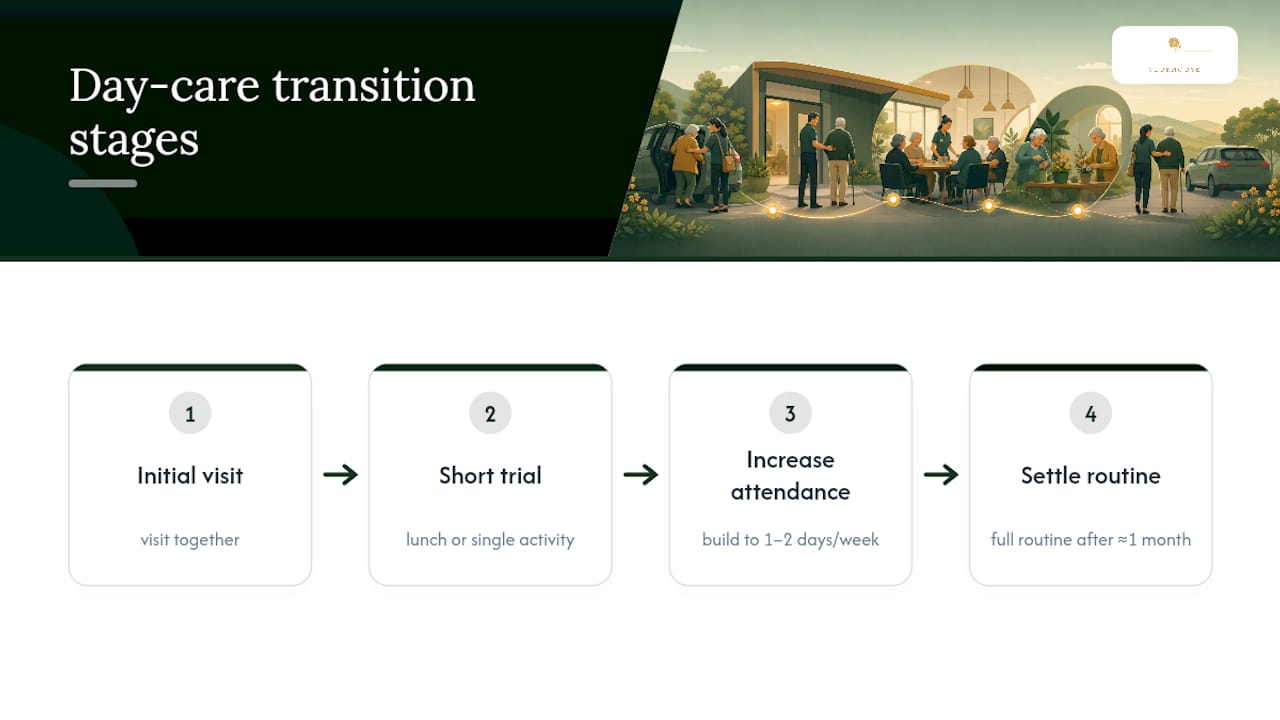
Rushing the start rarely goes well. The Alzheimer's Association recommends a staged approach: visit together first, then attend for lunch or a single activity, then build up to one or two days a week over roughly a month before settling into a fuller routine.
Watch for positive signs during those early weeks, better engagement, improved sleep, a calmer mood at home. Persistent distress, increased agitation on the days your relative attends, or reluctance that doesn't ease after several visits are signs the fit isn't right, and worth raising with staff or a GP promptly rather than pushing through.
Keep a short log during the trial period: mood before and after, sleep that night, and anything specific staff mention when you collect them. That record makes it far easier to judge genuine progress rather than relying on memory alone.
What do dementia day centres typically cost?
Most centres charge either a single daily fee or offer discounted session passes for regular attendance, and it's worth comparing both against how often your relative will actually go. Fees commonly include meals and the core activity programme, though some therapies or transport may be charged separately.
Before booking, clarify the practical details: the cancellation policy, what happens if pickup runs late, and whether there are additional charges for things like hairdressing or chiropody visits. These small print items add up if you don't ask upfront.
Funding routes vary. Many families pay privately, but it's worth checking whether a local authority needs assessment or relevant benefits could contribute towards costs, since eligibility differs by area and circumstance. A local authority carer's assessment is usually the right starting point for that conversation.
What families consistently prioritise, and why it matters
Every family we speak with wants the same three things: safety, dignity and routine. It's rarely about the number of activities on a schedule, it's about whether their relative is treated as a person first, throughout the day, not just during the "engaging" bits.
That's why we built The Alderley Clubhouse around full CST training for the whole care team, a 35-person daily cap so everyone is known by name, and a 9:30am to 4:30pm day, an hour longer than most local provision. This is precisely because rushed mornings and early pickups create the very distress families are trying to avoid.
Two things to try when comparing centres yourself: ask to see a full day's schedule rather than a highlights list, and ask what happens on a bad day, not just a good one.
— Scott @ The Clubhouse
Ready to see how The Alderley Clubhouse fits your checklist?
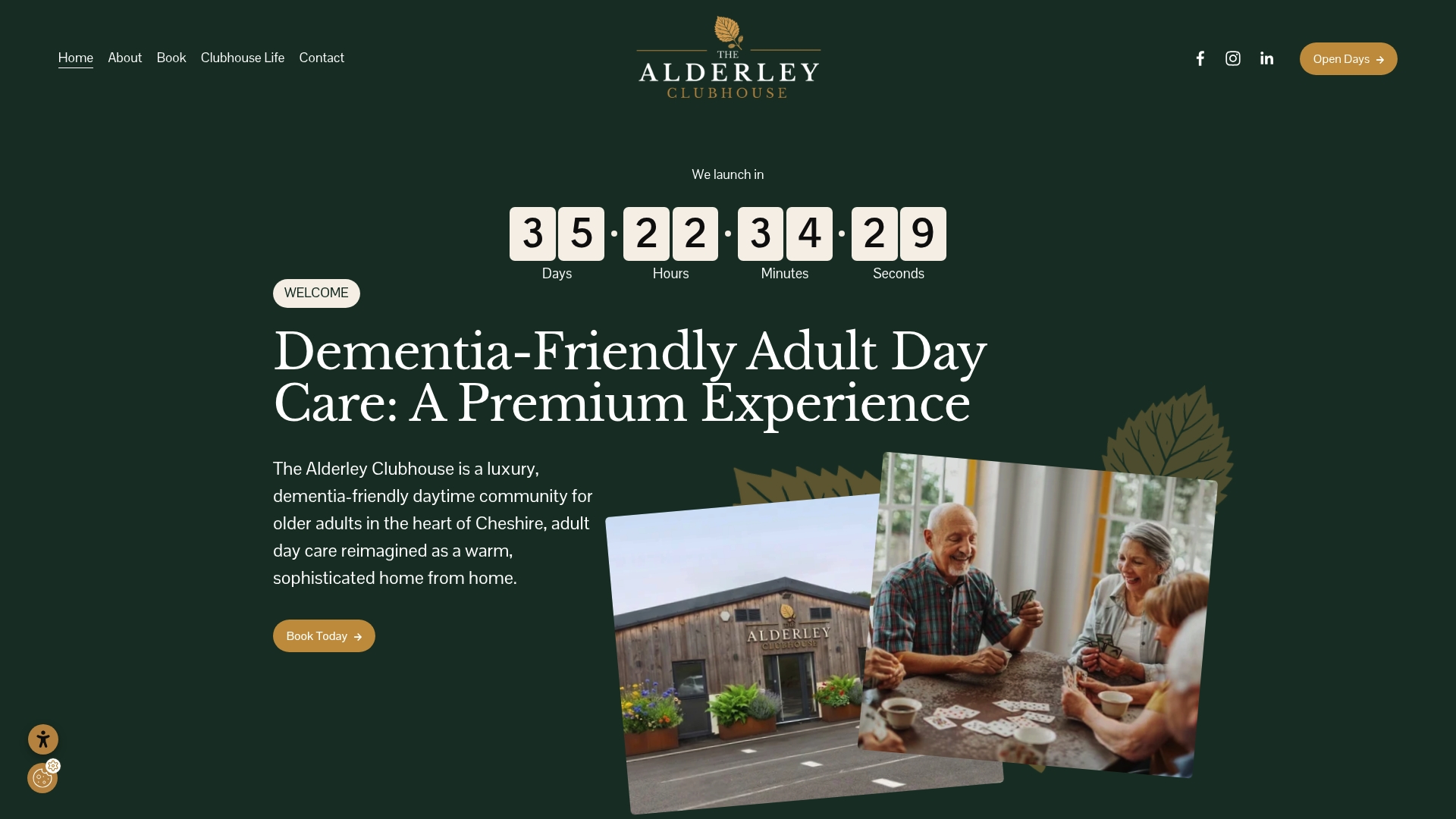
Everything covered above, dementia-trained staff, individual care plans, a calm accessible environment, capped numbers, maps directly onto how The Alderley Clubhouse runs day to day. Every member of our care team is trained to deliver Cognitive Stimulation Therapy, attendance is capped at 35 members so your relative is genuinely known, and the day includes breakfast on arrival, a cooked two-course lunch, afternoon tea and an all-day hydration station, all within a purpose-built, dementia-friendly space with secure parking right at the door.
For a first visit, bring any current care notes and a list of foods or activities your relative particularly enjoys, it helps our team tailor the day from the start. Get in touch to arrange a trial visit or book your first day pass through The Alderley Clubhouse.
Where to check further evidence and inspection records
For deeper reading, the Alzheimer's Association's guidance on choosing an adult day centre and AARP's overview of adult day care benefits both offer practical, evidence-based checklists. To check a centre's regulatory standing directly, search the CQC's location records for its latest inspection summary before you commit.
Sources
- Choosing an adult day center (Alzheimer's Association)
- What is adult day care and how it helps caregivers (AARP)
- CQC location record (example)