
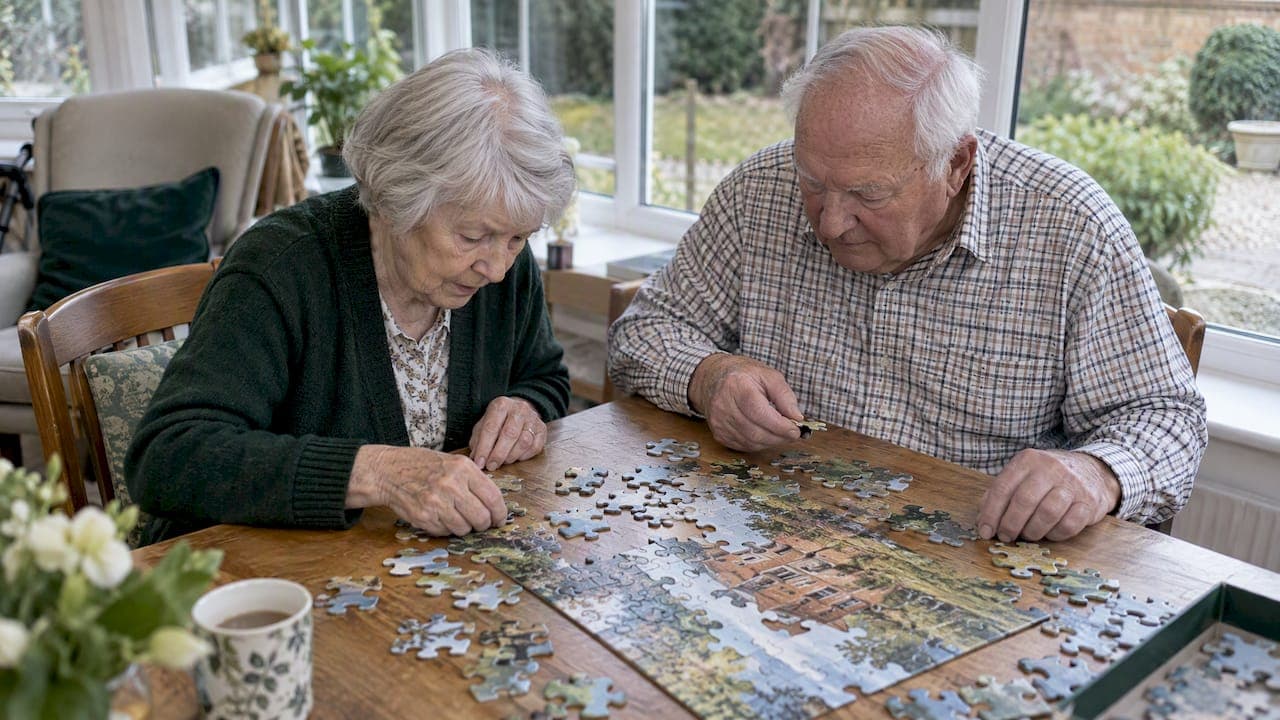
Puzzles for dementia work best as part of Cognitive Stimulation Therapy (CST), a structured, therapist-led group programme rather than a solo activity. If you're supporting someone with mild to moderate dementia, the most effective step is to seek out CST-based group sessions, either through an NHS memory service or a day club such as The Alderley Clubhouse, and try a session before committing to one.
TL;DR:
- The standard CST course runs 14 sessions of about 45 minutes, twice weekly for seven weeks, with each meeting built around a different theme.
- Facilitators should prioritize conversation over correct answers, switch written tasks to verbal prompts or physical objects, and keep easier versions ready if frustration appears.
- Inclusive sessions adjust difficulty within activities and use large print, high contrast materials, magnetic pieces, sensory cues, or team play instead of solo performance.
- Before choosing a day centre, confirm CST training, session schedule, and group size, observe staff prompting discussion, and ask about a trial before booking.
Table of Contents
- Why therapists use puzzles in Cognitive Stimulation Therapy
- How facilitators run puzzle-based activities in a group
- Adapting difficulty and keeping activities inclusive
- Checklist: choosing a day centre that delivers puzzle-based CST
- A carer's-eye view on why this matters
- Trial days and Day Passes at The Alderley Clubhouse
- FAQ
- Sources
Why therapists use puzzles in Cognitive Stimulation Therapy
CST follows a well-tested format: typically 14 sessions of around 45 minutes, delivered twice weekly over seven weeks, each built around a different theme. This structure, recommended by NICE and summarised by researchers at the University of Stirling, gives puzzle-based activities a reliable rhythm that participants come to recognise and look forward to.
The evidence behind this approach is substantial. Cochrane's review of cognitive stimulation finds genuine benefits for cognition and quality of life, and draws a clear line between CST's social, group-based approach and narrower cognitive training drills. NHS England's evidence summary notes that CST is both clinically recommended and cost-effective, which is part of why it's become so widely adopted across UK memory services.
Within a session, a puzzle rarely sits on its own. It's there to:
- Spark conversation between group members who might otherwise sit quietly
- Offer gentle memory cues without the pressure of a formal test
- Give people a reason to practise problem solving at their own pace
- Encourage give and take within the group, where one person's idea prompts another's
Cognitive stimulation produces measurable benefits in cognition and quality of life for people with dementia. That single finding is why CST now sits at the centre of non-drug dementia care across the UK.
What matters most in the room isn't whether someone finishes a crossword or names every face in a photo. It's whether they're leaning forward, chatting, laughing at a shared memory. A skilled facilitator treats a half-finished puzzle as a success if it got people talking.
How facilitators run puzzle-based activities in a group
CST sessions tend to follow themes, and puzzles are woven into most of them. The practical breakdown of the 14 CST session themes gives a fuller picture, but here's how a handful of common sessions typically play out:
- Word games. Facilitators use simple anagrams, word associations or "missing letter" prompts. The aim is conversation, not spelling accuracy; for a lower-ability group, swap in a verbal word chain instead of anything written.
- Number games. Simple sums, number sequences or pub-quiz-style counting tasks. Materials are often large-print cards or dominoes; for higher ability, add a light time element to build friendly challenge.
- Faces and scenes. Photos of well-known faces or local scenes prompt recognition and storytelling. Within TEWV NHS's CST sessions, this theme is used specifically to stimulate memory and talk, not to test recall.
- Categorising and sorting. Sorting objects, pictures or words into groups (fruits, countries, decades). Works well with physical items on a tray; simplify by reducing the categories to two.
- Adapted jigsaws. Large-piece, dementia-friendly jigsaws with a clear image. For lower ability, use fewer pieces; for higher ability, choose a busier picture.
- Team quizzes. Light general knowledge in pairs or small teams removes the pressure of an individual "right answer".
Good facilitation follows a routine: a warm-up to settle the group, a reality orientation board showing the day, date and season, then the main themed activity using physical objects wherever possible, with the facilitator prompting conversation throughout. Practical CST facilitation guidance recommends having an easier backup ready, because switching tasks smoothly matters more than pushing through a struggle.
Pro Tip: Keep a puzzle's real purpose in mind: the conversation it starts matters more than the answer it produces.
Adapting difficulty and keeping activities inclusive
Not everyone in a CST group is at the same stage, and a good programme plans for that from the outset. Many facilitators work with two difficulty tracks for the same activity, often called Level A and Level B, and will move a participant between them within a single session depending on how things are going. The iCST trial published in PLOS Medicine confirms this two-track approach is standard practice for maintaining inclusivity and a sense of achievement for everyone in the room.

Switching mode matters too. If a written puzzle becomes frustrating, a good facilitator will pivot to a verbal prompt or invite show-and-tell with a physical object instead, so nobody feels singled out for struggling.
Practical aids make a real difference:
- Larger print and higher-contrast materials for anyone with visual changes
- Magnetic pieces or puzzle trays that stay put and reduce fumbling
- Multisensory cues such as textured objects or familiar scents
- A carer or support worker on hand for anyone who needs a steadier hand
The Alzheimer's Society activities handbook recommends sorting jigsaw pieces by colour and offering team play rather than solo performance, precisely to take the pressure off. Look for small groups, flexible pacing, encouraging staff, and a genuine mix of materials. Those are the signs of a programme built around the person, not the activity sheet.
Checklist: choosing a day centre that delivers puzzle-based CST
A short checklist helps when you're calling around or visiting in person:
- Ask directly whether CST is delivered, and whether staff hold recognised CST training
- Confirm session length, frequency and typical group size
- Ask to observe a session, or request examples of the puzzle activities used that week
- Listen for a reality orientation board, a warm-up, and staff actively prompting conversation rather than just handing out worksheets
- Enquire about trial options, such as a single visit, before booking a longer package
Once you're satisfied, the natural next step is to arrange a trial day, ask what a Day Pass or multi-session pass includes, and request a short written summary of the centre's CST approach so you can compare it against others you've visited.
A carer's-eye view on why this matters
What we care about most at the end of a session isn't whether someone finished every puzzle piece. It's whether they arrived a little withdrawn and left chatting, whether the routine gave their day a shape it was missing.
Carers often tell us the same thing after a trial day: better appetite, a calmer evening, a parent who actually wants to go back next week. That feedback matters more to us than any single activity on the programme.
Fit matters just as much as the activity list. A warm, familiar room and staff who know someone's name will do more for their wellbeing than the cleverest puzzle ever could.
— Scott @ The Clubhouse
Trial days and Day Passes at The Alderley Clubhouse
We built The Alderley Clubhouse around the checklist above, because it's the one we'd want answered honestly if we were choosing care for our own family. Sessions run in small, capped groups, and every day includes breakfast, a cooked two-course lunch and afternoon tea alongside the activity programme.
Here's how our offering maps to what you should be checking for:
| What to check | What we offer |
|---|---|
| CST-trained staff | Care team trained to deliver CST |
| Group size | Capped daily attendance |
| Session structure | Structured cognitive, creative and social programme |
| Day length | Full weekday daytime hours |
- Book a Day Pass to try a full day of activities, meals and company
- Ask about our 10-Session Pass for ten days at the price of nine
- Visit our Open Day to see the building and meet the team before booking
If you'd rather ease in gently, our Be Our Guest day gives you a genuine taste of a Clubhouse day before you commit to anything further.
This article is general information, not a substitute for advice from a qualified doctor. Consult a qualified healthcare professional about your own circumstances before acting on anything here.
FAQ
Are puzzles for dementia the same as cognitive training?
No. CST uses puzzles as part of social, group-based activity rather than repetitive drills aimed solely at sharpening a specific skill. Cochrane's review is clear that this social focus is what separates cognitive stimulation from narrower cognitive training.
How often should puzzle-based CST sessions run?
The standard model is 14 sessions of around 45 minutes, delivered twice weekly over seven weeks, as set out in CST evidence summaries. Twice-weekly sessions tend to support stronger routine and repetition than once-weekly groups.
What types of puzzles work best for mild to moderate dementia?
Large-piece jigsaws, simple word and number games, and photo-based "faces and scenes" tasks tend to work well, especially with adaptations such as larger print or magnetic pieces. The Alzheimer's Society activities handbook recommends simplifying rules and favouring team play over solo performance.
How much does a day at The Alderley Clubhouse cost?
A Day Pass is available to book directly, with pricing shown at the time of booking on our Day Pass page. A 10-Session Pass offers ten days for the price of nine.
Can puzzle activities help beyond cognition?
Yes, group puzzle activities within CST are also associated with improved mood and social engagement, alongside the cognitive benefits Cochrane's review describes. Many carers also notice better fine motor engagement when sessions use physical pieces, trays or sorting objects.
Sources
For readers who want to look deeper into the evidence behind CST and puzzle-based group activity, these primary sources cover the guidance, session structure and research we've drawn on throughout this article. Related reading on our own blog covers the CST model in more depth, games you can adapt at home, and short sensory activities that pair well with puzzle sessions. For general background on why puzzle play engages the mind, see this partner piece on puzzle benefits.
- CST evidence summary (University of Stirling)
- CST session themes and delivery (TEWV NHS)
- Cochrane review: Can cognitive stimulation benefit people with dementia?
- NHS England summary of evidence on CST