
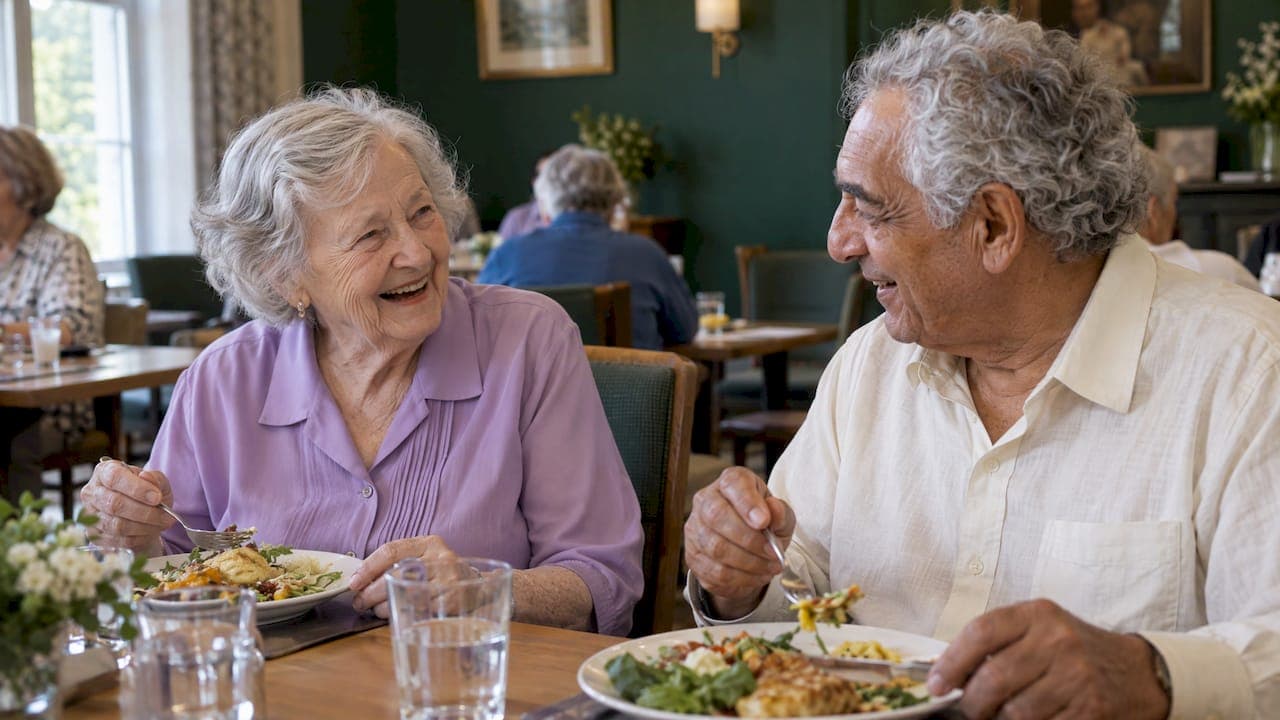
Older adult day care is a daytime service where people aged 50 and over spend the day in a safe, friendly building. They join activities, share meals and see other people, then go home in the evening. For the person attending, it means company and purpose. For the family, it means a dependable break. At The Alderley Clubhouse in Nether Alderley, Cheshire, we run days from 9:30am to 4:30pm, Monday to Friday, and this guide explains what to expect from any good day centre and how to choose one with confidence.
Key Takeaways
- Day care is a daytime community: meals, activities, company and support, with your loved one back home each evening.
- For people with mild to moderate dementia, look for trained staff who deliver Cognitive Stimulation Therapy (CST), the group therapy NICE recommends.
- A good centre knows each person by name, offers personal choice in activities and has a building designed to be easy to move around.
- Check hours, meals, accessibility, parking and how families are kept informed before you decide.
- You can see how a day feels first: we offer a complimentary taster day, and day passes are £120 including VAT.
Table of Contents
- What older adult day care actually is
- What a typical day looks like
- Day care and dementia
- How to choose a day centre
- Types of day provision at a glance
- Our perspective
- Cost, funding and getting started
- Try a day with us
- FAQ
- Sources
What older adult day care actually is
Researchers describe day centres as community, building-based services that provide care, health-related support or activities for older people who are disabled or in need. People can attend for a whole day or part of one, according to a scoping review of day centres for older people. The same review notes that day centres have been part of social care in England since the National Assistance Act 1948, so this is a long-established way of supporting people.
The basic idea is simple. Instead of spending long hours alone at home, your relative goes somewhere welcoming, takes part in things they enjoy and comes home tired in the pleasant way that a good day brings.
How it differs from care at home
Home care brings one person to the door, usually for a set visit. A day centre brings a whole community together. That matters because loneliness is often the hardest part of later life, and a carer at the door, however kind, cannot replace a table of people sharing a joke over lunch.
Many families use both. A home care provider or live-in carer keeps the routine going at home, and the day centre gives that person a change of scene and gives the carer a proper break. We welcome family carers, live-in carers and home care providers for exactly this reason.

Who day care suits
Day care can suit:
- adults who are active and sociable and want more to do with their week
- people who feel lonely or isolated, perhaps after bereavement or retirement
- people living with mild to moderate dementia who benefit from structure, familiar faces and tailored activities
- family carers who need dependable time to rest, work or simply catch up with life
The NHS describes day care as a chance for people who find it hard to get out and about to socialise, make friends and take part in activities. The Alzheimer's Society adds that day centres can be a welcome break for people who want to leave the house but need to stay well supported and safe, and that some are run by local services while others are privately owned.
What a typical day looks like
Every centre is different, but a good day has a gentle rhythm: a warm welcome, something to eat and drink, activity in the morning, lunch, quieter or social time in the afternoon, and a relaxed goodbye. The NHS says day centres may offer tea dances, singing, games, arts and crafts, hairdressing, foot care and assisted bathing, and that transport is often provided though there may be a charge.
Here is how a day runs with us:
- 9:30am: arrival, with breakfast waiting and a friendly face who knows your name.
- Morning: physical, creative, cognitive or social activities, chosen around what each member enjoys.
- Lunch: a cooked two-course meal, served at the table together.
- Afternoon: more activities, weekly live entertainment, or visits from our hairdresser and chiropodist.
- Afternoon tea: traditional, unhurried and often the happiest hour of the day.
- 4:30pm: home time. Our days are a full hour longer than most local provision, which helps families who work or need a longer break.
Through the day we keep a hydration station open, because we find that sipping little and often is the easiest way to keep people comfortable. You can see more on our facilities and activities page.
Activities that fit the person
The best activities are not generic. NICE guidance for older people recommends a range of group, one-to-one and volunteering activities that meet the needs and interests of local older people, especially those most at risk of losing independence and mental wellbeing. In practice, this means asking about a person's life: the job they loved, the music they danced to, the garden they kept.

If you want to think about how a person's interests, routines and needs shape their week, this overview of caregiver roles and check-ins is a helpful starting point for families sharing the load. For ideas you can try at home between visits, our guide to personalised dementia activities offers five quick ones.
Day care and dementia
For someone living with dementia, a familiar routine and friendly company can make days feel calmer and more meaningful. The Alzheimer's Society says day centres can be good places for people with dementia to take part in activities and meet other people, and that centres supporting dementia may include activities such as reminiscence.
Cognitive Stimulation Therapy
CST is a group programme for people with mild to moderate dementia. UCL's International CST Centre explains that it involves 14 or more themed sessions, typically twice a week, and that groups can take place in settings including day centres. UCL also reports that its effects appear comparable in size to those of currently available anti-dementia drugs.
NICE guidance on dementia recommends offering group cognitive stimulation therapy to people living with mild to moderate dementia, alongside activities to promote wellbeing that are tailored to the person's preferences. Our care team is fully qualified and trained to deliver CST, so it sits naturally inside the day rather than being something separate.
NICE's quality standard on dementia lists the kinds of activity that can support wellbeing, including exercise, art, gardening, baking, reminiscence and music therapy. If you would like to understand more, read our guide to cognitive stimulation therapy, or see how a CST-based group plan is built session by session.

How to choose a day centre
When you visit somewhere, trust what you see and feel. A good centre feels calm, warm and organised, and the people in it look at ease. Use this checklist.
- Staff and atmosphere. Do the team greet members by name? Are they trained for the needs of the people attending, including dementia?
- Group size. Smaller groups mean more attention. We cap attendance at 35 members a day, so everyone is known by name.
- The building. Is it easy to get around, well lit and dementia-friendly? Ours is purpose-designed, fully accessible and has secure parking with a drop-off point at the door.
- Food and drink. Are meals cooked fresh and is drink always within reach?
- Hours. Do they fit your working day or your need for a break? Ours run 9:30am to 4:30pm.
- Personal touches. Hairdressing and foot care visiting the centre make a real difference to dignity and to your to-do list.
- Keeping in touch. Can you see how the day went? Our FamilyNet app gives families daily updates.
- Standards. Care providers in England work to national fundamental standards. CQC regulations cover person-centred care, dignity and respect, safe care, safeguarding, nutrition and hydration, premises and equipment, and staffing. Our guide on CQC and day centres explains how this applies.
A useful rule is to picture an ordinary Wednesday. Would your relative be greeted, fed well, kept busy in ways they like and brought home content? If the answer is yes, you have likely found the right place.
Types of day provision at a glance
| Type | Usually run by | Often suits | Typical feel |
|---|---|---|---|
| Council or charity day centre | Local councils, charities | People assessed as eligible for local support | Community hall or centre, set programme |
| Private day club | Independent providers | Families who want longer hours, more choice and a premium setting | Smaller groups, hospitality-led |
| In-home day support | Home care providers | People who prefer to stay home | One-to-one at home |
The NHS notes that day centres are usually run by councils or local charities, and suggests contacting your local council or a charity such as Re-engage or Age UK to see what is available near you. Private options sit alongside these for families who want a different level of choice and attention.
Our perspective
We opened The Alderley Clubhouse because we believe a day away from home should feel like a day well spent, not a day in a care setting. Many older people, and many families, tell us they do not want something clinical. They want somewhere with good food, good company and real warmth.
That is why we built a purpose-designed, dementia-friendly clubhouse, why we cap each day at 35 members so everyone is known by name, and why our days run an hour longer than most local provision. It is also why our team is trained in Cognitive Stimulation Therapy, the only non-drug therapy NICE recommends for mild to moderate dementia. Good hospitality and good dementia care belong together.
We think families deserve dependable respite without guilt. When your relative is enjoying breakfast, a quiz, live music and afternoon tea, you can rest knowing they are being looked after by people who know them.
Scott @ The Clubhouse
Cost, funding and getting started
Private day care is paid per day. Our day passes are £120 including VAT, and our 10-Session Pass gives you ten days for the price of nine. There is no subscription, so you book the days you need.
You may also be able to get help from your council. The NHS says that to qualify for council-funded day centre visits, the person you look after needs to have had a care needs assessment, and carers should have a carer's assessment. For people with dementia, the NHS confirms that adult social services can help with personal care and access to day centres, and that a needs assessment is free and anyone can ask for one. Our guide to funding private day care with Attendance Allowance walks through what families commonly consider.
Preparing your loved one
A gentle start helps. These steps work well:
- Talk about it simply. Describe it as a club or a day out, rather than care.
- Start with a taster. One relaxed day, with no pressure to commit.
- Share their story. Tell the team about favourite music, foods, hobbies and anything that worries them.
- Keep the routine steady. Regular days become familiar quickly.
- Ask about their day. Small, warm questions on the way home build the habit.
Try a day with us
The easiest way to know whether it fits is to spend a day. Our complimentary taster day lets your loved one enjoy breakfast, lunch, activities and afternoon tea, and lets you see how the team works. When you are ready to book regular days, you can reserve a day pass at £120 including VAT. We welcome families from Alderley Edge, Wilmslow, Knutsford, Macclesfield and across Cheshire East. You can find out more at The Alderley Clubhouse.
FAQ
What is older adult day care?
It is a daytime service in a community building where older people join activities, enjoy meals and meet others, then return home each evening. Some are run by councils or charities and some are private. At The Alderley Clubhouse, days run from 9:30am to 4:30pm, Monday to Friday.
Is day care suitable for someone with dementia?
Often, yes, particularly for mild to moderate dementia. Familiar routine, friendly staff and activities tailored to the person can help. Our team is trained to deliver Cognitive Stimulation Therapy, which NICE recommends for people with mild to moderate dementia.
How much does day care cost?
Our day passes are £120 including VAT, and the 10-Session Pass gives ten days for the price of nine. Meals are included: breakfast, a cooked two-course lunch and afternoon tea. Some families also look at council assessments or benefits that may help with costs.
Can I try it before I commit?
Yes. We offer a complimentary taster day so your loved one can experience a full day and you can meet the team. There is no obligation to book further days.
How do I find out about council-funded day centres?
Contact your local council's adult social care team and ask for a care needs assessment, which is free. Local charities such as Age UK can also tell you what is available in your area.
Sources
- Day centres for older people: a systematically conducted scoping review
- NHS: Carers' breaks and respite care
- Alzheimer's Society: Types of respite care
- NICE NG32: Older people, independence and mental wellbeing
- UCL International Cognitive Stimulation Therapy Centre
- NICE NG97: Dementia recommendations
- NICE QS184: Activities to promote wellbeing
- CQC: Regulations for service providers and managers
- NHS: Dementia, social services and the NHS