

Build three daily anchors, morning, mealtimes and evening calm, and write each one as a short day map of five to seven steps. Test it for a week before changing anything. This works because predictable timing lowers anxiety and makes personal care easier, and it sits alongside NICE-recommended Cognitive Stimulation Therapy, Alzheimer's Society guidance, and the day structure we use ourselves at The Alderley Clubhouse.
TL;DR:
- Consistent routines reduce decision fatigue, cue procedural memory, and stabilize circadian signals, which together improve daily activity and mood for people with dementia.
- Building routines around personal life history and abilities ensures they are sustainable and adaptable, with a focus on cues over rigid schedules to accommodate individual responses.
- Testing a routine over a week and changing only one variable at a time helps identify effective adjustments without causing confusion or frustration.
- In cases of distress or sundowning, pre-emptive identification of triggers and simple de-escalation techniques like familiar objects and calming lighting are key to managing symptoms.
- Seeking professional support early, including respite and day services, prevents caregiver burnout and maintains the routine’s effectiveness over time.
Table of Contents
- Why a structured routine dementia approach actually works
- A practical 4-step framework to build a personalised routine
- Sample day maps and dementia-friendly activity ideas
- Handling distress, sundowning and sudden changes
- Keeping the routine working without burning out
- How The Alderley Clubhouse designs a structured day
- The gap between routine advice and routine reality
- Book a welcome tour or day pass at The Alderley Clubhouse
- Sources
- FAQ
Why a structured routine dementia approach actually works
The science behind structured routine dementia care is not complicated, but it is worth knowing, because it explains why some days go smoothly and others fall apart for no obvious reason.
A systematic review and meta-analysis of non-pharmacological interventions for moderate to severe dementia looked at ten randomised controlled trials and found something carers will recognise instantly: structured activity, exercise and music therapy improved activities of daily living, with a standardised mean difference of 0.28, and reduced depression scores by a similar margin. Music therapy specifically eased some behavioural symptoms in subgroup analysis. That is a meaningful signal from real trial data, not a wellness claim dressed up as science.
The evidence in brief: Structured non-drug approaches improved daily living skills and reduced depression in people with moderate to severe dementia, according to a pooled analysis of ten clinical trials.
What is actually happening underneath that statistic? Three mechanisms, and they are worth understanding because they change how you build a routine, not just whether you bother.
- Reduced decision fatigue. A person with dementia who does not have to decide what happens next, and when, has one less cognitive load to carry. Fewer decisions often means less agitation.
- Cueing procedural memory. Long-practised habits, like the shape of a morning or the ritual of a cup of tea, tend to survive longer than short-term memory. A consistent cue can trigger the action even when verbal memory has faded.
- Stabilised circadian signals. Regular meal times, daylight exposure and a consistent bedtime help anchor the body clock, which is often disrupted in dementia and is a major driver of late-afternoon distress.
Carers who put this into practice tend to notice the same pattern: fewer refusals at mealtimes, calmer evenings, and mornings that no longer feel like a negotiation. NHS guidance on daily living backs this up directly, recommending consistent timing for meals, activity and rest, short advance notice before any change, and simple, timely explanations rather than long conversations. None of this requires special equipment. It requires consistency, and a bit of patience while the pattern beds in.
A practical 4-step framework to build a personalised routine
There is no universal template here, and that is not a caveat, it is the whole point. Alzheimer's Society guidance is clear that the most effective routines are built around a person's own life history and current abilities, not a generic schedule copied from a leaflet. A retired teacher and a former shift worker will need very different mornings.
Here is the four-step method we recommend to families:
- Collect life-history cues and current abilities. Before you write a single time slot, list what this person still enjoys, what they can still do unaided, and what habits ran through their working life. Did they always have tea before anything else? Did they garden every weekend? These details become your anchors, not afterthoughts.
- Choose three anchors and cap each at 5 to 7 steps. Morning, mealtimes and hydration and an evening wind-down are usually the three that matter most. Keep each day map short. A ten-step morning routine looks thorough on paper and collapses within three days because nobody, carer included, can sustain that much detail.
- Create clear cues, and start the task for them. People with dementia often struggle with initiation, the first move of a task, even when they can complete the rest of it easily. Practical caregiver guidance recommends breaking tasks into single actions and starting the first step yourself, handing over the toothbrush already loaded, or placing the cup by the kettle. The cue matters more than the schedule itself.
- Test for seven days, then change one variable. Keep a one-line stress diary each day: what happened, how they reacted, what helped. After a week, review it and adjust a single element, perhaps moving breakfast twenty minutes earlier, rather than overhauling the whole plan. Changing everything at once makes it impossible to know what worked.
Pro Tip: Write the day map on a single sheet of paper and pin it somewhere visible, the fridge, the hallway. A routine that only exists in the carer's head is a routine that collapses the moment you're tired, unwell, or away for the day.
This four-step approach for creating routines for dementia care sits comfortably alongside professional support. If a loved one attends structured activities for dementia through a day centre, the same life-history questions the centre asks at assessment are exactly the ones you should be asking at home. Consistency between the two settings, rather than two competing schedules, is what actually protects the routine.
Sample day maps and dementia-friendly activity ideas

A day map is simply the routine written down in plain steps, timed loosely rather than to the minute. Here are two starting points, one for earlier-stage dementia, one for moderate stage, both built around the orientation, essential needs, movement and calm structure that works across most ability levels.
Early-stage day map
- Gentle "good morning," curtains open, brief orientation to day and weather.
- Wash and dress with minimal prompting, laid-out clothes as the cue.
- Breakfast with tea or coffee at the same table, same time.
- A short walk or garden task, ten to fifteen minutes.
- A hobby-based activity, crossword, jigsaw, or a call to a grandchild.
- Lunch, followed by a quiet rest period.
- Evening wind-down: dim lighting, familiar music, same chair, same time.
Moderate-stage day map
- Slow wake-up with a soft voice, name used, simple orientation ("It's Tuesday morning").
- Hygiene support with one instruction at a time, task already started for them.
- Breakfast with hydration cue built in, a full glass beside the plate, not just offered.
- Seated exercise or hand-over-hand gardening, short and low-pressure.
- Sensory activity: familiar photographs, textured objects, or ten minutes of favourite music.
- Light lunch, then quiet time with reduced noise.
- Early, unhurried evening routine before light fades, to get ahead of sundowning.
Worth knowing: the meta-analysis of non-pharmacological interventions found music therapy specifically reduced some behavioural symptoms in people with moderate to severe dementia, which is why it appears in both maps above rather than as an optional extra.
Group your activity choices by what they are actually for, rather than picking at random: orientation tasks (naming the day, looking at a calendar), movement (walking, seated exercise, gentle gardening), cognitive stimulation (jigsaws, reminiscence, simple games), sensory calming (music, familiar scents, tactile objects) and social connection (a phone call, a shared meal, a visit). Ten-minute music activities work particularly well as a bridge between two anchors, filling the gap between breakfast and the first proper activity of the day. Medication and hydration cues should sit inside the meal anchors rather than floating separately. A hydration routine built around meal times is far easier to sustain than one that relies on remembering to offer a drink every couple of hours.
Handling distress, sundowning and sudden changes
Sundowning, the late-afternoon rise in confusion and agitation, is one of the most common reasons a well-built routine seems to unravel. It is not a sign your plan has failed. It is a predictable pattern, and local NHS guidance on coping with distress sets out sensible, low-effort responses.
Common triggers are worth knowing in advance, because pre-empting them beats reacting to them:
- Sudden visitors or unfamiliar trips, which the same guidance flags as a frequent trigger for agitation.
- Any unannounced change to routine, even a small one like a different mealtime.
- Tiredness, hunger or an unmet need the person cannot articulate clearly.
- Overstimulation from noise, bright light, or too many people talking at once.
When distress does appear, a few simple techniques tend to help. Lower your voice and slow your pace rather than repeating yourself louder. Bring out a familiar photograph or play a favourite piece of music, both are specifically recommended in NHS trust guidance for de-escalation. Offer a tactile comfort object, a soft blanket or a familiar cushion, and check quietly for an unmet need before assuming the distress is purely emotional; a full bladder or an empty stomach often masquerades as confusion. Dimming harsh overhead light in the early evening, rather than waiting until dusk, also softens the transition; small lighting adjustments around the home can take the edge off sundowning before it builds.
Pro Tip: If a change to routine is unavoidable, a hospital visit, a new carer, tell the person in short, simple sentences as close to the event as possible. Long advance warning can cause more anxiety than short, calm notice given just before the change happens.
Know the red flags that mean it is time to involve a professional rather than manage alone: a sudden, marked change in behaviour, new physical symptoms alongside the distress, or agitation that no longer responds to any of the usual calming steps. In those cases, contact the GP or the NHS dementia support pathway rather than assuming it will pass. A sudden shift is frequently physical, an infection, pain, or medication side effect, before it is behavioural.
Keeping the routine working without burning out
A routine only survives as long as the carer does, and that is the part most guides skip over. Alzheimer's Society is direct on this point: sustainable carer routines depend on planned breaks and early use of respite, not waiting until you hit crisis point.
Three things keep a routine dependable over months rather than days:
- Track it lightly, not obsessively. A one-line note each evening, what worked, what didn't, is enough. Combined with the seven-day test rule from the framework above, this tells you quickly whether a change needs to stick or be reversed.
- Build in your own recovery, not just theirs. Swap a demanding task for an easier one on hard days, and schedule a proper break before you are exhausted, not after. Respite support accessed early tends to be far more sustainable than respite accessed as an emergency measure, and assessments that unlock respite funding are worth looking into long before you feel you need them.
- Use day services to reinforce the routine, not replace it. If you're considering a day centre visit, ask how their daily structure compares to the anchors you've already built at home. Continuity between the two matters more than either setting being perfect on its own.
How The Alderley Clubhouse designs a structured day
We built our own weekday structure around exactly the anchors described above, because the same principles that work at a kitchen table scale up to a room of thirty-five people just as well.
Days at a typical adult day care centre run from morning to mid-afternoon, often less than eight hours, which matters when a carer needs a genuinely useful stretch of respite rather than a token morning. The structure mirrors the three-anchor framework directly:
- Morning anchor: breakfast on arrival, giving members an unhurried start rather than rushing a meal before leaving home.
- Meals and hydration anchor: a cooked two-course lunch, traditional afternoon tea, and an all-day hydration station, so drinking enough is built into the rhythm of the day rather than left to memory.
- Activity and movement anchor: a full programme of physical, creative, cognitive and social activities, plus weekly live entertainment.
- Wellbeing extras: visiting hairdressing and chiropody, folded into the day rather than treated as separate appointments.
Our care team delivers Cognitive Stimulation Therapy, the only non-drug therapy NICE recommends for mild to moderate dementia. Attendance is capped at 35 members a day, which keeps the room small enough that staff know everyone by name, and the building itself is purpose-designed and fully accessible, with secure parking and a drop-off point at the door.
The gap between routine advice and routine reality
Most guidance on dementia routines is technically correct and practically useless, because it describes an ideal week rather than a survivable one. The seven-day test rule and the one-variable-at-a-time principle matter more than any specific schedule you'll read, because they are the only parts of the advice that account for the fact carers are human, tired, and running on incomplete information most days.
Where conventional advice falls short is in treating routine as something you design once and maintain forever. It isn't. It's something you rebuild every few weeks as the person's abilities shift, and the families who cope best are the ones who expect that rebuilding, rather than seeing it as failure.
If you take one thing from this, prioritise the cue over the clock. A routine that starts at a slightly different time each day but always uses the same trigger, the same cup, the same chair, the same first sentence, will outperform a rigid timetable that ignores how the person actually responds.
— Scott @ The Clubhouse
Book a welcome tour or day pass at The Alderley Clubhouse
Alzheimer's Society guidance is clear that carer breaks should happen before crisis point, not after, and that is exactly the gap a day pass is built to fill. A day at The Alderley Clubhouse gives your relative a full structured day, breakfast, a cooked lunch, afternoon tea, and a genuine programme of activity, delivered by a team trained in Cognitive Stimulation Therapy, while you get a dependable stretch of respite to rest, work, or simply breathe.
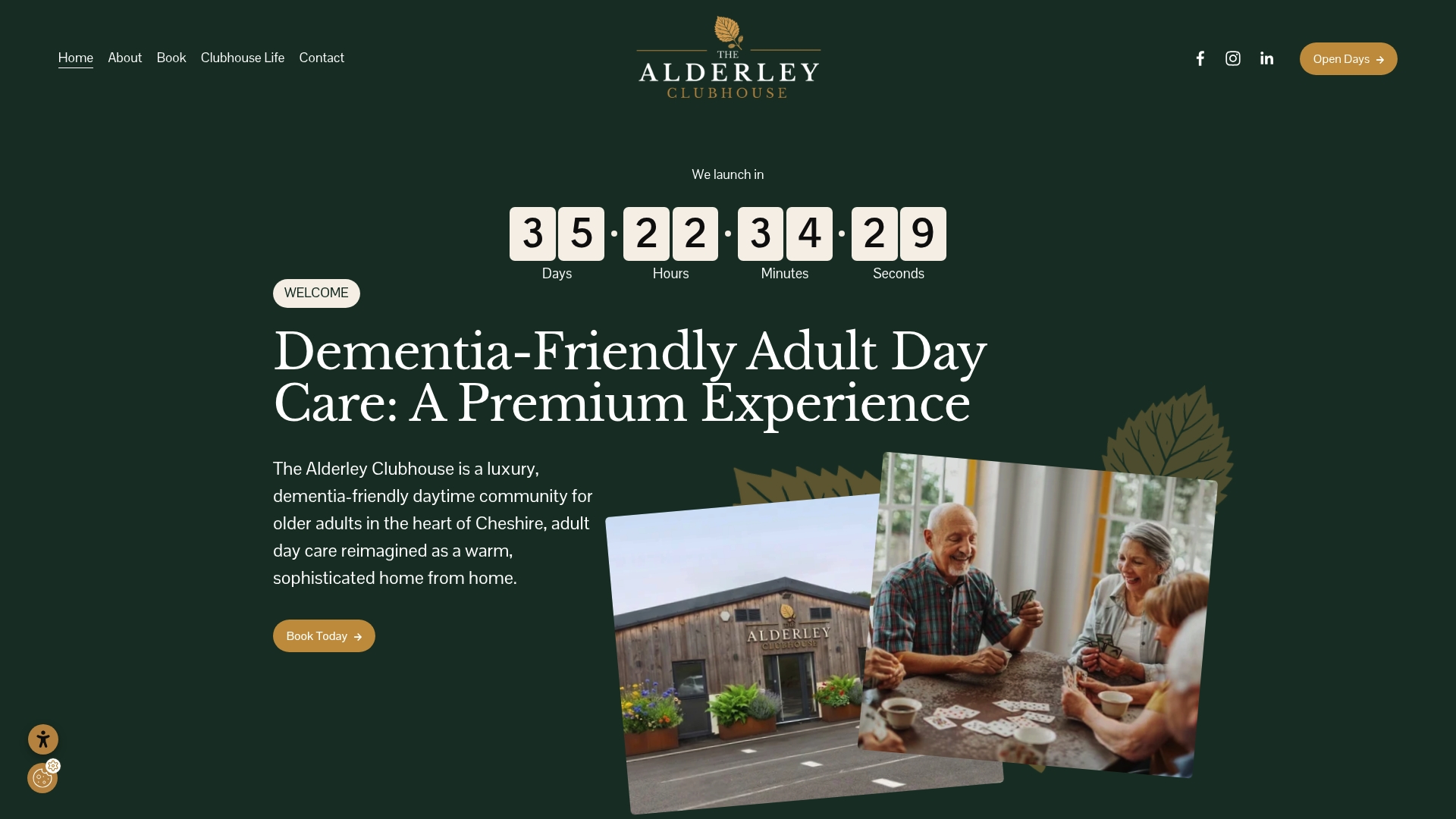
This is not a replacement for the routine you've built at home. It's reinforcement. Bring your day map with you, or talk it through with our team, and we'll shape the day around the same anchors you already rely on, so your loved one arrives home into a familiar rhythm rather than a jarring change. Attendance stays capped at 35 members, so the day never feels overwhelming or anonymous.
If this sounds like the kind of dependable structure your week is missing, book a Day Pass or arrange a welcome tour first to see the building and meet the team before committing to anything.
Sources
- A systematic review and meta-analysis of nonpharmacological interventions for moderate to severe dementia
- Understanding and supporting a person with dementia (Alzheimer's Society)
- Coping with distress: calming techniques for a person with dementia (Oxford Health NHS Foundation Trust)
- Dementia UK
This article is general information, not a substitute for advice from a qualified doctor. Consult a qualified healthcare professional about your own circumstances before acting on anything here.
FAQ
What is the best daily routine for someone with dementia?
The best routine is not a fixed template but three consistent anchors, morning, meals and hydration, and evening calm, each written as a short five to seven step day map. Alzheimer's Society guidance confirms there is no single routine that suits everyone; it should reflect the person's own life history and current abilities.
What is the average life expectancy for people with aggressive dementia?
Life expectancy varies enormously depending on the type of dementia, age at diagnosis and overall health, so there is no single reliable figure to quote here. Speak with a GP or specialist dementia service for guidance specific to the individual, and DementiaUK offers further stage-based support for families navigating this.
What are the 6 C's of dementia care?
Definitions of the "6 C's" vary between training programmes and are not a single standardised clinical framework, so we won't state a fixed list here. If you've seen this term used by a specific care provider or course, ask them directly for their definitions rather than relying on a generic version.
What is the 90 second rule for dementia patients?
This is not a term used in NHS or Alzheimer's Society clinical guidance, and definitions circulating online vary widely, so we can't confirm a single agreed meaning. If a care professional has mentioned it to you directly, ask them to explain the specific technique they mean.
How much does a day pass at The Alderley Clubhouse cost?
Current pricing for a Day Pass Membership is available on the booking page, where you can also check availability and arrange a first visit.