

Offer a drink every one to two hours, keep it small and varied, and note the colour of urine at least once a day. Those three habits, done consistently, are the most effective things you can do right now to reduce dehydration risk in someone living with dementia. The Alzheimer's Society confirms that even mild dehydration can worsen cognitive function, which means a simple cup of tea or a bowl of soup genuinely matters.
Start today with these actions:
- Place a visible, filled drink within easy reach at all times.
- Sit down and drink together — shared moments encourage sipping.
- Offer a favourite warm drink, a cold flavoured water, or a Jelly Drop if plain water is refused.
- Note urine frequency and colour once a day (pale yellow is the target).
- Keep a simple tally of cups offered and accepted.
Seek urgent help immediately if you notice: sudden severe confusion or collapse, very little or no urine output, rapid heartbeat, or shortness of breath. Call 999, NHS 111, or your GP without delay. These are red-flag signs that need medical attention, not home management.
Key takeaways
Consistent, small-volume fluid intake offered frequently, monitored daily, and adjusted for medical complexity is the most effective approach to managing hydration in someone living with dementia.
| Point | Details |
|---|---|
| Offer drinks little and often | Small amounts every one to two hours are more effective than large volumes infrequently. |
| All fluids count | Tea, soup, milky drinks, and water-rich foods all contribute — variety helps when plain water is refused. |
| Watch for acute change | Sudden confusion or reduced urine output may be dehydration, not progression — trial small sips and monitor closely. |
| Personalise for medical conditions | Heart failure or kidney disease may require a specific fluid target agreed with the GP or specialist team. |
| Escalate promptly | Contact NHS 111 or your GP if the person passes little urine for eight hours or shows severe signs; call 999 for collapse or loss of consciousness. |
Table of Contents
- Why hydration and dementia are so closely linked
- How to spot dehydration in someone with dementia
- Everyday strategies to help someone with dementia drink enough
- Managing swallowing difficulties safely
- When "drink more" needs to be balanced with medical conditions
- Simple monitoring checks you can do at home
- Hydration near the end of life
- What the evidence and UK guidance say
- A perspective from The Alderley Clubhouse on everyday hydration practice
- See hydration care in action at The Alderley Clubhouse
- Where to read more: trusted UK guidance and resources
- Sources
Why hydration and dementia are so closely linked
People living with dementia face a combination of physical and cognitive barriers that make dehydration far more likely than in the general older population.
Physiological factors play a significant role. The thirst sensation weakens with age, so an older person may genuinely not feel thirsty even when their body needs fluid. Total body water decreases as we age, and the kidneys become less efficient at conserving water, meaning the margin between adequate and inadequate intake narrows considerably.
Cognitive and behavioural factors add another layer of difficulty. A person with dementia may forget they have not drunk anything since breakfast, fail to recognise a cup as something to drink from, or become too apathetic or agitated to respond to a drink being offered. Wandering and restlessness also increase fluid loss through perspiration without any compensating intake.
Practical barriers compound the problem further. Painful or ill-fitting dentures make drinking uncomfortable. Swallowing difficulties (dysphagia) create fear around liquids. Reduced mobility means a person may not be able to reach a drink independently. Some medications, including diuretics and certain antipsychotics, alter fluid balance directly. Social isolation removes the natural cue of drinking alongside others.
Acute dehydration in someone with dementia can look almost identical to a sudden step-change in the condition itself. Increased confusion, agitation, or sleepiness that appears over hours or a day or two — rather than weeks — should prompt you to check fluid intake before assuming the dementia has progressed. A trial of small, frequent sips and close observation over a few hours can be genuinely revealing.
Dementia UK notes that this kind of acute change is one of the most commonly missed signals in home care settings.
How to spot dehydration in someone with dementia
Recognising dehydration early is harder when the person cannot reliably report how they feel. Grading signs by severity helps you respond proportionately.
Mild to moderate signs
- Dry or sticky mouth and lips
- Reduced urine frequency (fewer than three times in a day)
- Darker urine (amber or deeper)
- Constipation or reduced bowel movements
- Headache or complaints of head pain
- Increased confusion, restlessness, or irritability beyond their usual baseline
- Fatigue, dizziness, or unsteadiness
Severe signs requiring urgent attention
- Sudden delirium or extreme disorientation
- Very little or no urine output over several hours
- Rapid heartbeat or low blood pressure
- Fainting or near-fainting
- Extreme lethargy or altered consciousness
Distinguishing dehydration from dementia progression
The key question is: has this changed acutely? Dementia progression is gradual, measured in weeks and months. Dehydration-driven deterioration tends to appear over hours or a day or two, often following a recent illness (vomiting, diarrhoea, or fever), a hot spell, or a period of reduced intake. A quick response to small volumes of fluid — the person becomes a little more alert or settled within an hour or two — is a strong clue that dehydration, not permanent decline, is driving the change.
Urine colour is one of the most practical monitoring tools available. A urine colour chart from Hertfordshire County Council is freely downloadable and worth printing for a bathroom or care folder. Pale straw yellow (shades 1–3 on a standard chart) indicates good hydration; amber or darker (shades 4–8) signals a need to increase fluid intake promptly.
A note on the evidence: A prospective cohort study published on PubMed found that higher serum osmolarity (a marker of poorer physiological hydration) was associated with greater decline in global cognitive function over two years in older adults with metabolic syndrome. The association was statistically significant (β: -0.010; 95% CI -0.017 to -0.004, p=0.002), though the population was specific and the design observational. The finding supports the clinical principle that keeping someone well hydrated protects cognitive function, even if it cannot prove causation alone.
Everyday strategies to help someone with dementia drink enough
The goal is to make drinking easy, pleasant, and frequent — not a chore or a confrontation.
What to offer
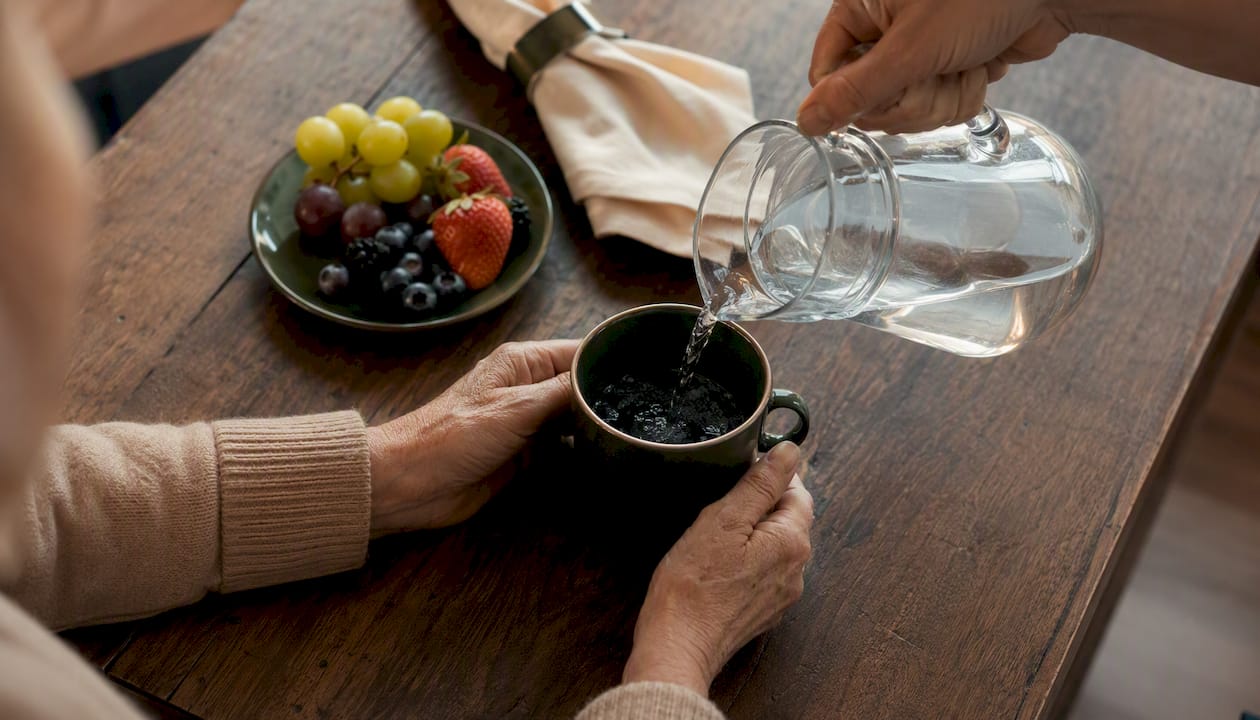
All fluids count towards daily intake, with the exception of alcohol. This is a point the Alzheimer's Society makes clearly, and it is liberating for carers who worry that tea or coffee "don't count." They do. Offer:
- Tea, coffee, and milky drinks (including hot chocolate and malted drinks)
- Water, squash, and fruit juices
- Soups, broths, and warm drinks
- Smoothies, milkshakes, and yoghurt drinks
- Water-rich foods: cucumber, melon, strawberries, jelly, yoghurt, and porridge
How to serve drinks
- Offer small amounts frequently rather than large volumes infrequently.
- Use brightly coloured or clear cups so the drink is easy to see and identify.
- Choose weighted or easy-grip vessels that are stable and comfortable to hold.
- Offer a straw if the person finds lifting a cup difficult.
- Place the drink directly in front of the person at eye level.
- Sit down and drink alongside them — this is one of the most effective prompts of all.
Building hydration into the daily routine
Link drinks to activities that already happen: a cup of tea after the morning wash, a glass of squash with each snack, a warm drink at medication time. Visual prompts help too — a brightly coloured jug on the kitchen table is a reminder in itself. Shared social drinking, whether a mid-morning coffee or an afternoon cuppa, works because it removes the clinical feel and replaces it with something enjoyable.
Practical tools worth knowing about:
- Jelly Drops® — small, water-based sweets designed specifically for people who struggle to drink. Dementia UK lists them as a useful option, and many carers find them accepted readily when a cup is refused.
- Bottles with measurement markings help you track intake at a glance.
- Small measured beakers (100–150 ml) make frequent top-ups feel manageable rather than overwhelming.
- Cold flavoured waters, particularly lemon or cucumber infusions, are often more appealing than plain water.
Pro Tip: Keep a simple tally sheet on the fridge — a row of boxes, one per drink offered. Tick when accepted, circle when refused. After a week you will see patterns: which drinks are accepted, which times of day work best, and whether intake is genuinely improving.
For carers thinking about why hydration matters more in summer, seasonal adjustments — cooler drinks, more frequent prompts, water-rich foods at mealtimes — are worth planning ahead.
Managing swallowing difficulties safely
Dysphagia (difficulty swallowing) is common in dementia, particularly in moderate to advanced stages, and it changes how you approach hydration entirely.
Signs that swallowing may be a problem:
- Coughing or choking during or after drinks
- A wet or gurgling voice after swallowing
- Repeated chest infections without a clear cause
- Unexplained weight loss or reluctance to eat and drink
- Food or drink dribbling from the mouth
If you notice any of these, do not simply encourage more drinking. Thin fluids can be aspirated into the lungs, causing aspiration pneumonia, which is serious. The right response is to seek a referral.
Immediate steps at home while awaiting assessment:
- Keep the person upright during and for at least 30 minutes after drinks.
- Offer small sips rather than large mouthfuls.
- Never rush a drink or apply pressure to swallow faster.
- Do not thicken fluids yourself unless a Speech and Language Therapist (SALT) has specifically advised a texture and shown you how.
- Supervise all drinks and meals until the assessment is complete.
Referring to a SALT: Ask the GP to refer the person for a SALT assessment. When you make contact, bring notes on specific incidents (dates, what happened, what was being drunk), any recent weight changes, and examples of which foods and drinks cause problems. SALT specialists can advise on texture modification, safe cup types, and positioning — a proper assessment opens up options rather than closing them down.
Swallowing difficulties do not mean someone must go without adequate fluids. A SALT assessment often reveals safe strategies that carers would not have found on their own — modified textures, specific cup designs, or positional changes that make drinking both safer and more comfortable.
When "drink more" needs to be balanced with medical conditions
For most people with dementia, encouraging more fluid is straightforwardly helpful. For some, it requires careful thought.
Clinical situations where hydration targets need personalising:
- Heart failure: excess fluid can worsen breathlessness and oedema. Fluid intake may be restricted to a specific daily volume set by the cardiology or heart failure team.
- Advanced kidney disease: impaired kidneys cannot excrete excess fluid or electrolytes efficiently, so both overhydration and dehydration carry real risks.
- Hyponatraemia risk: drinking very large volumes of plain water without adequate electrolytes can dilute sodium levels dangerously, particularly in people on certain medications.
- Diuretics: these increase urine output and can accelerate dehydration, but the dose is usually set for a reason — do not reduce them without medical advice.
Monitoring daily weight and checking for swollen ankles or legs (peripheral oedema) gives useful information about fluid balance. A sudden weight gain of 1–2 kg over a day or two in someone with heart failure warrants a call to the GP or heart failure nurse.
The ESPEN 2024 guideline is clear that hydration plans in dementia should be individualised. A blanket instruction to "drink more" is not appropriate for everyone — the right target depends on the person's medical history, current medications, and clinical status.
What to bring to a GP or specialist appointment:
- A list of current medications (including over-the-counter items)
- A recent fluid intake record (even a rough tally is useful)
- Notes on urine frequency and colour
- Any recent weight changes
- SALT recommendations if dysphagia has been assessed
Work with the GP, heart failure team, or renal service to agree a personalised daily fluid target. That figure, written down and shared with everyone involved in the person's care, is far more useful than a general rule.
Simple monitoring checks you can do at home
Consistent, low-effort monitoring catches problems early. You do not need clinical equipment — just a routine.
Daily monitoring checklist:
- Check urine colour at least once (use a printed colour chart).
- Count the number of times the person passes urine (fewer than three times suggests low intake).
- Tally drinks offered and accepted.
- Check lips and mouth for dryness.
- Note any change in alertness, mood, or behaviour from their usual baseline.
Weekly checks (where appropriate):
- Weigh the person at the same time of day, on the same scales, in similar clothing. Rapid weight loss (more than 1–2 kg in a week) can indicate dehydration; rapid gain may suggest fluid retention.
- Review the week's fluid tally and identify patterns.
| Monitoring check | What to look for | When to escalate |
|---|---|---|
| Urine colour | Pale straw yellow (shades 1–3) | Amber or darker on two consecutive checks |
| Urine frequency | At least 3 times per day | Fewer than 3 times, or none in 8 hours |
| Daily fluid tally | Consistent intake across the day | Persistent refusal or less than half usual intake |
| Mouth and lips | Moist, comfortable | Dry, cracked, or sticky |
| Weight (weekly) | Stable within 1–2 kg | Loss or gain of more than 2 kg in a week |
When to call for help: Contact NHS 111 or your GP if the person has passed little or no urine for eight hours, appears suddenly more confused than usual, has a dry mouth alongside a rapid pulse, or has not accepted any fluid for more than 12 hours. Call 999 if they lose consciousness, collapse, or show signs of severe distress.
The NHS dehydration guidance sets out these escalation steps clearly and is worth bookmarking as a reference.
Hydration near the end of life
When dementia reaches its advanced stages, the goals of care shift. Comfort and dignity take priority over clinical targets, and this changes how we think about hydration entirely.
Comfort-focused principles:
- Small sips of a favourite drink, offered gently and without pressure, can bring real pleasure even when intake is minimal.
- Mouth care — moistening lips and the inside of the mouth with a damp sponge or mouth swab — relieves the discomfort of dryness even when swallowing is no longer safe.
- Ice chips or frozen fruit pieces can be soothing and are often accepted when drinks are not.
- Never force fluids. Aspiration risk increases significantly in the final stages, and distress caused by forced drinking outweighs any benefit.
Artificial hydration (drip or tube feeding): Intravenous or enteral hydration is rarely appropriate in advanced or terminal dementia. The ESPEN 2024 guideline frames these decisions within an individualised, goals-of-care approach. Clinical evidence does not support routine artificial hydration in the final stages of dementia, and it can cause discomfort (oedema, respiratory secretions) without extending meaningful quality of life.
Families often feel that not providing a drip means "giving up." It does not. Skilled mouth care, gentle sips, and a calm, loving presence are active, compassionate care. Involving the GP or palliative care team early means these conversations happen with support, not in a crisis.
If you are unsure about what is appropriate, ask the GP for a referral to the community palliative care team. They are experienced in supporting families through exactly these decisions, and their guidance is both practical and compassionate.
What the evidence and UK guidance say
The evidence base for hydration in dementia is growing, though much of it remains observational. Here is what the current guidance and research actually support.
ESPEN 2024 recommends that all care settings treating people with dementia adopt written care plans with standard operating procedures for hydration, routine screening for dehydration risk, and individualised fluid targets. The guideline notes that most of its 40 recommendations are good practice points rather than high-grade evidence, reflecting the limited number of high-quality trials in this population — but the clinical rationale is sound and the recommendations are widely endorsed.
NHS and charity guidance (Alzheimer's Society and Dementia UK) converge on the same practical message: all fluids count, small and frequent is better than large and infrequent, and carers should watch for acute changes in behaviour as a dehydration signal rather than assuming progression.
- A prospective cohort study in older adults with metabolic syndrome found that poorer physiological hydration (higher serum osmolarity) was associated with greater cognitive decline over two years. Fluid intake measured by self-report was less clearly predictive, suggesting that actual hydration status matters more than the volume drunk.
- A small observational study in a geriatric facility found a positive association between higher fluid intake per lean body mass and improvement in MMSE scores, particularly when intake was below a defined threshold. The sample was small (a small group of participants) and the design cannot prove causation, but the direction of the finding is consistent with broader clinical experience.
- Emerging mechanistic research suggests dehydration may influence amyloid accumulation and vascular health, though this work remains largely preclinical.
Safe inferences for carers:
- Keeping someone well hydrated is supported by both clinical guidance and emerging evidence.
- Physiological hydration status (what the body is actually doing) matters more than a fixed daily volume target.
- Overhydration carries its own risks, particularly in people with heart failure or kidney disease.
- Routine monitoring is more useful than a single daily "big drink."
A perspective from The Alderley Clubhouse on everyday hydration practice
Hydration is one of those things that sounds straightforward until you are actually caring for someone with dementia. Then you realise how many small decisions it involves, and how much the environment and routine matter.
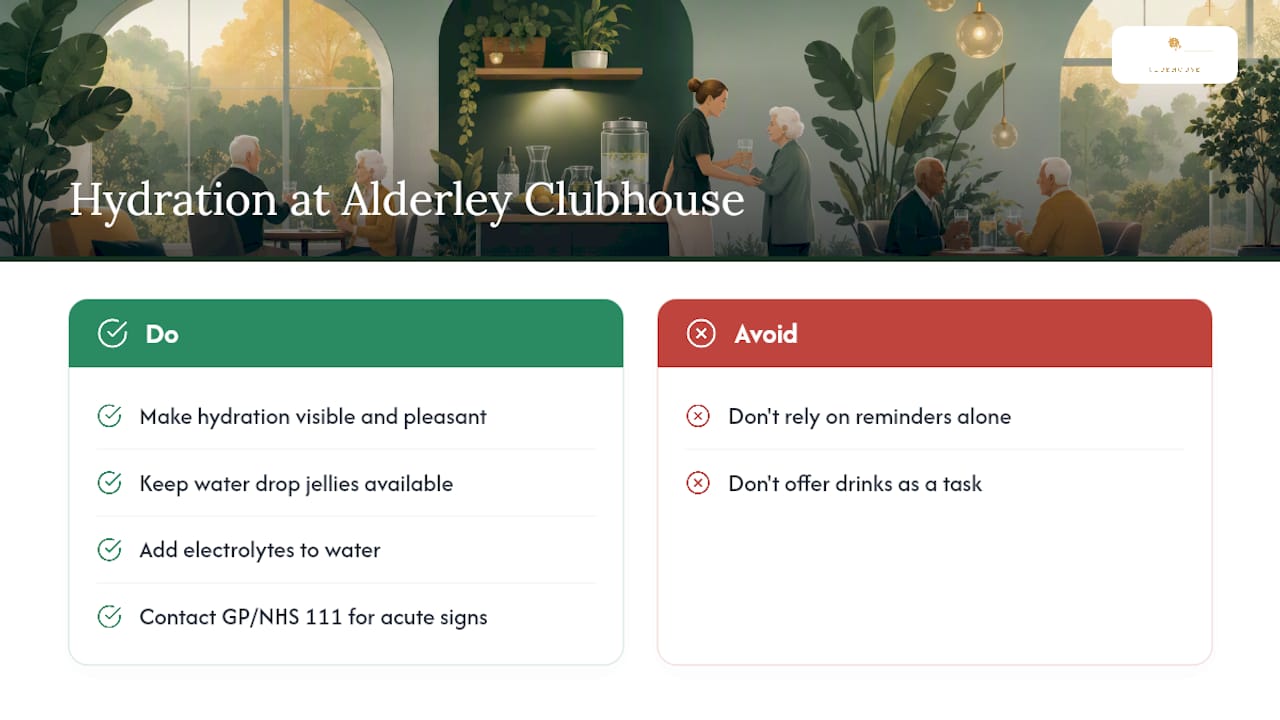
At The Alderley Clubhouse, we have made hydration a permanent, visible part of the day rather than something that happens when someone remembers to offer a drink. Our hydration stations are always stocked with chilled lemon and cucumber water, and both stations have added electrolytes to support better nutrient absorption. The water is cold, it looks appealing, and it is simply there — which means members reach for it naturally during conversation or activity. We also keep water drop jellies available for members who find drinking from a cup difficult or unappealing. They are accepted readily, they contribute meaningfully to daily fluid intake, and they remove the pressure that can make mealtimes and drink times stressful.
What families can take from this approach is less about the specific products and more about the principle: make hydration visible, pleasant, and social. A jug of cold flavoured water on the kitchen table is more effective than a reminder to drink. A shared cup of tea mid-morning is more effective than a clinical prompt. Staff at the Clubhouse are trained to offer drinks as part of conversation, not as a task — "shall we have a cuppa?" rather than "you need to drink more."
The moment to move from these gentle strategies to clinical escalation is when the person shows signs of acute deterioration: sudden confusion, very dark urine, or refusal of all fluids for more than a few hours. At that point, contact the GP or NHS 111 rather than trying to manage it with more prompting.
See hydration care in action at The Alderley Clubhouse
If you are supporting someone with dementia and finding hydration a daily challenge, we would love to show you how we approach it. The Alderley Clubhouse in Cheshire is a premium dementia-friendly day club where hydration is woven into every part of the day — from our electrolyte water stations to our chef-prepared menus featuring water-rich foods and nourishing drinks.
Every member is known by name, every day is structured around their comfort and wellbeing, and every detail — including what they drink and when — is attended to with genuine care. Book a welcome tour to see our facilities and routines in person, or secure a day pass to give your loved one a trial visit. We are here to support you both.
Where to read more: trusted UK guidance and resources
These are the sources we return to most often, and the ones we recommend to families and professionals alike.
- Alzheimer's Society: Drinking, hydration and dementia — practical tips on what to offer, how to present drinks, and why even mild dehydration affects cognition. A good starting point for family carers.
- Dementia UK: Dementia and dehydration — covers causes, severity-graded signs, and caregiver strategies including Jelly Drops. Their Admiral Nurses helpline (0800 888 6678) offers free specialist dementia nursing advice.
- NHS: Dehydration — clear escalation guidance on when to call NHS 111 or 999, and first-line actions for mild dehydration.
- ESPEN 2024 guideline on nutrition and hydration in dementia — the most current European clinical guideline; relevant for care home managers, GPs, and healthcare professionals designing care plans.
- Urine colour chart (Hertfordshire County Council) — a free, printable chart for home or care setting use. Print it and put it somewhere visible.
- NHS 111 — call 111 any time for non-emergency guidance on dehydration signs or when you are unsure whether to seek urgent help.
This article provides general information for carers and is not a substitute for professional medical advice. Always consult a GP, specialist, or qualified health professional for guidance specific to the person in your care.