
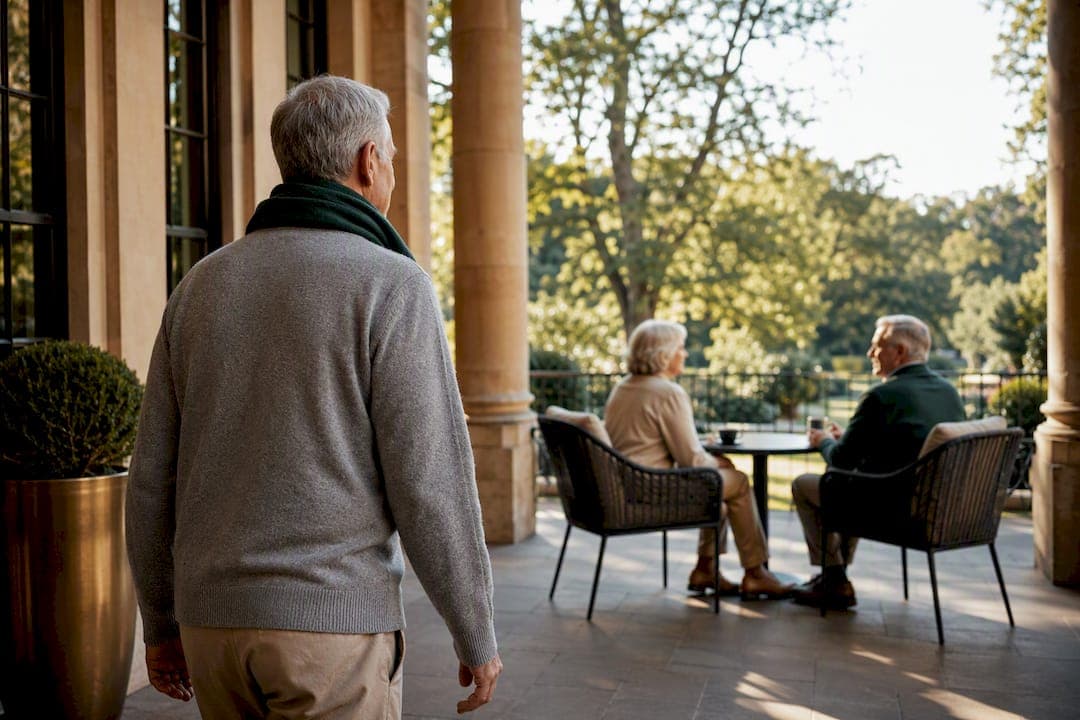
Loneliness and social isolation are consistently linked with a higher risk of dementia and with faster cognitive decline once someone has been diagnosed. A large pooled analysis coordinated with the National Institute on Aging found loneliness raised all-cause dementia risk by around 31%. The key distinction to understand is that loneliness (how someone feels) and social isolation (how much contact they actually have) are not the same thing, and they don't affect the brain in quite the same way. If someone you care for seems withdrawn or increasingly alone, that's worth acting on, not waiting out.
TL;DR:
- Loneliness increases dementia risk by around 31%, but social isolation affects brain structure independently, with a hazard ratio of approximately 1.26.
- Addressing loneliness requires repeated assessments over time, as fluctuations can influence cognitive decline and indicate emerging issues.
- Interventions like cognitive stimulation therapy and structured social programs that emphasize routine and sustained engagement show the most evidence-based benefits.
- Most people with dementia, especially from certain groups like those living alone or with early-onset, experience loneliness or social isolation that tends to worsen without intervention.
- Practical care steps include asking about social contact regularly, prioritizing quality over quantity in visits, and using social prescribing or day programs tailored to individual needs.
Table of Contents
- What does the strongest dementia and loneliness research show?
- Loneliness vs social isolation: why the difference matters
- How common is loneliness among people with dementia?
- How does loneliness affect cognitive decline and brain health?
- What actually helps? Interventions with real evidence behind them
- How a structured day programme puts the evidence into practice
- What can carers do today to ease loneliness?
- Where to find trusted information and support
- Why the usual advice on dementia and loneliness misses the point
- A day programme built around connection, not just supervision
- Sources
What does the strongest dementia and loneliness research show?
The most persuasive evidence comes from studies that followed thousands of people over many years, rather than snapshots taken at a single point in time. That matters, because loneliness can fluctuate, and only repeated measurement shows whether it's a lasting pattern or a passing phase.
Statistic: The pooled analysis coordinated with the NIA, drawing on more than 600,000 participants across multiple cohorts, found loneliness was linked to roughly a 31% increase in dementia risk, with some analyses showing raised risk specifically for Alzheimer's and vascular dementia.
Separately, UK Biobank analysis published in Neurology looked at social isolation rather than loneliness and found it carried its own, independent risk. After adjusting for other factors, socially isolated participants had an adjusted hazard ratio of around 1.26 for later dementia. Loneliness, once depressive symptoms were accounted for, showed a weaker association. That single detail reshapes how we should think about this:
- Social isolation appears to act partly through changes in brain structure, independent of mood.
- Loneliness's link to dementia risk seems to run largely through depression.
- Both are worth monitoring, but they may need different responses.
None of this proves loneliness or isolation directly cause dementia. These are observational studies, so confounding factors (existing poor health, early undiagnosed cognitive change, or social withdrawal as an early symptom rather than a cause) can't be fully ruled out. Measurement also varies between studies, which is why researchers increasingly call for repeated assessments over time rather than one-off questionnaires.
Loneliness vs social isolation: why the difference matters
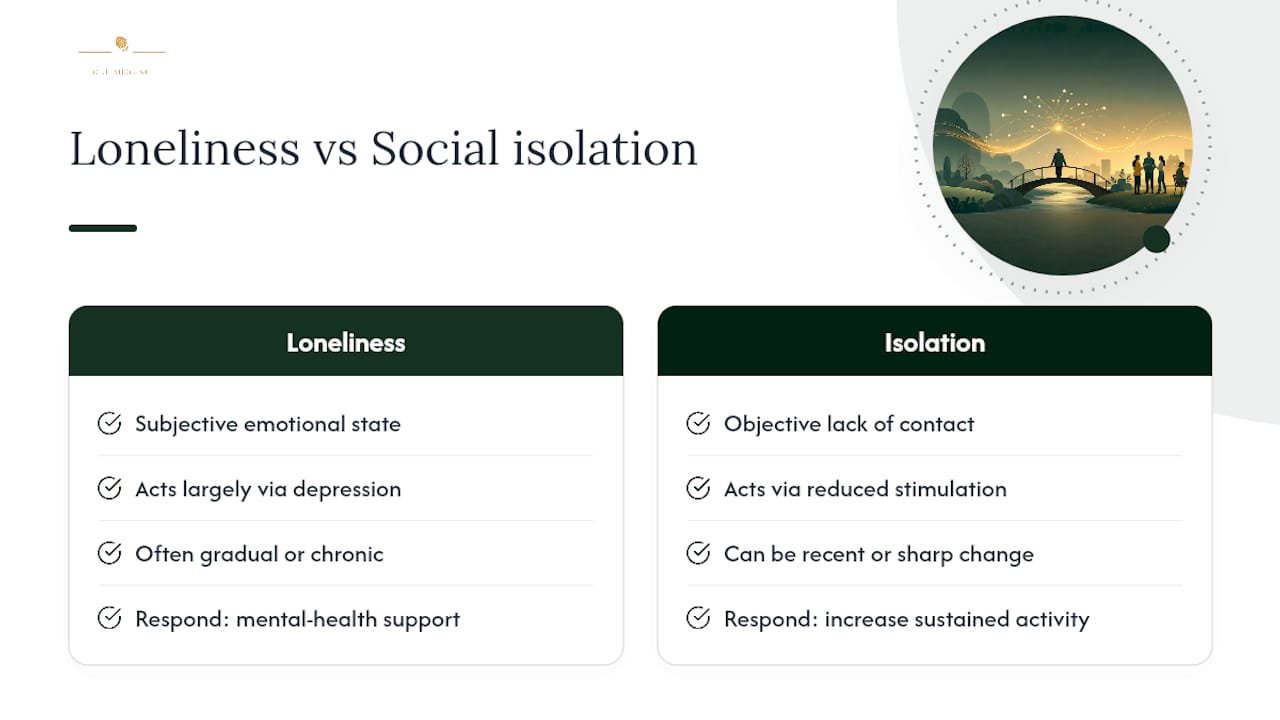
Loneliness is subjective. It's the gap between the social contact someone wants and what they actually get, and you can feel lonely in a room full of people. Social isolation is objective. It's about the actual size and frequency of someone's social contacts, regardless of how they feel about it. A person can be socially isolated and perfectly content, or surrounded by family and still deeply lonely.
The mechanisms linking each to dementia differ too:
- Loneliness tends to drive risk through depression, chronic stress hormones, and reduced motivation to stay physically active.
- Social isolation reduces the sheer volume of cognitive stimulation a brain receives daily, conversation, problem solving, following group discussion.
- Both can contribute to inflammation and cardiovascular risk, which independently affect brain health.
- Isolation shows a link to lower grey matter volumes in temporal and hippocampal regions, areas central to memory.
Pro Tip: Don't assume a person living alone is lonely, or that someone in a busy household isn't. Ask directly, gently, and more than once, because the honest answer often takes a second conversation.
How common is loneliness among people with dementia?
Loneliness among people with dementia isn't a minority experience. It's close to the norm, and it tends to worsen rather than improve without intervention.
Statistic: The IDEAL programme, a UK cohort study following people with mild-to-moderate dementia, found a substantial proportion were lonely and socially isolated at the outset, with these levels increasing after 24 months.
That upward drift over just two years tells you this rarely resolves on its own. At population level, the World Health Organization estimates around one in ten older adults experience loneliness, and roughly one in four are socially isolated in some datasets, well below the rates seen among people living with dementia specifically. Certain groups face higher risk:
- People living alone, especially after a spouse's death or move into unfamiliar accommodation.
- Those with depressive symptoms alongside their dementia diagnosis.
- People with smaller social networks before diagnosis.
- Those in neighbourhoods with lower perceived trust, which the IDEAL programme found predicted worsening loneliness over time.
- People with younger-onset dementia, who often lose peer networks and workplace contact earlier than expected, leaving a social gap most support services aren't designed for.
How does loneliness affect cognitive decline and brain health?
The clearest signal comes from electronic health record data, which lets researchers track cognitive scores over time rather than relying on a single test. A retrospective cohort study using natural language processing found patients recorded as lonely had MoCA (Montreal Cognitive Assessment) scores 0.83 points lower at the point of diagnosis than those who weren't. Socially isolated patients showed something different: a faster rate of decline, around 0.21 MoCA points per year, concentrated in the six months immediately before diagnosis.
That timing detail matters for anyone managing a loved one's care. A sudden, rapid drop in someone's day-to-day sharpness in the months leading up to diagnosis may be linked to isolation rather than the disease process alone.
Clinicians who responded to early documented reports of loneliness or isolation, by arranging contact or referral, sometimes saw a temporary stabilisation in cognitive scores. Assessment itself can be an intervention point, not just a measurement.
Practical implications for anyone involved in ongoing care:
- Ask about social contact at every routine review, not just at diagnosis.
- Treat a sudden change in social contact as a flag worth raising with a GP.
- Consider social prescribing as a referral route where available, alongside any medical review.
What actually helps? Interventions with real evidence behind them
Cognitive Stimulation Therapy (CST) has the strongest backing of any non-drug intervention for people with mild-to-moderate dementia. NICE recommends CST specifically because structured group sessions, run by trained facilitators, support both cognition and social engagement at the same time, addressing two problems in one activity rather than treating them separately.
Beyond CST, several other approaches show promise, though the evidence base is thinner:
- Structured social programmes with regular attendance and consistent group membership tend to outperform occasional drop-in contact.
- Befriending schemes show modest benefits, particularly when matched carefully and sustained over months rather than weeks.
- Social prescribing, where a GP refers someone into community activities, is gaining traction but has fewer large-scale trials specific to dementia.
- CBT-based approaches targeting the negative thought patterns that often accompany chronic loneliness show benefit in broader reviews of older adults, though dementia-specific trials remain limited.
Pro Tip: A single weekly visit rarely shifts loneliness on its own. The interventions that show the most consistent benefit combine structured activity, cognitive engagement and some form of psychological support, delivered regularly enough to become routine.
The honest caveat: trial quality varies, effect sizes are often modest, and what works for one person may not suit another. Tailoring and consistency matter more than the specific activity chosen.
How a structured day programme puts the evidence into practice
We designed The Alderley Clubhouse around exactly this evidence base, so it's worth being upfront: this is our own service, not a neutral comparison of providers. We think it illustrates the research well.
In practice: Our care team is trained to deliver CST, the only non-drug therapy NICE recommends for mild-to-moderate dementia, within a capped group of no more than 35 members a day.
Elements that map directly onto what the research points to:
- CST sessions led by trained staff, not occasional or ad hoc contact.
- A full day of physical, creative, cognitive and social activity, giving repeated stimulation rather than a single hour of company.
- A purpose-designed, dementia-friendly building that reduces the sensory strain which can otherwise make social settings exhausting.
- Capped daily attendance, so members and staff genuinely know one another by name, addressing the "surrounded but still lonely" problem directly.
We'd add one honest note: no day programme replaces a full clinical picture. It sits alongside, not instead of, GP review and any social prescribing pathway already in place.
What can carers do today to ease loneliness?
Small, consistent steps tend to outperform occasional grand gestures. Here's where to start.
- Assess first. Ask directly and gently whether they feel lonely, and separately, how often they actually see people, since the two answers can differ.
- Prioritise quality over frequency. One properly engaged hour beats three distracted, rushed visits.
- Build routine, not novelty. A regular Tuesday visit or class works better than sporadic outings, because predictability itself is calming.
- Ask the GP about social prescribing or CST referral, particularly if a formal diagnosis is already in place.
- Use respite deliberately, not only when you're exhausted. Planned time apart, spent in structured social settings, benefits both of you.
When talking with someone living with dementia about loneliness, keep questions short and concrete ("Did you enjoy seeing Pat on Tuesday?") rather than abstract ("Do you feel lonely?"). Avoid correcting their sense of time or contact frequency; focus on the feeling behind what they've said.
Pro Tip: A rapid change in mood, withdrawal, or a sudden drop in sharpness over a few weeks is worth flagging to a GP promptly rather than waiting for the next scheduled review.
Our guide to booking day services and this piece on dementia-friendly games both offer more detail on building this into daily life.
Where to find trusted information and support
For deeper reading, start with the original research and established guidance bodies rather than secondary summaries.
- The IDEAL programme findings, best suited to researchers and clinicians wanting cohort-level detail.
- The UK Biobank analysis in Neurology, useful for understanding imaging and hazard-ratio evidence.
- NICE guidance on CST, the clearest reference for clinicians considering referral.
- WHO's brief on social isolation in older people, a good starting point for carers wanting context.
- Accessibility and amenity guidance from AFHCircle, aimed at those assessing care settings.
Why the usual advice on dementia and loneliness misses the point
Most guidance on this topic treats loneliness and social isolation as interchangeable, and that's the biggest gap between what the research shows and what carers are actually told. The evidence doesn't support that. Isolation seems to act through brain structure and reduced stimulation; loneliness seems to act largely through depression. Treating them the same means offering the same fix, more visitors, more phone calls, to two problems that don't always respond to it.
The conventional advice also underplays timing. The EHR data showing accelerated decline in the six months before diagnosis suggests isolation isn't just a slow background risk. It can show up as a sharp, recent change worth investigating now, not managing indefinitely.
What we'd prioritise first, based on everything here: assessment before activity. Find out whether someone is lonely, isolated, both, or neither, before assuming more social contact of any kind will help. Then choose something structured and sustained, whether that's CST, a regular group, or a day programme, over something occasional and well-meant. The research is consistent on this point even where it disagrees on plenty else: consistency beats good intentions.
— Scott @ The Clubhouse
A day programme built around connection, not just supervision
If you've read this far, you're probably weighing up how to get consistent, structured social contact into a loved one's week, not just an occasional visit. The Alderley Clubhouse is built specifically for that gap: a capped, daily community in Nether Alderley, Cheshire, running weekdays from morning until afternoon, longer than most local alternatives.
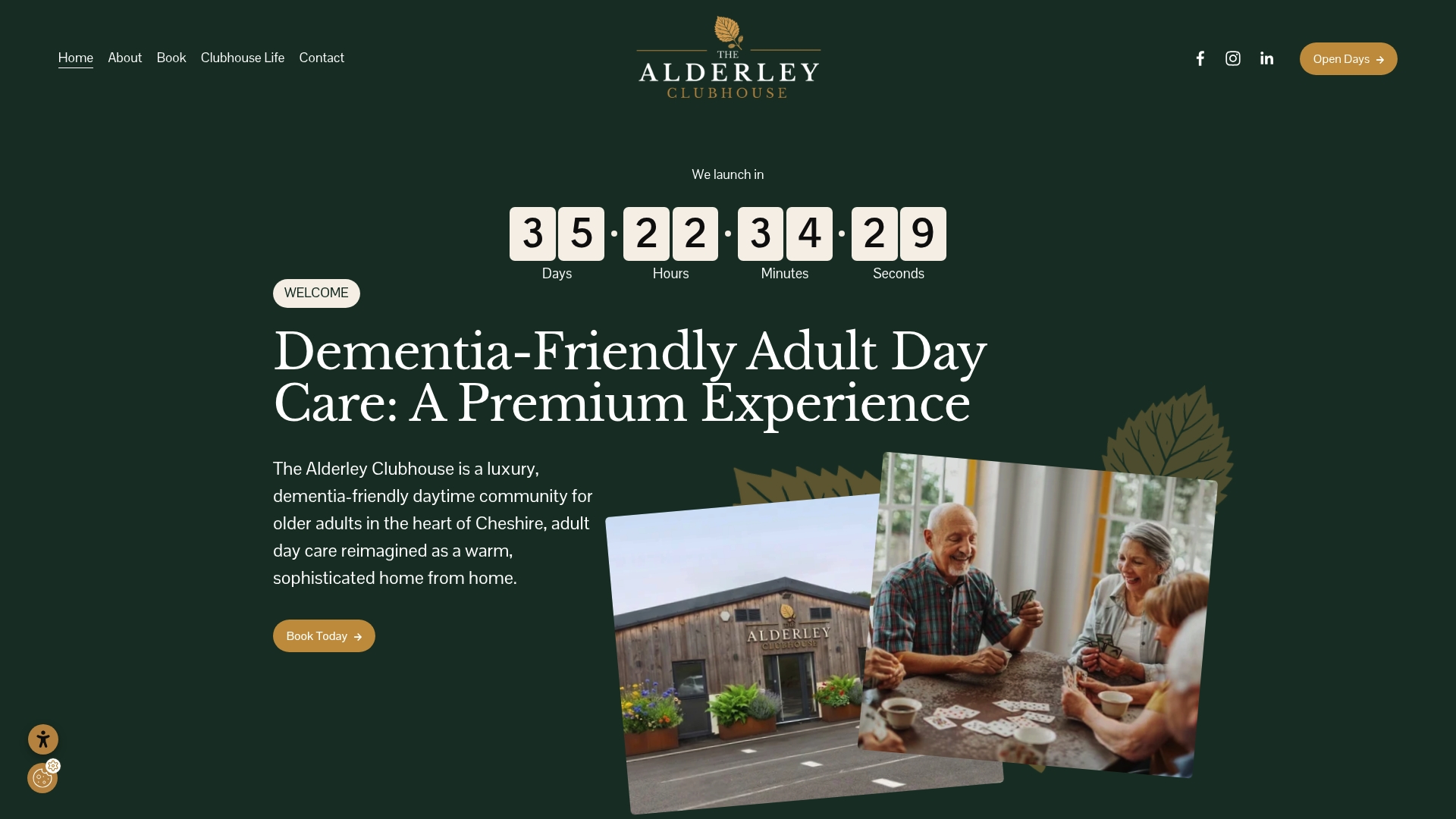
Every day includes breakfast, a cooked two-course lunch, afternoon tea, and a full programme of physical, creative, cognitive and social activity, delivered by trained care staff. Attendance is capped so members are known by name, and family carers receive dependable daytime respite. Day passes pricing and packages are available on the official website. Visit The Alderley Clubhouse to check availability and book a first visit.
This article is general information, not a substitute for advice from a qualified doctor. Consult a qualified healthcare professional about your own circumstances before acting on anything here.
Sources
- Predictors and correlates of loneliness and social isolation in people with dementia: longitudinal findings from the IDEAL programme
- Loneliness linked to dementia risk in large-scale analysis
- Loneliness, social isolation, and effects on cognitive decline in patients with dementia: A retrospective cohort study using natural language processing
- Cognitive stimulation therapy: guidance