
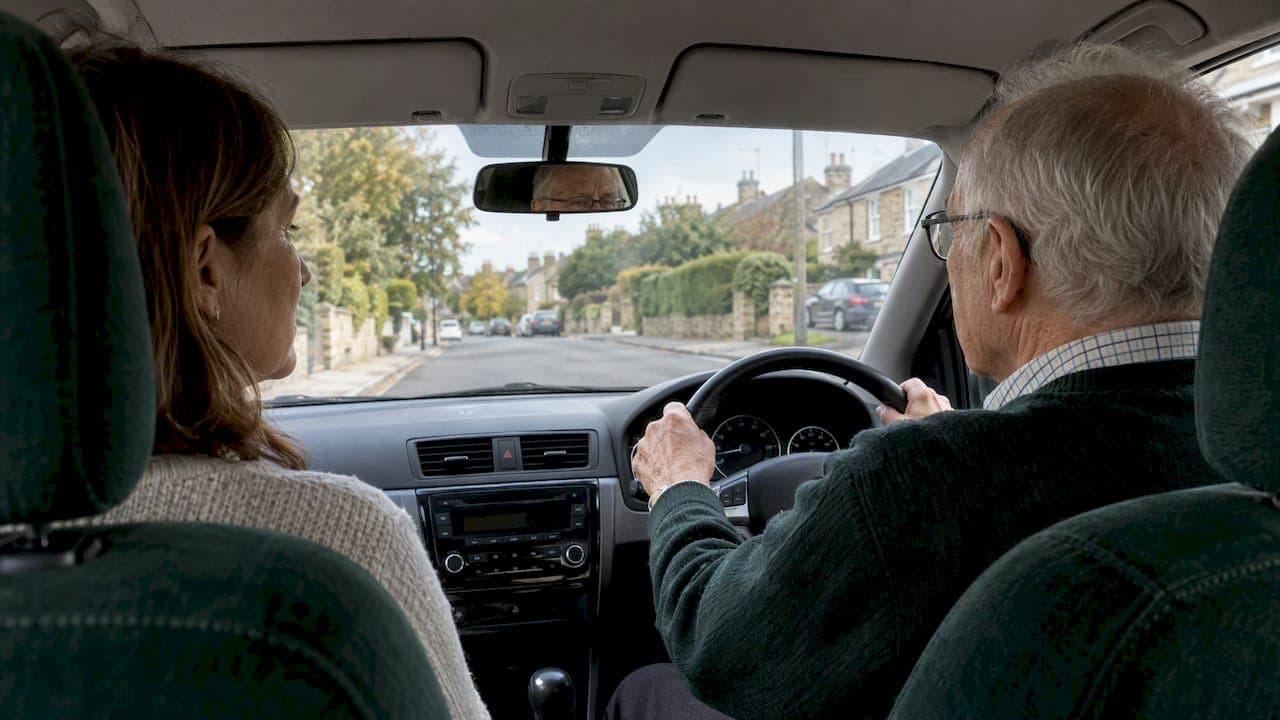
A diagnosis of dementia does not automatically mean giving up driving, but it does mean telling the DVLA. Alzheimer's Society explains that many people can carry on for a time, with regular checks. The decision rests on whether the person can still drive safely, not on the label of the condition. For most families it is one of the hardest conversations they will have, because driving stands for independence, routine and identity.
We are The Alderley Clubhouse, a daytime community for older adults in Nether Alderley, Cheshire. Many of the families we talk to are weighing up this very question. This guide sets out the legal duties in the UK, how fitness to drive is assessed, the warning signs, and how to talk about stopping kindly. It also covers how to keep life full and sociable once the car keys are put away.
Key Takeaways
- A dementia diagnosis does not automatically end driving, but you must tell the DVLA. You can be fined up to £1,000 for failing to report a medical condition that affects driving.
- You must also tell your car insurer straight away, or your insurance may be invalidated.
- The DVLA mostly decides using medical reports. It may also ask for a formal driving assessment.
- Poor short-term memory, disorientation and lack of insight are the signs that most clearly point to unsafe driving.
- Planning alternatives early, and building a full week of activity and company, makes stopping far easier to accept.
Table of Contents
- Can someone with dementia still drive in the UK?
- What you must tell the DVLA, and your insurer
- How fitness to drive is assessed
- Signs that driving may no longer be safe
- Making driving safer while it continues
- When driving has to stop
- Talking about it with someone you love
- Staying independent without the car
- How a day club can fill the gap
- FAQ
- Sources
Can someone with dementia still drive in the UK?
Yes, for a while, and in many cases. People with dementia are not stripped of their licence when they are diagnosed. Alzheimer's Society describes continued driving as possible for many people, as long as it is combined with regular checks on their ability.
What changes is that driving becomes a matter of ongoing review. Dementia affects memory, attention, judgement and reaction time, and it progresses at different speeds in different people. A person with early-stage dementia may drive well on a quiet road they have known for forty years and still struggle with a roundabout in an unfamiliar town. That is why the system relies on individual assessment rather than a blanket rule.
The same Alzheimer's Society guidance recognises that driving is an important source of independence and enjoyment. It also asks the people closest to the driver to stay aware of their skills. That balance is the right starting point for any family: respect what driving means, and keep a steady, calm eye on safety.
What you must tell the DVLA, and your insurer
The legal position is simple. GOV.UK states that you must tell the DVLA if you have dementia. The duty sits with the licence holder. If the person can no longer manage the paperwork, a family member, carer or someone holding power of attorney can often help them through it.
There are real consequences for not doing so:
- You can be fined up to £1,000 if you do not tell the DVLA about a medical condition that affects your driving.
- You may be prosecuted if you are involved in an accident as a result.
Tell your insurer too. Dementia UK advises that people with dementia must inform their car insurance provider immediately, and that failing to do so may invalidate the insurance. This matters for the whole household. If the person is still driving and an accident happens, an invalid policy can mean heavy personal costs and added distress at the worst moment.
What doctors are expected to do
GPs and specialists have a part to play as well. The DVLA's guidance for medical professionals, updated in November 2025, says doctors have a duty to advise patients about how their condition affects driving and about their legal duty to notify the DVLA. If a patient refuses to notify, the doctor may be required to tell the DVLA directly where road safety is at risk.
That can feel like a betrayal to the person concerned. It helps to explain in advance that the doctor is following a professional duty. The guidance reflects the GMC position: doctors owe patients confidentiality, but disclosure can be justified where failing to disclose could expose others to a risk of death or serious harm.
How fitness to drive is assessed
Many families expect a driving test. In practice, the first step is usually paperwork. GOV.UK's guidance on psychiatric disorders and driving explains that fitness to drive is assessed mainly through medical reports, and that a formal driving assessment may be needed.
The DVLA itself acknowledges that this is difficult. Dementia presents in different ways and progresses at different rates, so licensing decisions are usually based on medical evidence rather than a single snapshot.
Once the DVLA has been notified, Dementia UK explains that it may:
- contact the driver's doctor,
- ask for a health check, or
- require a formal driving assessment at one of 20 approved centres across the UK.
Who pays for an assessment
If the DVLA (or the DVA in Northern Ireland) refers someone for an assessment, the agency pays. A person can also arrange an independent assessment themselves, which costs between £70 and £90 on average, according to the same Dementia UK page. Some families find that an independent assessment gives them a neutral, professional view, which takes the pressure off the family and gives the driver a fair chance to show what they can do.
Signs that driving may no longer be safe
The official guidance names the warning signs clearly. In the DVLA's assessment guidance, poor short-term memory, disorientation, and lack of insight and judgement are the features that almost certainly indicate someone is not fit to drive. Disorders of attention also cause impairment.
In everyday life, families tend to notice things like these:
- Getting lost on a familiar route, or arriving somewhere and not knowing why.
- New scrapes or dents on the car that nobody can explain.
- Confusion at junctions, or hesitation about which pedal to use.
- Drifting between lanes, or driving much more slowly than before.
- Becoming angry, anxious or flustered behind the wheel.
- Not seeming to notice any of the above. Lack of insight is one of the most important signs, because the person cannot judge their own driving.
None of these proves anything on its own, and a bad day is not a diagnosis. But a pattern is worth taking seriously. Note down what you see, with dates, and share it with the GP or memory clinic. Specific examples are far easier to act on than a general worry.
Riding along
One gentle way to see what is happening is to travel as a passenger on a normal trip, such as the usual run to the shops. Resist the urge to comment. Just watch. Dementia UK suggests that families can monitor driving, suggest alternatives and go with the person to an assessment, and a quiet ride-along is a natural place to begin.
Making driving safer while it continues
While someone is still cleared to drive, a few simple habits can lower the risks. According to Dementia UK, safety may improve if the person:
- drives in daylight and at quieter times of day,
- sticks to familiar routes and short distances, and
- reduces distractions, such as turning off the radio.
These are sensible, low-key changes that do not feel like losing independence. They also prepare the ground for the day when driving does stop, because the person has already started to rely a little less on the car.
When driving has to stop
According to Dementia UK, a person should stop driving if their doctor says they are unsafe, or if the DVLA (or DVA) requires them to give up their licence. Under GOV.UK rules on medical conditions and driving, you must surrender your licence if:
- your doctor tells you to stop driving for 3 months or more,
- your condition affects safe driving for 3 months or more, or
- you do not meet the required driving standards.
If you disagree with the decision
If the DVLA decides a driver must stop, there is a right of appeal. GOV.UK sets out that in England and Wales you appeal through the local magistrates' court within 6 months. In Scotland, you appeal through the sheriff's court within 21 days. Because the Scottish window is so short, act quickly if that applies to you.

A licence can sometimes be applied for again. The DVLA's letter will say whether you may reapply and whether there is a waiting period first. With a progressive condition like dementia this is less common, but it is worth reading the letter closely.

Talking about it with someone you love
The conversation is usually harder than the paperwork. A few things we have seen help families:
- Choose the moment. Pick a calm time, not straight after a near miss or an argument.
- Start with feelings, not rules. "I know how much driving means to you" opens a door that "You can't drive any more" closes.
- Bring in a third voice. The GP, a memory clinic nurse or an assessor can say what family members cannot. It is the doctor's duty, not your decision.
- Offer something in return. Alone, "stop" feels like a loss. A clear plan for getting about makes it feel like a change.
- Expect more than one conversation. Dementia can affect memory of earlier chats, so repeat gently and patiently without turning it into a fight.
The Alzheimer's Society's guidance on stopping driving after a diagnosis is a helpful companion for these talks. Many people with dementia accept the change better when they feel they have been part of the decision.
Staying independent without the car
Losing the car can shrink a person's world quickly if nothing replaces it. Dementia UK notes that after stopping driving, a person can use a bus pass for free travel or walk, and that planning alternatives ahead helps. Add to that lifts from family and friends, and it is worth sorting these out before the day arrives rather than after.
Think about what the car actually gave them. For many people it is not the driving itself but the things it led to: the weekly shop, meeting friends, the church or club, a reason to get dressed and go out. Replacing those gives the person back what they have really lost.
- Routine. A regular weekday plan gives structure that the car used to provide.
- Company. Loneliness often follows when people stop driving, so regular, familiar faces matter.
- Purpose. Activities that use skills the person still has keep confidence up.
Safety at home matters more too, as the person spends more time there. Our guide to dementia safety at home covers practical steps, and if you worry about someone setting off on foot and getting lost, read about the Herbert Protocol and wandering.
How a day club can fill the gap
This is where our daytime community can help. The Alderley Clubhouse is a private day club for adults aged 50 and over, including people living with mild to moderate dementia. Days run from 9:30am to 4:30pm, Monday to Friday. Each day includes breakfast on arrival, a cooked two-course lunch, traditional afternoon tea and a hydration station that is open all day. There is a full programme of physical, creative, cognitive and social activities, weekly live entertainment, and visiting hairdressing and chiropody. See our facilities and activities for the full picture.
Our care team is trained to deliver Cognitive Stimulation Therapy, which NICE recommends as the only non-drug therapy for mild to moderate dementia. Attendance is capped at 35 members a day, so everyone is known by name. The building is purpose-designed, dementia-friendly and fully accessible, with secure parking and a drop-off point at the door, so there is no need for the member to drive at all.
For a family, a regular day club can mean the weekly outing is still there, with company and a good lunch, while the worry about the road disappears. It also gives family carers a dependable break. If you are considering this, our guide to what to look for in a dementia day centre lists the red flags worth watching for, and our note on day service safety checks is a useful companion.

Try a day with us
A day pass costs £120 per day, including VAT, and a 10-Session Pass gives you ten days for the price of nine. If you would like to see the Clubhouse before deciding anything, you can be our guest for a complimentary taster day, or look at our day pass options.
Our view: stopping driving should not mean stopping living
We meet many families at exactly this crossroads. The car keys are one worry, but underneath it sits a bigger fear: that their parent, husband or wife will slowly lose their place in the world.
Our experience is that people cope with the end of driving far better when something good is waiting on the other side. A familiar face at the door. A table where they are expected. A day with a purpose, good food, music, and people who know their name.
That is why we designed the Clubhouse as we did. We open for a full day, 9:30am to 4:30pm, an hour longer than most local provision, because a short session leaves too much of the day empty. We keep numbers to 35 so nobody is lost in a crowd. Our team is trained in Cognitive Stimulation Therapy, and the setting is relaxed and non-clinical, more like a good club than a care ward.
If you are facing this decision, take it step by step. Talk to the GP, tell the DVLA and your insurer, and then think about what a good week looks like without the car. We would be glad to help you picture it.
Scott @ The Clubhouse
FAQ
Do I have to stop driving as soon as I'm diagnosed with dementia?
No. A diagnosis does not automatically mean you must stop. You must tell the DVLA, which will look at medical evidence and may ask for an assessment before deciding whether you can keep your licence. You should stop if your doctor advises it or the DVLA tells you to.
What happens if I don't tell the DVLA?
You can be fined up to £1,000 for not reporting a medical condition that affects your driving. You may also be prosecuted if you are involved in an accident as a result. Your insurance may be invalid too if your insurer has not been told.
How much does a driving assessment cost?
If the DVLA refers you, it pays. If you arrange an independent assessment yourself, Dementia UK says the average cost is between £70 and £90. Prices vary by centre, so check with the centre when you book.
What can I do if a family member refuses to stop?
Start by involving their GP or memory clinic, as doctors have a duty to advise on driving and can tell the DVLA if road safety is at risk. Offer a ride-along, suggest an independent assessment, and have alternatives ready. Patience and repeated, gentle conversations usually work better than a single confrontation.
Can I appeal if the DVLA takes away my licence?
Yes. In England and Wales you appeal to a magistrates' court within 6 months. In Scotland you go to a sheriff's court within 21 days. Read your DVLA letter, which will also say whether you can reapply later.
Sources
- Dementia and driving, GOV.UK
- Medical conditions, disabilities and driving, GOV.UK
- What DVLA will decide, GOV.UK
- Psychiatric disorders: assessing fitness to drive, GOV.UK
- Assessing fitness to drive: a guide for medical professionals, DVLA
- Driving and dementia, Dementia UK
- How to keep driving after a dementia diagnosis, Alzheimer's Society
- Tips about driving after a dementia diagnosis, Alzheimer's Society