

Safeguarding in a day centre means protecting people's rights, wellbeing and safety through clear written procedures, a named safeguarding lead, up-to-date staff training and prompt reporting to statutory bodies. Get those four elements right and most other safeguarding problems solve themselves. Get them wrong, and even well-meaning staff will freeze when it matters most.
TL;DR:
- Safeguarding relies on clear written procedures, a designated lead, regular staff training, and prompt reporting, as most problems stem from procedural lapses.
- Proactive safeguarding involves noticing behavioral changes or environmental risks early, rather than waiting for obvious signs of abuse or neglect.
- Legally, providers and staff are personally accountable for safeguarding compliance, including timely DBS referrals after dismissals or removals from regulated activities.
- Key policies must be accessible, regularly reviewed, and reinforced through simple training, with staff knowing where to find contact details and procedures instantly.
- Proper recordkeeping, quick escalation, and dynamic risk assessments are essential for preventing harm and maintaining safe, dignified support environments.
Table of Contents
- What safeguarding actually means in an adult day centre
- UK legal and regulatory responsibilities for day-centre providers
- Policies and procedures every day centre must have
- Recognising abuse: types and signs to watch for in your day centre
- Reporting and immediate actions: what to do when a concern arises
- Using risk assessments to strengthen individual care plans
- Who does what: roles, governance and multi-agency liaison
- Preventing harm while protecting dignity and independence
- Recordkeeping and evidence: what to keep and why it matters
- Where to find help: local and national safeguarding contacts
- How the Alderley Clubhouse applies safeguarding in daily practice
- Why most safeguarding failures are procedural, not principled
- Looking for a day centre that takes safeguarding seriously?
- Sources
What safeguarding actually means in an adult day centre
Safeguarding isn't a policy document gathering dust in an office drawer. It's a daily discipline built around one simple idea: adults who attend a day centre have the right to live free from abuse and neglect, while keeping as much choice and independence as they can manage. SCIE's guidance frames this as a rights-based, proactive approach, one that should sit inside everyday assessment and care planning rather than bolted on as an afterthought.
The distinction between proactive safeguarding and reactive protection matters more than most managers realise. Reactive protection waits for something to go wrong, then reacts. Proactive safeguarding spots the conditions that let harm happen and removes them before anyone gets hurt. A member arriving with unexplained bruising is reactive territory. Noticing that same member has stopped joining in group activities over three consecutive weeks, and asking why, is proactive safeguarding in action.
What does this look like on an ordinary Tuesday? Quite a lot, actually:
- A staff member notices a member seems unusually withdrawn and gently asks how they're doing, without making it a big production.
- Medication is checked against a signed administration record before it's given, every single time.
- A member's family raises a money worry, and the concern gets logged rather than brushed off as "probably nothing".
- Staff double-check that a member genuinely wants to skip an activity, rather than assuming silence means agreement.
- Arrival and departure times get recorded properly, so any gap in supervision is visible immediately.
None of this needs drama or heroics. It needs attention, consistency, and a culture where raising a small concern feels normal rather than awkward.
UK legal and regulatory responsibilities for day-centre providers
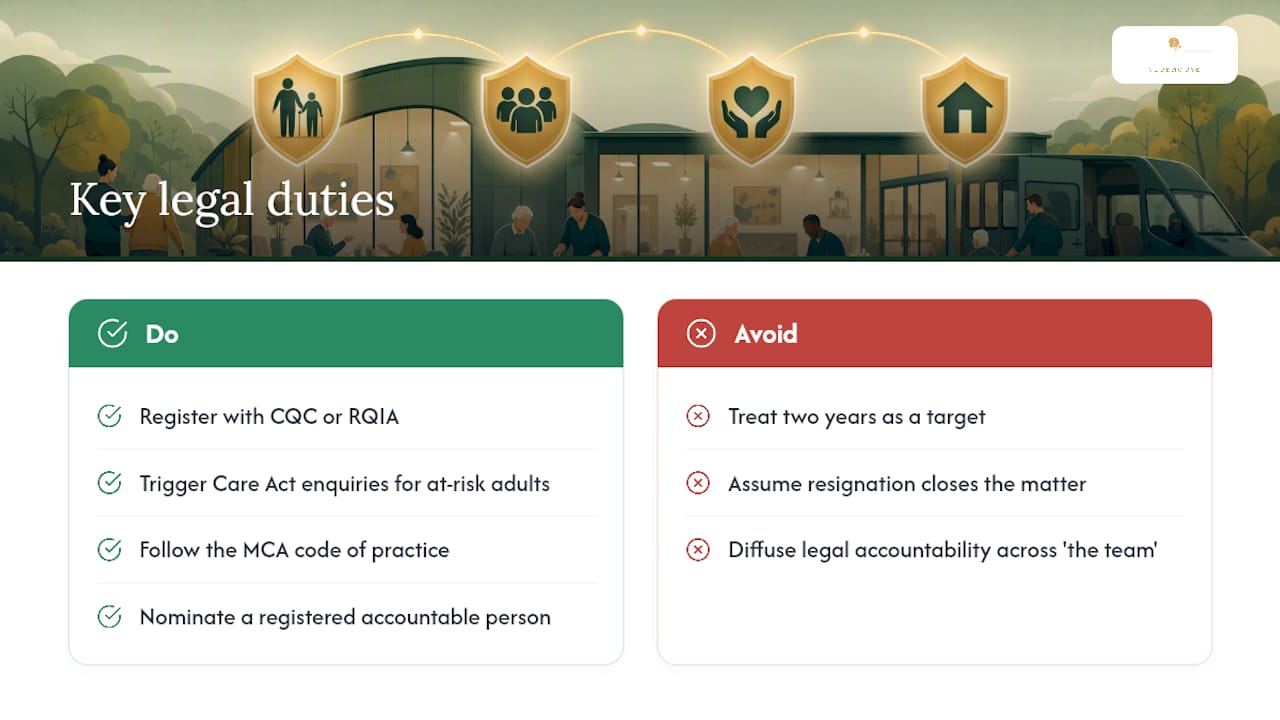
The regulatory picture in the UK depends on where a day centre sits geographically, but the underlying duties are strikingly similar everywhere. In England, providers register with the CQC and must meet its fundamental standards on safeguarding. In Northern Ireland, the equivalent regulator is the RQIA, whose Day Care settings minimum standards set out explicit expectations for how safeguarding is trained, documented and reviewed.
Underneath both regulatory frameworks sits the Care Act 2014, which places a statutory duty on local authorities to make enquiries when an adult with care and support needs may be at risk of abuse or neglect. The Mental Capacity Act code of practice sits alongside it, guiding decisions about consent and best interests wherever a member's capacity to decide for themselves is in question.
The registered person carries personal legal accountability for safeguarding compliance. That's not a shared responsibility that dissolves into "the team" when something goes wrong. It's specific, named, and answerable to the regulator.
Regulatory checkpoint: RQIA standards state that safeguarding procedures must be included in staff induction, and that safeguarding training for staff and managers should be refreshed at least every two years. Treat two years as a maximum gap, not a target to aim for.
One duty catches providers out more than any other: DBS referrals. If a staff member is dismissed, or removed from regulated activity, because they harmed or may have harmed a vulnerable person, the employer must refer that person to the Disclosure and Barring Service. Crucially, this duty still applies even if the staff member resigns before the dismissal process finishes. Providers sometimes assume a resignation closes the matter. It doesn't.
Multi-agency working underpins all of this. A day centre rarely resolves a serious safeguarding concern alone; local authority safeguarding teams, health partners and, where relevant, the police all have a role, and the CQC's day centre standards guidance is worth reading alongside your regulator's own framework.
Policies and procedures every day centre must have
A safeguarding policy that nobody has read is worse than no policy at all, because it creates a false sense of security. The written procedures that matter are the ones staff can quote from memory, not the ones filed neatly and never opened.
Every UK day centre needs the following core policies, kept current and cross-referenced against each other:
- Safeguarding adults policy, defining abuse types, reporting routes and the designated lead's contact details.
- Whistleblowing policy, protecting any staff member who raises a concern about a colleague or manager.
- Complaints policy, giving members and families a clear, non-intimidating route to raise dissatisfaction.
- Consent and mental capacity policy, aligned with the Mental Capacity Act code of practice.
- Financial safeguarding policy, covering how members' money, valuables and financial decisions are protected.
- Medication management policy, setting out administration, storage and error-reporting procedures.
These documents only work if they're genuinely accessible. That means a copy in the staff handbook, a summary built into induction week one, and versions in large print or plain-English formats for members and families who need them. A policy locked in a management-only folder fails the accessibility test before it's even been read.
Pro Tip: Run a two-minute "policy pop quiz" at team meetings, asking one random staff member where the safeguarding policy is kept and who the designated lead is. If they hesitate, your induction needs work, not your policy.
Training cadence deserves particular care. Safeguarding training belongs in induction from day one, well before a new starter is left alone with members. After that, RQIA guidance recommends refreshing the training regularly, with a maximum recommended gap of two years, though many well-run centres choose annual refreshers given how quickly guidance and case law shift. Training records should note not just attendance but which scenarios were covered, so gaps in knowledge are visible at a glance rather than assumed to be covered.
Recognising abuse: types and signs to watch for in your day centre
Abuse rarely announces itself. It shows up in small behavioural shifts, an unexplained bruise, a sudden reluctance to attend, a family member who always seems to answer questions on someone else's behalf. Recognising the pattern early is the whole point of safeguarding training.
The main categories staff need to recognise, each with a day-centre-specific example:
- Physical abuse — unexplained bruising, burns, or a member flinching when approached for personal care.
- Psychological abuse — a member who seems anxious around a particular relative, or who has become withdrawn without an obvious cause.
- Financial abuse — a member suddenly unable to afford activities they previously enjoyed, or confusion over who controls their bank card.
- Neglect — arriving hungry, in soiled clothing, or without prescribed medication that should have been taken at home.
- Sexual abuse — signs of distress around a specific individual, or behaviour changes that don't fit the person's usual character.
- Discriminatory abuse — comments or treatment that target a member's race, disability, sexuality or religion, including from other members.
- Organisational abuse — poor practice embedded in the day centre's own routines, such as rushed personal care or ignored call bells.
Watch for signs across the whole day, not just during formal activities. Arrival is often the most revealing moment, because it shows how someone has been cared for overnight or that morning. Departure matters too: does the person collecting them speak over the member, or answer questions clearly aimed at someone else?
When something doesn't sit right, the immediate priority is safety and dignity together. Move the conversation somewhere private if needed, reassure the person without promising outcomes you can't guarantee, and resist the urge to interrogate. A single open question, "Would you like to tell me what happened?", followed by patient listening, does more good than a barrage of follow-ups.
Reporting and immediate actions: what to do when a concern arises
The sequence matters as much as the content. Get the order wrong, and evidence gets lost or a vulnerable person stays at risk longer than necessary.
- Make the situation safe first. Separate the person from immediate risk if there is one, and call emergency services if there's any threat to life or urgent medical need.
- Preserve what you observe. Note exact words used, times, and who else was present, before memory fades or details blur.
- Inform the designated safeguarding lead immediately, not at the end of the shift. Delay is one of the most common failures in real investigations.
- Document formally, using the centre's incident recording system, while details are fresh.
- Escalate to the local authority's adult safeguarding team, who hold statutory responsibility for making enquiries under the Care Act.
- Consider regulator notification, using CQC or RQIA reporting routes where the incident meets their thresholds.
- Assess whether a DBS referral is required. If a staff member has been dismissed or removed from regulated activity because they harmed or may have harmed someone, the DBS referral duty applies, even if that person resigned first.
Every step should be recordable. If you can't point to a written note showing when the lead was informed, or when the local authority was contacted, the investigation that follows will struggle to establish what actually happened and when.
Using risk assessments to strengthen individual care plans
Static risk assessments, written once and filed away, miss the point entirely. Safeguarding risk shifts constantly: a member's mobility declines, a new medication changes their alertness, a family carer starts showing signs of strain. SCIE's guidance on safe delivery treats risk assessment as something that must be integrated with individual care planning, not run alongside it as a separate exercise.
A useful day-centre risk assessment covers three layers at once:
- Individual factors — mobility, cognitive changes, medication, known triggers for distress or agitation.
- Activity-specific factors — supervision ratios for outings, equipment safety for physical sessions, seating arrangements that avoid isolating anyone.
- Building and environment factors — secure entry points, safe flooring, clear sightlines for staff supervising communal areas.
Care plans should update the moment any of these change, not at the next scheduled review. A fall, a new diagnosis, a change in who collects the member at the end of the day, each of these should trigger an immediate reassessment rather than waiting for the calendar to catch up. SCIE also flags carer wellbeing as an early warning indicator worth building into these reviews: a family carer who seems exhausted or resentful is sometimes the first visible sign that things at home have become unsustainable, which links directly to the risk of neglect. Reading around carer burnout signs helps staff spot this pattern before it escalates.
Set a routine review cadence, perhaps every three to six months for stable members, and layer trigger-based reviews on top for anything sudden.
Who does what: roles, governance and multi-agency liaison
Every day centre needs a designated safeguarding lead whose name every single staff member can recite without hesitation. This isn't a title for a business card; it's the person who takes the call at 3pm on a Wednesday when a support worker isn't sure whether something counts as a concern.
Clear governance around that role includes:
- A named designated lead and at least one deputy, so cover exists during holidays or sickness absence.
- Documented liaison contacts with the local authority safeguarding team and relevant health partners, reviewed and updated regularly rather than left to go stale.
- Regular supervision sessions where staff can raise low-level concerns before they become serious ones.
- Periodic audits of safeguarding records, checking that incidents were logged, escalated and closed out properly.
- Incident reviews conducted as learning exercises, not blame exercises, feeding lessons back into training and policy.
RQIA's own standards recommend listing named liaison staff prominently in the handbook and induction material, precisely because delay at the point of escalation causes more harm than any gap in policy wording.
Pro Tip: Print the designated lead's name and mobile number on a laminated card kept at every staff station. It sounds basic. It's also the single cheapest safeguarding improvement most centres can make this week.
Preventing harm while protecting dignity and independence
Overprotection is its own kind of harm. A day centre that wraps every member in cotton wool, banning activities, restricting choices, hovering constantly, strips away the independence that brought people there in the first place. The Mental Capacity Act code of practice is explicit that any restriction should be the least restrictive option available, proportionate to the actual risk rather than the worst-case scenario someone imagined.
Getting this balance right in practice looks like:
- Offering choices in plain language, and giving members time to answer rather than answering for them.
- Using accessible information formats, pictures, large print, simple sentences, so consent is genuinely informed rather than assumed.
- Involving family members and nominated persons in decisions, without letting a relative's voice override the member's own wishes.
- Reviewing any restriction regularly, asking honestly whether it's still needed or has simply become habit.
- Documenting the reasoning behind best-interest decisions, so the logic is visible to anyone reviewing the case later.
A good rule of thumb: if a restriction would embarrass you to explain to the member's family in plain terms, it's probably too restrictive.
Recordkeeping and evidence: what to keep and why it matters
Good records protect everyone, the member, the staff, and the centre itself, when questions get asked later. Day-care minimum standards emphasise keeping written records of every safeguarding concern, including investigation details, outcomes and actions taken, not just a brief note that "something happened".
The essentials to maintain:
- Incident logs, capturing what was observed, when, and by whom.
- Investigation notes and outcomes, showing the full chain from concern to resolution.
- Attendance registers with arrival and departure times, since RQIA guidance treats these as key evidence during any safeguarding investigation.
- Staff-on-shift records, establishing exactly who was supervising at any given moment.
Attendance logs might feel like administrative housekeeping. In an investigation, they're often the single most decisive document, establishing beyond doubt who was present and when supervision existed.
Store records securely and in line with UK GDPR, retaining them for the period your regulator and local authority protocols specify. When in doubt, keep longer rather than shorter; a deleted record helps nobody once questions start being asked.
Where to find help: local and national safeguarding contacts
Knowing who to call before a crisis hits saves precious minutes when it matters. Every day centre should have a laminated contact sheet, not a folder buried in a shared drive nobody can access under pressure.
Priority contacts worth keeping close:
- Your local authority's adult safeguarding team, the statutory first port of call for any concern involving a person with care and support needs.
- CQC or RQIA reporting pages, used when an incident meets your regulator's notification threshold.
- We Are Hourglass, a charity offering practical support and reporting guidance specifically around elder abuse.
- Ann Craft Trust, which publishes safeguarding templates and training materials useful for policy reviews.
- Carers UK, a valuable resource when a family carer's wellbeing itself becomes part of the safeguarding picture.
How the Alderley Clubhouse applies safeguarding in daily practice
We built safeguarding into how The Alderley Clubhouse runs, not as a policy exercise but as daily habit. Attendance is capped at 35 members a day, which means every member is known by name and any change in mood or behaviour gets noticed quickly. Our care team is trained to deliver Cognitive Stimulation Therapy, the only non-drug therapy NICE recommends for mild to moderate dementia, so staff understand cognitive change as it happens, not after the fact.
Our building is purpose-designed and dementia-friendly, reducing environmental risk before it becomes a safeguarding issue. Families researching what adult day care actually offers often ask us how small-group settings support safer supervision, a question worth exploring through research-backed questions about small-group day care.
Why most safeguarding failures are procedural, not principled
Most day centres already believe in safeguarding. Nobody sets out to neglect a vulnerable adult. The gap between good intentions and good outcomes almost always sits in the boring middle: who was told, when, and what got written down.
Conventional safeguarding advice loves abstract principles, dignity, empowerment, proportionality, and rightly so. But principles don't stop harm on their own. What stops harm is a support worker who can name the designated lead without checking, an attendance log that actually gets filled in at 9:32am rather than retrospectively at 4pm, and a DBS referral that gets made within days rather than quietly forgotten because the staff member "just left".
If you manage a day centre and only fix one thing this month, fix escalation speed. Named leads, laminated contact cards, and same-day documentation close more gaps than another policy rewrite ever will. The paperwork matters, but it's the plumbing beneath it, who gets told, how fast, and what gets recorded, that actually determines whether a vulnerable adult stays safe.
— Scott @ The Clubhouse
Looking for a day centre that takes safeguarding seriously?
Families comparing options for a loved one with dementia often find the safeguarding conversation gets skipped entirely, with glossy brochures instead of straight answers about staffing, training and supervision. The Alderley Clubhouse is built the other way round: safeguarding shapes the daily structure, not an afterthought bolted onto marketing.

Attendance is capped to help staff get to know members' usual mood, appetite and mobility, so changes can be noticed promptly. Our care team is trained in Cognitive Stimulation Therapy to support understanding of cognitive changes clinically rather than by guesswork. The building itself is dementia-friendly and fully accessible, with secure parking and a drop-off point at the door, removing common environmental risks before they start. This is a paid, premium service with day passes and multi-session packages available; current pricing details are available on our website.
If you'd like to see how this works day to day, visit The Alderley Clubhouse to check availability or arrange a visit, or explore a typical day at the Clubhouse before you enquire.
Sources
- Day care settings minimum standards (RQIA) – August 2021
- Making barring referrals to the Disclosure and Barring Service
- SCIE — strengths-based approaches and safeguarding guidance
- Mental Capacity Act code of practice
- We Are Hourglass