
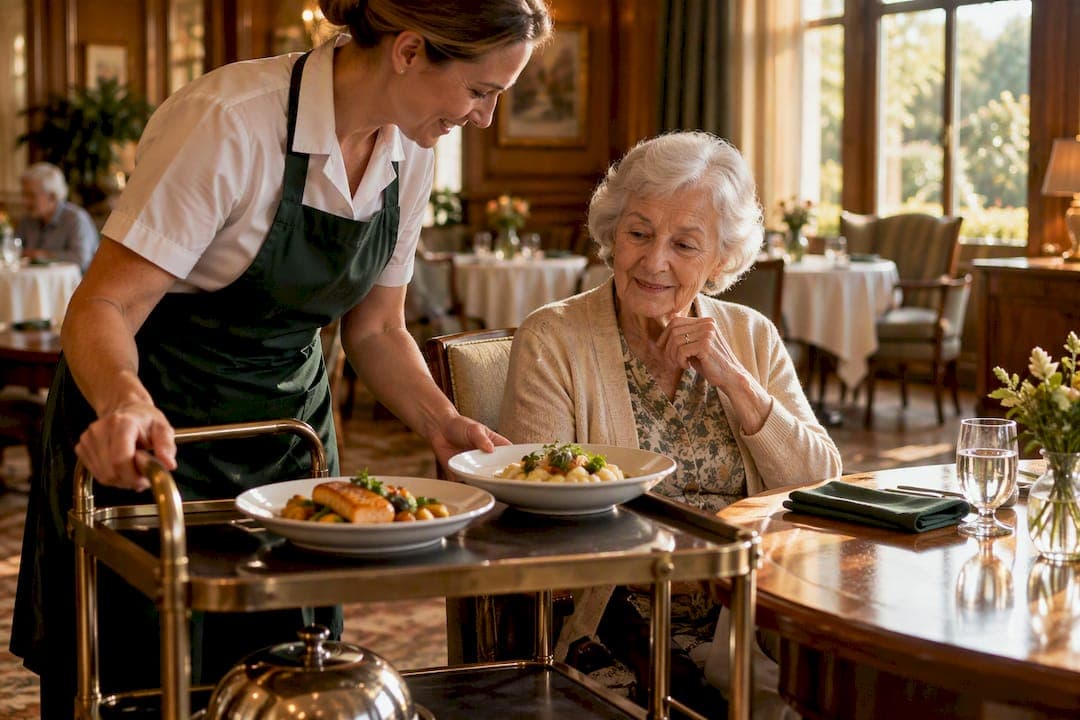
Yes, restaurant-style dining, when introduced with the right clinical safeguards and staff training, can support dignity and often raises social engagement and food intake for people living with dementia. The safety caveats matter as much as the hospitality: watch for signs of swallowing difficulty and refer to a speech and language therapist, and use MUST screening to catch nutritional risk early. Below, we cover the evidence, the checks, and a practical rollout checklist, along with a working example from our own Clubhouse.
TL;DR:
- Most residents benefit from tailored clinical safeguards, such as swallow assessments and nutritional risk screening, before transitioning to restaurant-style dining.
- Smaller, managed groups with known preferences, clear cues, and flexible service options improve social and nutritional outcomes for people with dementia.
- Staff training should focus on person-centered communication and vigilant supervision during meals to ensure safety and preserve dignity.
- Short pilot programs with measurable progress, environmental adjustments, and staff practice improvements are key to successful implementation.
- Family involvement in meal planning and regular feedback help align menus with residents' lifelong preferences and cultural needs.
Table of Contents
- What 'restaurant-style' dining actually means for someone with dementia
- What the evidence says about social, nutritional and wellbeing outcomes
- Safety and clinical checks before you change how anyone eats
- A step-by-step checklist for piloting restaurant-style dining
- Building the staff habits that make dining changes last
- Case example: how The Alderley Clubhouse approaches hospitality-led dining
- Getting families and residents involved in meal planning
- Adapting the dining experience as dementia progresses
- Menu design that reflects who is actually eating
- What most pilots get wrong
- Seeing hospitality-led dining in practice at The Alderley Clubhouse
- Practical resources and clinical guidance
- Sources
- FAQ
What 'restaurant-style' dining actually means for someone with dementia
Restaurant-style dining covers a few different service models, and it helps to know which one you are actually offering. Table service brings a server to take an order in the moment. Family-style dining places shared dishes on the table so residents help themselves or are helped by staff sitting alongside them. A 'pantry' or trolley model lets residents choose from what they can see and smell, right at the point of eating.
The detail that matters most is timing. Genuine choice happens at the meal itself, not on a form filled in the day before. Pre-order systems might look efficient on paper, but peer-reviewed evaluations suggest they rarely deliver the same quality of life benefits as choosing what looks good right there on the trolley. For residents with more independence, table service or a pantry model works well. For those who need more support, family-style dining with a staff member alongside them tends to keep the social connection without overwhelming the decision.
What the evidence says about social, nutritional and wellbeing outcomes
The research on this is more encouraging than many managers expect, provided you set the right measures from day one. Peer-reviewed evaluations of restaurant-style dining in residential homes for older people link the model to greater social interaction and higher resident satisfaction, with some modest nutritional gains as well.
Before starting, agree what you will actually track:
- Intake: calorie and protein consumption, tracked over a set number of meals.
- Weight: monitored on a schedule agreed with a dietitian.
- Satisfaction: simple resident or family feedback, collected consistently.
- Waste: plate and kitchen waste, which tends to shift when service changes.
Pilot studies reported increased resident satisfaction and some increases in protein and vegetable intake, alongside rises in production waste and foodservice costs, according to the same evaluation. That trade-off is worth planning for rather than being surprised by: more choice at the table often means more food prepared than eaten, at least at first, and kitchens need room to adjust batch sizes and ordering as they learn what residents actually pick.
Safety and clinical checks before you change how anyone eats
None of the above matters if a resident is unsafe to eat what is on offer, so this section comes before any menu planning. NHS speech and language therapy guidance and the Alzheimer's Society both set out clear referral triggers.
- Watch for red flags. Coughing during or after meals, holding food in the mouth without swallowing, and recurrent chest infections all warrant an SLT referral.
- Screen nutritional risk with MUST. The Malnutrition Universal Screening Tool flags residents who need a dietitian's input before any menu change goes ahead.
- Keep positioning upright. Sitting upright during and after meals reduces aspiration risk and is a first-line measure recommended before any other intervention.
- Never modify texture without SLT advice. A well-meaning switch to softer food can do more harm than good if it is not based on a proper swallow assessment.
- Supervise mealtimes. A staff member present throughout catches early warning signs and offers prompts without taking over the meal.
Environmental strategies and supervised mealtimes are recommended as first-line measures, with SLT referral reserved for cases where these signs persist.
A step-by-step checklist for piloting restaurant-style dining
Start small, measure what changes, and only then expand. The order below keeps disruption low while giving you real evidence to work with.
- Environment quick wins: high-contrast plates, clear place settings, less clutter on the table, and consistent cues such as music or the smell of cooking drifting from the kitchen.
- Service changes: offer choice at the table itself, serve smaller portions with seconds readily available, and add finger-food options for residents who find cutlery difficult.
- A pantry or trolley: lets residents see and choose food on demand rather than committing to a plate before they have seen what is available.
- Kitchen adjustments: smaller batch cooking, flexible plating, and closer stock control help manage the waste that often comes with more choice.
- Pilot first: choose a small group of eligible residents, run short pilot sessions over a few weeks, and measure intake and satisfaction before rolling the model out further.
Pro Tip: Run your pilot over two or three weeks with the same small group, so you can compare intake and satisfaction against a clear baseline before deciding whether to scale up.
Building the staff habits that make dining changes last
The décor and the trolley matter far less than what happens between staff and residents at the table. Training needs to prioritise person-centred communication, hand-over-hand support where useful, and the observation skills that catch a swallowing problem early. Pacing meals and offering gentle prompts, rather than rushing residents through, changes the whole tone of the room.
Operationally, that means rethinking staff roles so someone is always free to sit with residents rather than running back and forth to the kitchen. Protected time for social dining, free from other duties, is what actually lets the culture shift take hold.
Surveys of mealtime practice suggest audits and mentoring work better than one-off training sessions, so building in a simple regular check, rather than a single launch day, is worth the effort.
Case example: how The Alderley Clubhouse approaches hospitality-led dining
The Alderley Clubhouse runs a chef-prepared two-course lunch alongside breakfast on arrival, a traditional afternoon tea, and an all-day hydration station, all within a day that runs from 9:30am to 4:30pm. Attendance is capped at 35 members each day, which keeps mealtimes manageable and means staff know each person's preferences and needs by name.
Our care team is trained to deliver Cognitive Stimulation Therapy alongside daily hospitality, so social dining sits within a wider structure of cognitive and social activity rather than standing alone.
Several elements translate directly to residential settings: capped numbers per sitting, staff who know residents individually, and a fixed daily rhythm that builds familiarity. What does not translate directly is the venue-based, paid model itself. A residential home cannot simply cap attendance the way a day club can, but the underlying principle, that smaller, better-known groups eat better together, holds regardless of setting.
Getting families and residents involved in meal planning
Families often know a resident's lifelong food preferences better than any care plan can capture, and that knowledge is worth building into the menu from the start rather than treating as an afterthought.
A short conversation at admission, covering favourite meals, dislikes, and any cultural or religious requirements, gives kitchen staff a working brief rather than a guess. Revisit that conversation periodically, since preferences and abilities both shift as dementia progresses.
Simple, regular feedback loops work better than occasional surveys. A quick chat at the end of a meal, or a card left on the table asking what worked and what did not, catches problems while they are still fixable. Some homes invite family members to join a meal occasionally, which does two things at once: it gives staff direct feedback and it gives residents a valued social occasion.
Resident involvement matters just as much, even where verbal communication has become difficult. Watching what gets eaten, what gets left, and how a resident reacts to being shown two plates rather than asked an open question all count as feedback. For residents who can still express a preference clearly, a rotating short menu they help choose gives a genuine sense of ownership over the meal.
Digital tools have a role here too. Platforms such as Ravioli let care providers record individual preferences and manage menu choices digitally, which can make it easier to keep family input current without relying on paper files that go missing or fall out of date.
Adapting the dining experience as dementia progresses
What works at one stage of dementia can become unhelpful, or even unsafe, at another, so the model needs to flex rather than stay fixed.

In the earlier stages, most residents can manage full choice: a trolley, a short menu, or table service all work well, and independence should be protected as long as it is safe. The goal here is to preserve normal social eating for as long as possible, resisting the urge to simplify things before it is necessary.
As dementia progresses, decision-making becomes harder, and too many options can cause distress rather than pleasure. Reducing choice to two clear alternatives, shown rather than described, tends to work better than an open question. Finger foods become more useful here, since they reduce the demands of cutlery while keeping mealtimes social rather than assisted in a way that feels clinical.
In more advanced stages, supervision needs to increase, and any texture changes must follow SLT advice rather than staff judgement, given how common dysphagia becomes at this point. The social element does not have to disappear even when independence has: sitting alongside a resident, matching their pace and offering gentle verbal or physical prompts, keeps the meal a shared occasion rather than a task performed on someone.
The through-line across all three stages is the same principle: dignity of choice adapts in form, but it should not disappear as ability declines.
Menu design that reflects who is actually eating
A restaurant-style menu only works if it reflects the people sitting down to eat it, which means cultural and personal preferences need to shape the menu rather than sit as an exception handled separately.
Religious dietary requirements, whether that is halal, kosher, vegetarian, or another restriction, need to be built into standard planning rather than treated as a special request each time. The same goes for cultural food preferences: a resident who grew up eating a particular cuisine may find unfamiliar food genuinely disorientating, on top of whatever confusion dementia already brings to a mealtime.
Personal history matters just as much as cultural background. Someone who never ate spicy food will not suddenly enjoy it because it is on the menu, and someone who always had a cooked breakfast may find a continental option unsatisfying regardless of nutritional content. These details usually surface in conversations with family, which is another reason that early involvement pays off later.
Sensory cues also shape how much a menu succeeds in practice. Research from the University of Oxford highlights how sensory cues, the smell of food cooking, a properly set table, familiar sounds, help orient people with dementia to the meal and increase participation. A menu that looks right on paper still needs the room to smell and feel like a place to eat.

What most pilots get wrong
Décor gets the attention, but staff practice decides whether restaurant-style dining actually works. The trolleys and place settings matter less than whether someone sits with a resident and matches their pace. Expect a short-term rise in waste and production cost, and plan your kitchen batches around it rather than treating it as a failure. Start with a small pilot, measure something simple, and let the evidence tell you whether to expand.
— Scott @ The Clubhouse
Seeing hospitality-led dining in practice at The Alderley Clubhouse
If you want to see what restaurant-style dining looks like once the staff training and clinical safeguards are already in place, visiting a luxury adult day club can provide a working example without any operational change on your part.
- A chef-prepared two-course lunch served within a full day.
- A care team trained to deliver Cognitive Stimulation Therapy alongside mealtime and activity.
- Attendance capped to keep mealtimes manageable, so staff can know members' preferences and pace.
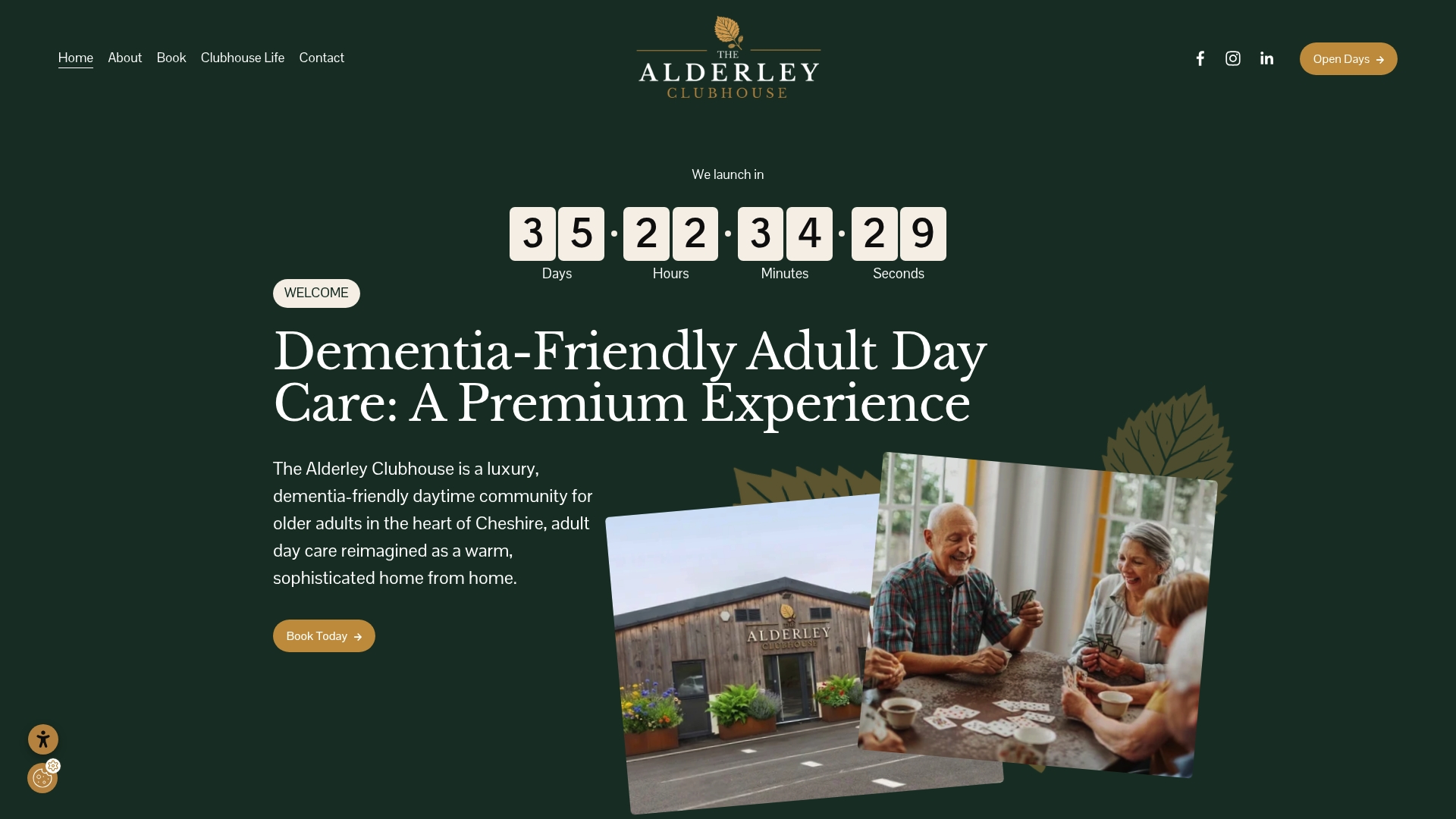
A visit lets you observe appetite, mood and social response to hospitality-led dining directly, which is useful whether you are planning a family member's care or researching a model for your own setting. Day passes can be booked through our day pass membership page.
Practical resources and clinical guidance
- Alzheimer's Society guidance on eating and drinking for symptom checks and SLT referral advice.
- NHS speech and language therapy leaflet on swallowing safety.
- Our own guides on nutrition for dementia and dementia-friendly design for further detail.
This article is general information, not a substitute for advice from a qualified doctor. Consult a qualified healthcare professional about your own circumstances before acting on anything here.
Sources
- Eating and drinking | Alzheimer's Society
- Advice on eating, drinking and swallowing in dementia (SLT leaflet)
- The restaurant within the home: experiences of a restaurant‑style dining provision in residential homes for older people
FAQ
What are the three main foods linked to dementia?
There is no established list of three specific foods that cause dementia, and no source in this article supports one. Nutritional guidance for people already living with dementia focuses on fortified meals, adequate hydration and easy-to-manage textures rather than avoiding particular foods.
What is the 90 second rule for dementia patients?
This is not a recognised clinical guideline referenced by NHS or Alzheimer's Society sources, so we cannot confirm a specific "90 second rule." What clinical guidance does recommend is allowing extra time at each mealtime step, with unhurried pacing and prompts rather than a fixed countdown.
What are the typical eating habits of people with dementia?
Eating habits often change as dementia progresses, including difficulty recognising food, holding food in the mouth without swallowing, and reduced appetite or interest in mealtimes. The Alzheimer's Society notes that swallowing difficulties (dysphagia) become more common as the condition advances, which is why environmental adjustments and SLT referral matter.
What are some good dinner options for people with dementia?
Good options tend to be familiar, easy to manage with the resident's current abilities, and offered as clear choices rather than long menus. Finger foods, fortified soups and smaller portions with seconds available are practical starting points, alongside respecting personal and cultural food preferences.
How can care settings start offering restaurant-style dining safely?
Start with a small pilot group, complete MUST screening and any needed SLT referrals first, then introduce environmental changes such as clearer place settings and choice at the table. Measure intake and satisfaction over a few weeks before expanding, since evidence from residential care settings shows benefits are strongest where staff practice, not just décor, changes alongside the service model.