
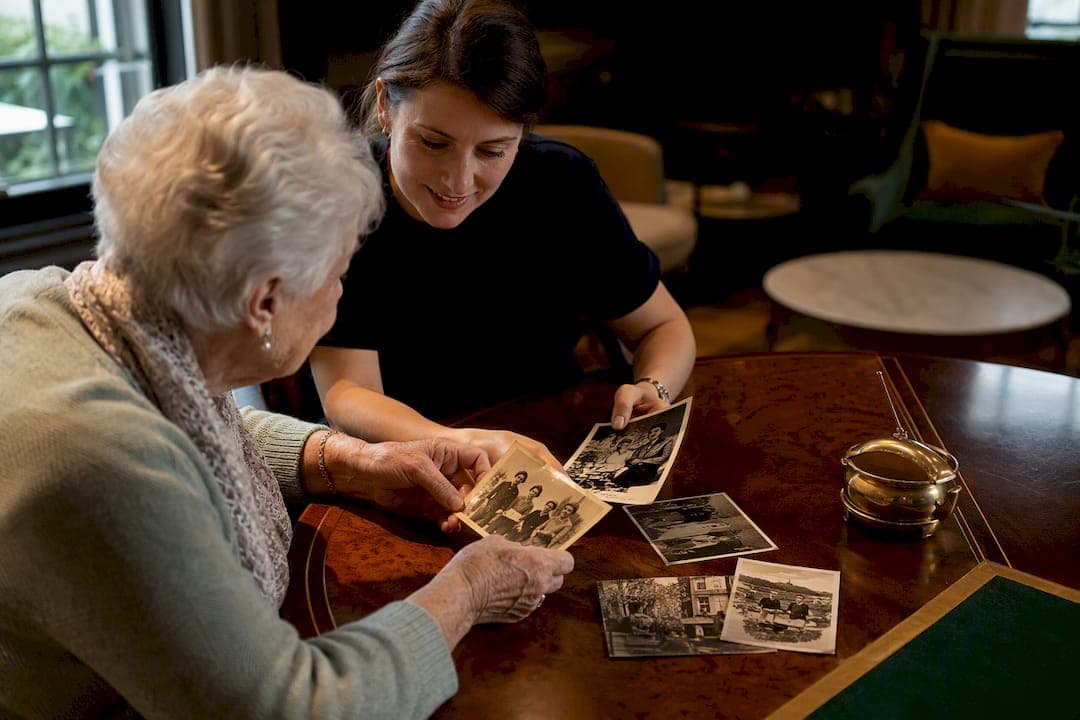
Systematic reviews and meta-analyses now show that reminiscence therapy brings measurable improvements in cognition, mood and quality of life for many people living with dementia. The effects are real but not universal: they depend heavily on how often sessions happen, where they take place, and how well they're tailored to the individual. We'll walk through what the evidence says, what a good session looks like, and how to run one safely at home or in a care setting.
TL;DR:
- Reminiscence therapy is most effective when delivered over 12 to 16 sessions in care settings, especially for people aged 60 to 70 with mild to moderate dementia.
- Sessions should focus on personal prompts, such as photographs or music from significant life periods, and avoid testing or pressuring recall.
- Carefully managing sensitive topics and watching for signs of distress are crucial to ensure safety and emotional well-being during sessions.
- Digital tools are emerging as feasible options, but they work best with facilitator support and personalized content.
- Incorporating reminiscence into wider care plans and professional guidance improves its benefits, especially for mood and identity reinforcement.
Table of Contents
- What is reminiscence therapy, and how is it different from a normal chat about the past?
- What the evidence actually says (and where it falls short)
- How reminiscence therapy is delivered: group, individual and digital approaches
- How to run a safe, person-centred reminiscence session
- Safety, sensitive topics and when to bring in professional support
- Why reminiscence therapy works: the psychology and the neuroscience
- Scott @ The Clubhouse: how we use reminiscence in daytime services
- Sources
What is reminiscence therapy, and how is it different from a normal chat about the past?
Reminiscence therapy is a structured approach that uses sensory prompts, photographs, music, familiar scents, favourite recipes and personal objects, to help someone recall and talk through past events. It's not the same as a casual chat about "the old days" over a cup of tea. A proper session has a purpose, a rough plan, and someone facilitating who knows what topics matter to that particular person.
The reason it works taps into something quite specific about how dementia affects memory. Long-term, autobiographical memory, the wedding day, the first job, the seaside holiday, tends to stay intact for longer than short-term memory. So a person who cannot recall what they ate for breakfast might still describe their childhood street in vivid detail. Reminiscence therapy is built around that preserved memory, rather than testing the memory that's already fading.
Commonly used tools include:
- Photographs from family albums or local history collections
- Music from a person's teens and twenties, often the most strongly anchored years
- Familiar scents, lavender, fresh bread, pipe tobacco, particular soaps
- Favourite recipes and foods tied to family occasions
- Everyday objects: ration books, old tools, war medals, knitting needles
What the evidence actually says (and where it falls short)
The headline numbers are encouraging. A systematic review and meta-analysis found reminiscence therapy improves cognitive function with a standardised mean difference (SMD) of 0.74 (95% CI 0.40 to 1.08), and quality of life with an SMD of 0.36 (95% CI 0.12 to 0.61). In plain terms, that's a moderate to large effect on cognition and a smaller but genuine effect on quality of life, not a marginal result you'd expect to disappear on closer inspection.
Subgroup analyses add useful detail. The biggest cognitive gains showed up where programmes ran for 12 to 16 sessions and took place in nursing home or professional care settings, rather than one-off or unstructured attempts. People in the 60 to 70 age bracket showed stronger effects than older subgroups, which may reflect differences in how advanced the dementia was rather than age itself.
The evidence isn't uniformly positive, though, and it's worth being honest about that. Another meta-analysis found consistent reductions in depressive symptoms and improvements in quality of life, but inconsistent results for behavioural and psychological symptoms of dementia, things like agitation or wandering, and for caregiver burden. Reminiscence therapy seems to help the person doing the remembering more reliably than it eases pressure on the person caring for them.
The same review calls for standardised protocols and more randomised trials to nail down the ideal dose and long-term effects. That gap matters for anyone weighing up how much to invest in a programme:
- Effects on cognition and mood are well supported across multiple reviews
- Effects on challenging behaviours and caregiver strain remain inconsistent
- Trial designs vary enough that "12 to 16 sessions" is a strong signal, not a fixed prescription
How reminiscence therapy is delivered: group, individual and digital approaches
Group sessions suit day-centre and care-home settings well, since shared memories, wartime rationing, early television, local dance halls, tend to spark conversation between participants rather than relying on one-to-one prompting. Individual sessions work better for someone in the earlier stages of dementia who wants a deeper, more personal conversation, or for topics too sensitive to explore in a group. Dyadic sessions, where a family carer takes part alongside the person with dementia, often strengthen the relationship as much as the memory recall itself.
Digital tools are entering the picture too. Pilot trials suggest digital reminiscence formats are feasible and may extend reach to people who can't attend in person, though the evidence base behind them is still thinner than for in-person group and individual work. A tablet loaded with old photographs, or a curated music playlist, tends to work best paired with a person sitting alongside, rather than left running unsupervised.
Who can lead a session matters more than people expect. NICE guidance recommends group cognitive stimulation therapy for mild to moderate dementia and suggests considering group reminiscence therapy as part of person-centred care, delivered by trained staff who understand the individual's history and triggers. Family carers and volunteers can run sessions too, provided they've had some guidance on pacing and person-centred approach.
- Group sessions: 45 to 60 minutes, once or twice weekly
- Individual sessions: 20 to 30 minutes, more flexible on frequency
- Digital aids: best used alongside a facilitator, not as a standalone activity
Pro Tip: Keep a simple folder or box of props specific to each person rather than a generic set for the whole group. A shared photo of a 1960s high street works for everyone; a photo of someone's actual wedding day works far better for them.
How to run a safe, person-centred reminiscence session
1. Build a one-page life-story profile. Before the first session, jot down six to eight prompts tied to different life stages, childhood home, first job, wedding, children, hobbies. This helps you find meaningful topics quickly and avoid stumbling into painful territory unprepared.
2. Choose two or three personal prompts, not a script. Pick a photograph, a piece of music, or an object connected to something on that profile. Fewer, better prompts beat a long list you never get through.
3. Open with a gentle question and follow their lead. Ask something open like "Tell me about this" rather than "Do you remember when...". Avoid quizzing for exact dates or names; testing recall undermines the point of the session and can cause anxiety rather than pleasure.
4. Let silences sit. A pause isn't failure. Give the person time to connect with the prompt before moving on.
5. Close on a positive note. Wind down with something calm, a familiar song or a cup of tea, rather than stopping abruptly mid-topic.
6. Record what worked. A quick note on which prompts landed well helps you refine future sessions and builds toward a structured programme of 12 to 16 sessions where that's practical.
Pro Tip: Weekly sessions with a predictable routine, same time, same chair, same opening ritual, seem to help people settle into the activity faster than sessions held ad hoc.
A practical checklist for the environment: minimise background noise, sit at eye level, keep the room well lit but not glaring, and have tissues and water nearby. Our guide to dementia-friendly design covers this in more depth if you're setting up a space at home.

Safety, sensitive topics and when to bring in professional support
Reminiscence carries real emotional risk alongside its benefits. A memory that seems harmless, a childhood home, an old job, can unexpectedly surface grief, loss, or trauma. That's exactly why the life-story profile matters: noting known sensitive subjects in advance (a difficult divorce, a child who died young, wartime experiences) means you're less likely to stumble into them unprepared.
Watch for signs of distress during a session: raised voice, agitation, tearfulness, or withdrawal. If this happens, gently change the subject, offer physical comfort if welcome, and move to something calm and familiar rather than pressing on.
- Keep a written note of topics to avoid, shared with anyone else who runs sessions
- Stop and redirect at the first sign of distress rather than waiting to see if it passes
- Contact the person's GP or memory clinic if distress becomes frequent or severe
- Carers who feel overwhelmed should seek support themselves, through talking therapies or their own GP, rather than pushing through alone
Reminiscence therapy works best as one part of a wider care plan, alongside interventions like cognitive stimulation therapy, and any medication review should stay with the person's specialist team rather than being adjusted informally.
Why reminiscence therapy works: the psychology and the neuroscience
The psychological mechanism is fairly intuitive once you see it laid out. Recalling a happy or meaningful memory activates a sense of identity and continuity, "I am still the person who did this", which appears to lift mood and reduce the agitation that often comes with confusion or disorientation. For someone whose sense of self is under daily pressure from memory loss, a well-chosen prompt offers something rare: a moment of competence and familiarity rather than struggle.
The neurological side helps explain why this particular type of memory holds up. Autobiographical memories, especially emotionally significant ones from young adulthood, tend to be encoded across multiple brain regions and reinforced through years of retelling. That distributed storage appears more resistant to the hippocampal damage that drives early dementia symptoms than the day-to-day memory needed to recall what happened an hour ago. Sensory prompts, a smell, a song, a texture, can also trigger recall through pathways that bypass some of the more damaged areas involved in deliberate, effortful remembering.
There's a social dimension too. Group reminiscence sessions create a shared moment of recognition between participants, which can reduce the isolation that so often accompanies a dementia diagnosis. That combination, personal identity, sensory access to preserved memory, and social connection, is likely why the effect on mood and quality of life shows up so consistently across the research, even where other outcomes are less clear cut.
Scott @ The Clubhouse: how we use reminiscence in daytime services
We build reminiscence into the rhythm of the day rather than treating it as a separate appointment. Themed music sessions bring out songs from the 1950s and 60s that get people singing before they've even settled into their chair. Memory tables scattered with props, tins, tools, photographs, invite quiet exploration between other activities. Mealtimes double as prompts too: a familiar pudding can spark more conversation than a direct question ever would.
Our care team's training in Cognitive Stimulation Therapy shapes how we run these moments, watching for what lands and adjusting gently rather than sticking to a script. We'd rather follow where a member's memory takes them than force a plan.
Sources
The clinical picture in this guide draws on the meta-analysis reporting cognitive and quality of life effect sizes, the PMC review on session frequency and setting, the systematic review on depression and BPSD outcomes, and NICE's dementia care guidance, the standard clinical reference for non-drug dementia interventions in the UK.
If you'd like to see reminiscence and Cognitive Stimulation Therapy in action, The Alderley Clubhouse runs both throughout its daytime programme in Cheshire, alongside chef-prepared meals and a full activity calendar, with day passes and 10-session packages available for families wanting to try it without a long-term commitment.
This article is general information, not a substitute for advice from a qualified doctor. Consult a qualified healthcare professional about your own circumstances before acting on anything here.
- Effects of Reminiscence Therapy for People Living With Cognitive Impairment and Their Caregivers: A Systematic Review and Meta-Analysis
- Reminiscence therapy for dementia - PMC - NIH
- Effects of reminiscence therapy in people with dementia: A systematic review and meta‐analysis
- Dementia: assessment, management and support for people living with dementia and their carers | NICE