
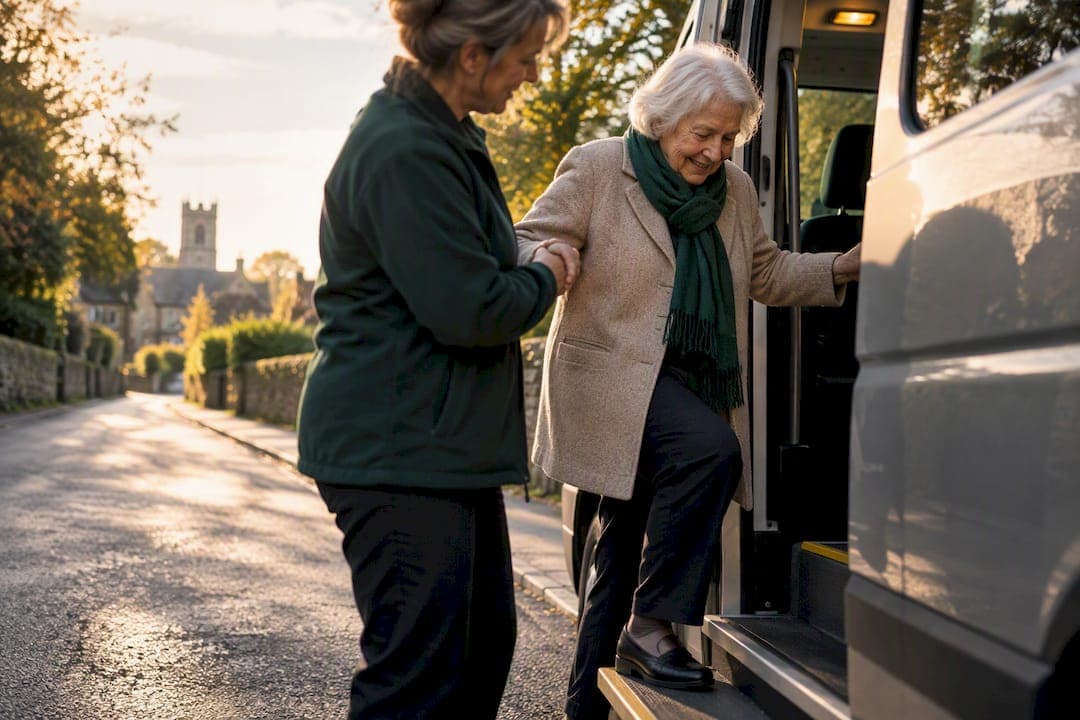
The main ways to get to a day centre are community transport schemes such as ring-and-ride and dial-a-ride, community car schemes with volunteer drivers, accessible taxis (WAVs), and specialist private minibus providers. What's available and what it costs varies significantly from one council area to the next, so checking local listings alongside these general options is always worth the ten minutes it takes.
TL;DR:
- Community transport services vary widely in availability, cost, and eligibility requirements, especially between rural and urban areas.
- Booking procedures require early planning, key details about mobility needs, and awareness of lead times and cancellation policies.
- Private providers are preferable for complex needs or if consistency with a specific driver is a priority, despite higher costs.
- Transport schedules often don't cover weekends or holidays, which can require exploring multiple options or private providers for extended or irregular hours.
- Reliable, familiar transport significantly impacts the day’s success, as predictable routes and known drivers reduce anxiety and facilitate smooth arrivals.
Table of Contents
- What community transport for seniors actually looks like
- How do I find and book local transport services?
- What does day centre transport cost, and who's eligible?
- When private and specialist transport makes more sense
- What safety checks should I make before booking?
- Are transport services available on weekends and holidays?
- How does transport timing affect day centre scheduling?
- What if I live in a rural or underserved area?
- Why familiar transport changes the whole day
- Booking a day pass and talking through your transport needs
- Sources
- FAQ
What community transport for seniors actually looks like
When families first search for day centre transport options, most are surprised by how many different schemes exist under that one umbrella term. They're not interchangeable, and knowing the difference saves a lot of wasted phone calls.
Community transport services exist specifically to fill the gap where ordinary buses and trains don't work for someone's needs, whether that's because of mobility, distance, or timing. The main types you'll come across are:
- Ring-and-ride — a demand-responsive minibus service, usually booked a day or more ahead, that collects passengers from home and drops them close to their destination.
- Dial-a-ride — similar in principle, often run by the local council or a charity, aimed at people who can't use conventional public transport.
- Community car schemes — volunteer drivers use their own vehicles for pre-booked journeys, charging a modest contribution rather than a commercial fare.
- Community buses — fixed or semi-fixed routes run by voluntary groups, filling gaps left by commercial bus operators.
- Accessible taxis (WAVs) — wheelchair-accessible vehicles, either from local private hire firms or specialist operators.
- Scheduled local bus services — sometimes viable for shorter, simpler journeys, particularly with a concessionary bus pass.
Operators range from county councils and registered charities to volunteer groups and private specialist companies. Community transport pages in areas like Devon show just how much of this provision depends on volunteers, particularly in rural pockets where a commercial bus route was withdrawn years ago and never came back. For a regular day centre run, most families end up choosing between a scheduled community transport slot and a private provider who can guarantee the same driver and time each week.
How do I find and book local transport services?
Finding the right scheme usually takes a few calls, not weeks of research. A clear plan makes it quicker.
- Start with your local authority's adult social care pages, then check Gov for the national picture on what these schemes are meant to do.
- Call Age UK or a local volunteer transport group if the council page is vague. They often know which schemes have capacity and which have long waiting lists.
- Have key details ready before you call: postcode, the person's mobility needs, wheelchair dimensions if relevant, whether an escort is needed, preferred times, and whether the journey must be door-to-door.
- Ask about registration or membership — many dial-a-ride schemes require you to join before booking, which can take a few days to process.
- Check lead times and cancellation policies. Some schemes need 48 hours' notice; others fill up around school holidays and popular clinic days.
- Save the direct booking number, not just a general enquiries line — council-run schemes often have a dedicated transport booking team separate from the main switchboard.
Pro Tip: Ring twice, at different times of day. Booking lines for popular dial-a-ride schemes are often the busiest first thing on a Monday, and you'll get through faster later in the afternoon.
What does day centre transport cost, and who's eligible?
Costs and eligibility rules differ by scheme, and it's worth checking both before you commit.
Some services need proof of eligibility, such as age, a registered disability, or a medical need, before you can register. Others are open to anyone who struggles with conventional public transport, no formal assessment required.
Fare models vary too:
- Flat fares for a single journey, common on community buses.
- Per-mile charges for community car schemes, often just covering the volunteer driver's petrol.
- Concessionary rates for council-run dial-a-ride, sometimes linked to a bus pass.
- Free or subsidised transport for medical appointments through NHS patient transport, though eligibility depends on your clinical need rather than simply lacking a car.
Sample fare structure: one county council's dial-a-ride scheme charges £2.10 for the first mile, with a lower per-mile rate after that, giving a useful benchmark for what to expect elsewhere. Always ask directly whether concessions apply. Patient transport for hospital appointments is assessed separately through your GP surgery or hospital, not through community transport schemes.
When private and specialist transport makes more sense
Community schemes work well for many people, but they're not always built for complex or unpredictable needs. That's where specialist private transport earns its keep.
Private providers typically offer:
- Trained escorts who understand dementia, mobility support, or behavioural needs.
- Dedicated minibuses or SEND-style vehicles with proper wheelchair securement.
- Booked regular runs on the same days each week, with the same driver where possible.
- Flexibility to adjust pickup times as a person's needs change.
Some care packages already include transport as part of the arrangement; others treat it as a separate contract you book directly with a provider or with the day centre itself. The national inclusive transport strategy recognises private and community providers as equally valid parts of accessible transport, not a fallback option.
Families tend to choose private providers when consistency matters more than cost. That's particularly true for someone living with dementia, where an unfamiliar driver or a last-minute schedule change can unsettle an entire day.
Pro Tip: Ask a private provider whether the same driver runs your loved one's route every week. Consistency in the person behind the wheel often matters as much as the vehicle itself.
What safety checks should I make before booking?
A quick checklist protects against unpleasant surprises on the first trip.
- Vehicle has proper wheelchair securement, a working ramp or step, and functioning seatbelts.
- Driver has relevant training, a valid DBS check, and basic first-aid knowledge.
- Escort support is available if the person can't be left alone at either end of the journey.
- Clear policy on medication, in case doses are needed during transit.
Ask specifically whether the service is door-to-door or curb-to-curb. For someone with mobility or cognitive difficulties, the difference between being walked to the front door and being left at the pavement can be the difference between a manageable journey and a genuinely stressful one.
Pro Tip: If a provider is vague about driver training or won't confirm DBS checks over the phone, treat that as a reason to ask more questions, not to book anyway and hope for the best.
Are transport services available on weekends and holidays?
This is where a lot of families come unstuck, usually because they've assumed weekday provision extends automatically to weekends. It rarely does.
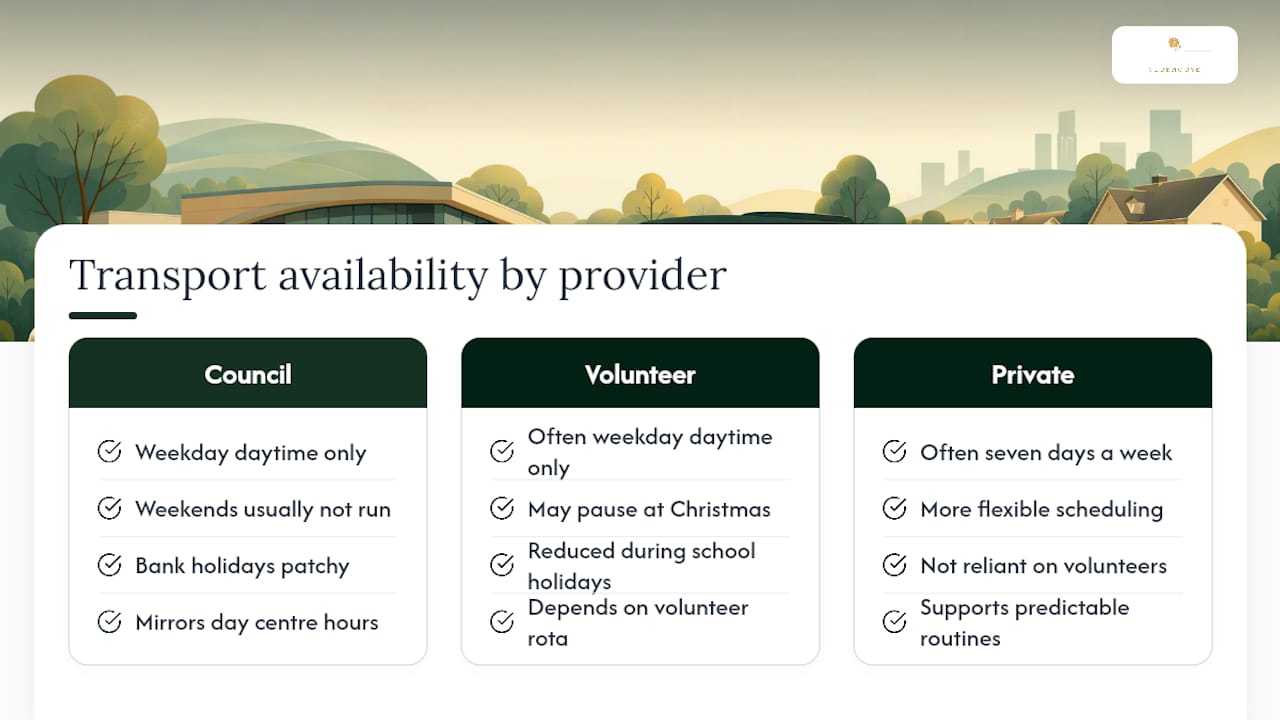
Most council-run dial-a-ride and ring-and-ride schemes operate on limited hours, typically weekday daytimes only, mirroring when day centres themselves are open. Weekend and bank holiday coverage tends to be patchy at best, and some volunteer-run community car schemes pause entirely over Christmas and other holiday periods when volunteer drivers are unavailable.
If a day centre itself runs weekend or extended sessions, it's worth asking directly whether they can arrange or recommend transport for those days, since council schemes may simply not run. Private specialist providers are usually more flexible here. Many operate seven days a week precisely because they're not reliant on a rota of volunteers, which matters if the person you're arranging transport for benefits from a predictable routine that doesn't skip weekends.
School half-terms and summer holidays can also affect community transport indirectly. Volunteer drivers who juggle grandchildren or their own family commitments sometimes have reduced availability during these weeks, even though the day centre itself keeps running as normal. Building in a buffer, and confirming holiday cover a few weeks ahead rather than the week before, avoids a scramble.
How does transport timing affect day centre scheduling?
Transport and day centre timetables aren't independent of each other. Get one wrong and it throws off the other, sometimes more than families expect.
A day centre with a fixed 9:30am arrival and a structured morning programme needs transport that reliably lands within a tight window, not "sometime between 9 and 10." Demand-responsive schemes like ring-and-ride can genuinely struggle here, because they're built around efficient multi-stop routing rather than a single fixed pickup time, and a passenger further down the route can delay everyone behind them.
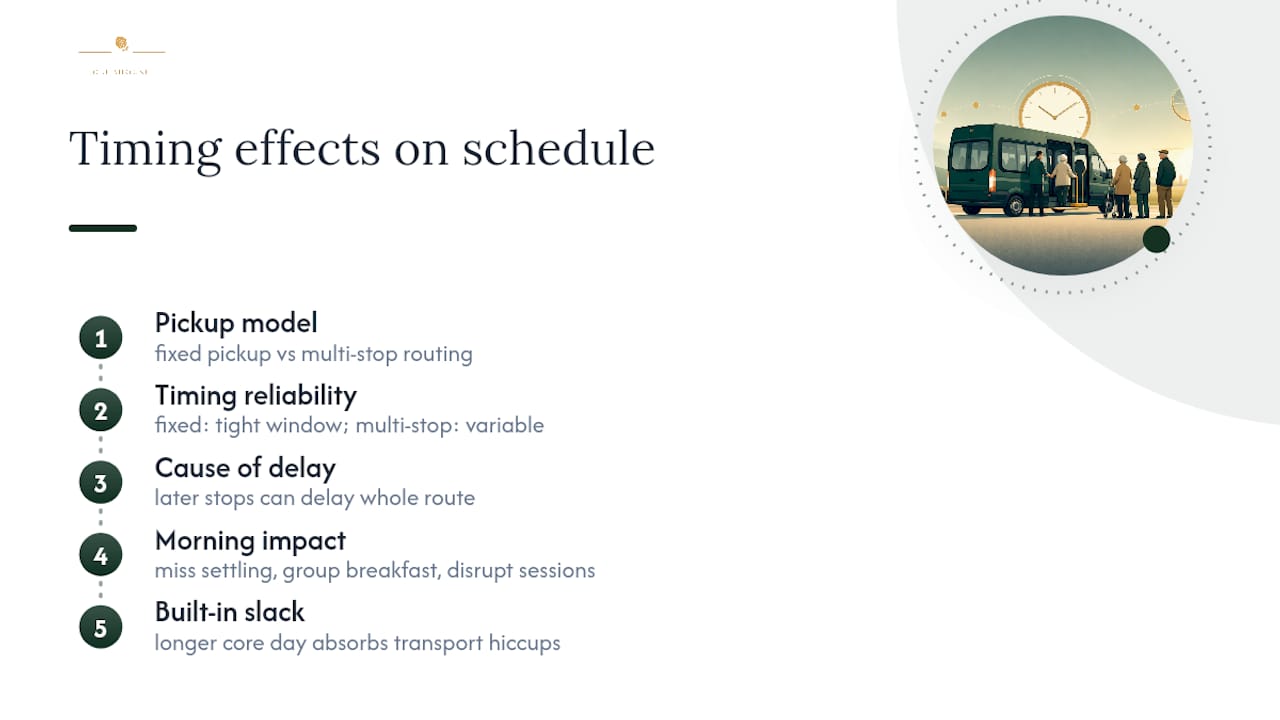
This matters more than it might sound. Arriving late to a day centre with cognitive stimulation activities, group breakfast, or entertainment sessions means missing the settling-in period that helps someone transition calmly into the day. It's also disruptive for the group, since staff often build the early part of a session around a full room.
Ask any day centre directly how flexible their arrival window actually is, and whether transport delays are common enough that they've built in slack. Centres with a longer core day, rather than a tightly packed few hours, tend to absorb transport hiccups better simply because there's more time either side of the schedule.
What if I live in a rural or underserved area?
Rural provision is where the gaps in community transport show up most sharply, and it's worth being honest about that rather than assuming a scheme will simply exist.
Some areas have no ring-and-ride coverage at all, and dial-a-ride waiting lists can run for weeks. In these pockets, volunteer-run community car schemes are frequently the only realistic option, and they depend entirely on how many local volunteers are actively driving that month.
Practical alternatives worth exploring include:
- Asking the day centre itself whether it can put you in touch with other families nearby who might share a private transport run.
- Checking whether a neighbouring, larger town's dial-a-ride scheme extends its catchment area further than you'd expect.
- Looking into parish council or village hall notice boards, which sometimes list informal lift-sharing arrangements not advertised online.
- Contacting a private specialist provider directly, since many will run further afield than council schemes if there's enough demand along a route.
None of these are perfect fixes, and rural transport gaps rarely close overnight. But combining two or three options, rather than relying on a single scheme, tends to be the most realistic way through.
Why familiar transport changes the whole day
We've seen how much a calm, predictable journey shapes what happens once someone arrives. A familiar escort and a driver who knows their routine take away one more source of anxiety before the day even begins.
Reliable transport isn't a footnote to a good day centre experience. It's often the difference between someone walking in settled and ready, or arriving flustered and needing twenty minutes just to feel steady again.
— Scott @ The Clubhouse
Booking a day pass and talking through your transport needs
Once you've worked through the transport options, the next step is finding a day centre worth arranging that journey for. A day centre may offer a Day Pass Membership providing a full day programme from morning until mid-afternoon, with meals and a variety of activities for older adults, including those living with mild to moderate dementia.

Attendance is often capped to keep group sizes manageable, and secure drop-off points may be provided at the entrance. If transport is the piece you're still figuring out, mention it when you enquire. We're happy to talk through timings and what to expect on arrival so the logistics feel sorted before the first visit. Have a look at Day Pass Membership booking details, or explore the wider facilities and daily activities to see what a typical day looks like.
Sources
- Find out about community transport services and ...
- Transport for people who can't drive or use public transport
- Devon
FAQ
How do I get free transport to hospital appointments?
NHS patient transport can be free, but it's assessed on clinical need through your GP surgery or the hospital booking your appointment, not automatically granted to everyone without a car. Check with your local NHS patient transport service before assuming eligibility.
How do seniors who can't drive get around?
Most rely on a mix of community transport schemes, such as ring-and-ride and dial-a-ride, concessionary bus passes, volunteer-run community car schemes, or private accessible taxis. Which combination works best usually depends on how rural the area is and how predictable the journey needs to be.
Who is eligible to use a community transport service?
Eligibility varies by scheme. Some require proof of age, a registered disability, or a medical need, while others are open to anyone who struggles with conventional public transport, and GOV.UK's guidance sets out the general purpose these schemes serve.
Do disabled people get free public transport?
Concessionary bus passes are widely available for disabled people, though rules and any age or eligibility conditions vary by local authority. Community transport schemes themselves usually still charge a modest fare or per-mile contribution rather than being entirely free.
What does the Alderley Clubhouse day pass cost?
Current pricing for the Day Pass Membership is available directly on the booking page, where you can also enquire about transport support when arranging a visit.