
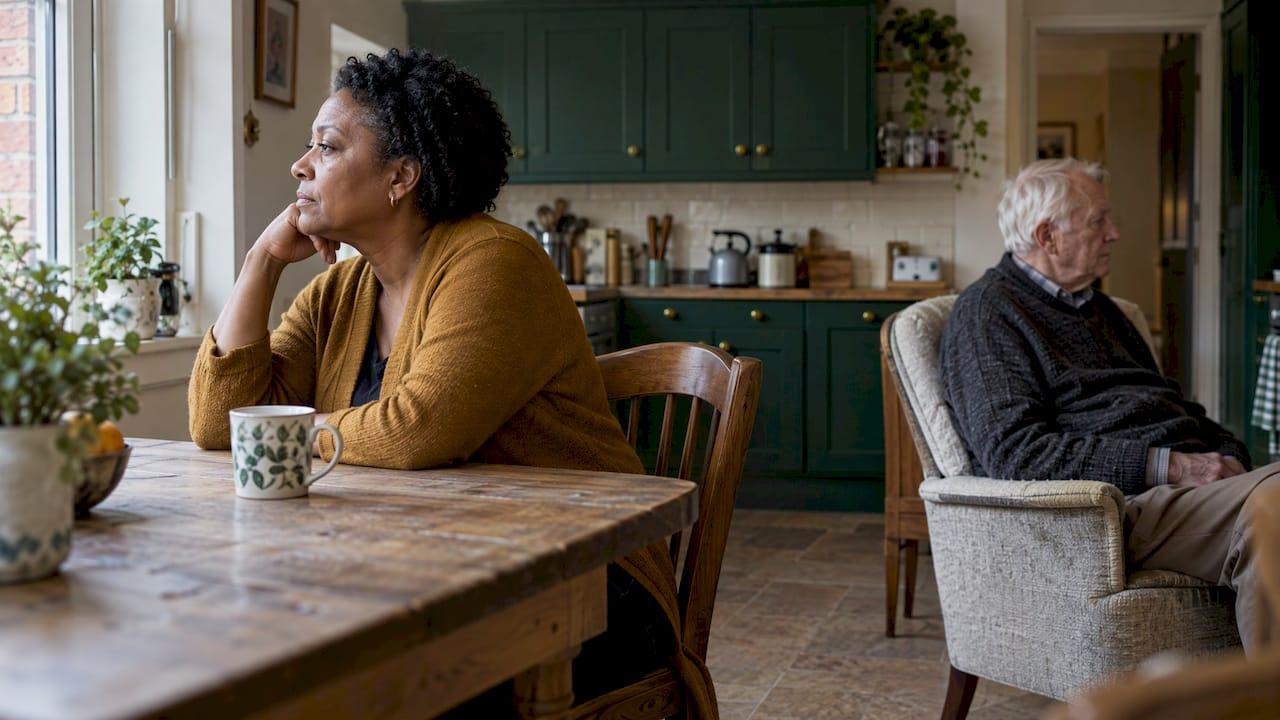
Caregiver isolation is common, it is not a personal failing, and it eases when you get regular, dependable time away from the caring role. If you look after someone with dementia, the days can shrink until the only conversations are about medication, meals and the next appointment. The most effective remedy is a steady rhythm of connection and rest: people to talk to, and a day each week or more when someone else takes over safely. Here is what the research says, what the warning signs look like, and how to start rebuilding your own life around your caring.
Key Takeaways
- Isolation is the norm for dementia carers, not the exception. Carers UK found that 43% of carers feel lonely and 59% have lost touch with family and friends because of caring.
- Loneliness, anxiety and poor sleep tend to arrive together, and each makes the others worse.
- Peer support, talking to your GP and keeping up face-to-face contact all help, and so does regular time off from caring.
- A predictable day of safe, stimulating daytime care gives you hours back and gives the person you care for company and activity.
- You can try our daytime community with a complimentary taster day before deciding anything.
Table of Contents
- What caregiver isolation actually means
- How common is it?
- Why dementia caring isolates so effectively
- When isolation turns into overwhelm
- Sleep: the quiet casualty
- What helps you stay connected
- Why a regular day of daytime care changes the picture
- Trying The Clubhouse
- FAQ
- Sources
What caregiver isolation actually means
Isolation and loneliness are related but different. Isolation is having few contacts or little time with other people. Loneliness is the painful feeling that the connection you have is not the connection you need. A carer can be in the same room as their husband, wife or parent all day and still feel profoundly alone, because the relationship has changed and the old conversations have gone. If you want to understand the difference in more detail, we have written about loneliness versus isolation and what they mean for dementia risk.
A qualitative study of informal carers in England described loneliness against a background of shrunken personal space and fewer social interactions caused by the caring role. Carers also spoke of loss, powerlessness and a feeling of sole responsibility. The same researchers noted that more respite opportunities could help carers manage some forms of loneliness.
That matches what many families tell us: it is rarely one big event. It is a slow narrowing. You cancel one lunch, then a second. Friends stop asking. Eventually you stop expecting to be asked.
How common is it?
More common than most people realise. The figures below come from large UK surveys and a systematic review.
| Finding | Figure | Source |
|---|---|---|
| Carers who feel lonely (2025) | 43% | Carers UK, State of Caring 2025 |
| Carers who have lost touch with family and friends (2025) | 59% | Carers UK, State of Caring 2025 |
| Carers who feel stressed or anxious (2025) | 74% | Carers UK, State of Caring 2025 |
| Dementia carers reporting anxiety in the past year | 33% | Alzheimer's Society, Cope Alone |
| Dementia carers reporting depression in the past year | 22% | Alzheimer's Society, Cope Alone |
| Carers aged 50 and over who report anxiety | 48% | Age UK, Unpaid Carers (England) |
A 2024 systematic review and meta-analysis found that loneliness and social isolation among informal dementia carers are notably higher than in the general population. The reviewers linked this to the long, enduring demands of dementia caregiving, which leave very little time for social contact.
If you recognise yourself in these numbers, you are in very large company. That is worth saying out loud, because Alzheimer's Society reports that 80% of dementia carers find it hard to talk about the emotional impact of caring. Many people are quietly coping with the same thing.

Why dementia caring isolates so effectively
Dementia is different from many other caring situations, and the reasons are practical as much as emotional.
- The role grows over time. A scoping review found that carers' social isolation was related to the progression of dementia, their own psychological state and a lack of support. As needs increase, there is less room in the week for anything else.
- Supervision is constant. Nearly 40% of dementia carers provide round-the-clock care, according to Alzheimer's Society. You cannot simply pop out.
- Social situations become harder. Restaurants, family gatherings and even a coffee with a friend can feel risky or exhausting when the person you care for becomes anxious or confused.
- Others do not always understand. Friends may not know what to say, so they say nothing. Carers describe feeling invisible.
- Your own health slips down the list. Carers have described stopping socialising and neglecting their own health, with little energy left at the end of the day.
None of this means you are doing it wrong. It means the situation itself is isolating, and it needs a deliberate counterbalance.
When isolation turns into overwhelm
Loneliness and overwhelm feed each other. When you have nobody to share the load with, small problems feel large. Alzheimer's Society's carers' factsheet lists signs that a carer may be struggling:
- feeling depressed or hopeless
- feeling constantly panicked and on edge
- strong negative feelings towards the person you care for, or a lack of concern
- often being overcome by irritation, agitation or anger
- difficulty sleeping
- missing appointments
Strong negative feelings towards someone you love are far more common than people admit, and they are a signal that you need support, not a verdict on you as a person. If several of these sound familiar, the factsheet advises talking to your GP, friends or family, or social services. Please do that this week rather than waiting for a crisis. The same guidance recommends talking therapies such as CBT for carers who feel anxious or depressed, and notes that counselling gives you a non-judgemental place to talk about how you feel.
It can also help to run through a short self-check of your own wellbeing. These quick checks for spotting caregiver burnout take only a few minutes. For a deeper look at causes and recovery, our guides on carer burnout signs and family caregiver burnout walk through what to do next.

Sleep: the quiet casualty
Isolation rarely arrives without tired eyes. In 2025, 65% of carers said caring made it hard to get a good night's sleep. In the 2023 survey, that figure was 69%, rising to 74% among people caring for more than 50 hours a week.
Poor sleep makes everything harder: patience, mood, and the energy to phone a friend. Alzheimer's Society notes that adults generally need 7 to 9 hours a night, and that worrying about the person you care for waking or getting up can keep you awake. Its suggestions are simple and worth trying:
- Keep a regular sleep pattern, going to bed and getting up at similar times.
- Make your bedroom dark, quiet and comfortable.
- Write down the thoughts circling in your head before you settle.
- Talk to your GP if nothing helps.
All of this comes from the carers' factsheet. Alzheimer's Society also points out that sleep problems become more common and severe as dementia progresses, so it is sensible to plan for rest early rather than waiting until you are exhausted.
Daytime matters too. A person who has had a full, stimulating and sociable day often settles better in the evening. We cover this in more detail in our piece on easing sundowning with a daytime routine and on a home routine that reduces dementia anxiety.
What helps you stay connected
There is no single fix. The most reliable improvements come from combining a few small habits.
Keep some contact face to face
Alzheimer's Society advises carers to stay in touch with friends or other carers as much as possible, ideally face to face. Even a short visit is worth more than a long text exchange. Ask one friend to come to you on a regular day, so the habit does not depend on your energy.
Find people who understand
The same guidance points to local support groups, including your local Alzheimer's Society office, Age UK and Carers UK, and to the free online forum Talking Point, which is open 24 hours a day. The Dementia Trust adds that carer support groups offer insight, coping strategies and a sense of community. Alzheimer's Society also reports that one evaluation of peer support groups in London found a social return of up to 400% on the money invested, through reduced loneliness and stress.
Use online connection when you cannot leave the house
A small 2023 study of an online psychoeducation toolkit for dementia carers in social isolation found increased social networks in both groups studied. In the moderate dementia group it also reduced distress and loneliness. Online support is a good bridge on the days when going out is impossible.
Protect a regular break
The Dementia Trust recommends carers take regular breaks, prioritise sleep, keep a schedule and contingency plan, and set boundaries that protect their own limits. The word that matters is regular. A break that happens only in an emergency is not a break, it is a rescue. A fixed day each week that you can count on allows you to plan a lunch, a walk, an appointment or simply a long uninterrupted afternoon.

Why a regular day of daytime care changes the picture
Most of the advice above needs one thing before it works: time. You cannot join a group, see a friend or catch up on sleep if you are never off duty. That is where dependable daytime care comes in, and it works best when the person you love is happy to go.
That is the idea behind The Alderley Clubhouse, our private daytime community in Nether Alderley, Cheshire, for adults aged 50 and over, including people living with mild to moderate dementia. Days run from 9:30am to 4:30pm, Monday to Friday, which is a full hour longer than most local provision. In practical terms that is a school-day-plus window for you to run errands, rest, work or see people.
For the person you care for, each day includes:
- breakfast on arrival, a cooked two-course lunch, traditional afternoon tea and an all-day hydration station
- a programme of physical, creative, cognitive and social activities
- weekly live entertainment, plus visiting hairdressing and chiropody
- Cognitive Stimulation Therapy delivered by a fully qualified and trained care team. CST is the only non-drug therapy recommended by NICE for mild to moderate dementia
- a purpose-designed, dementia-friendly and fully accessible building with secure parking and a drop-off point at the door
Attendance is capped at 35 members a day, so everyone is known by name. That matters for carers too: you are handing over to people who know the person you love.
If you would like to understand what a session of group activity involves, see our CST group activity plan, and for the practical side of mealtimes, our guide to dementia dining. We also have a page on dementia day care for family carers in Alderley Edge and details of our facilities and activities.
Trying The Clubhouse
We know that choosing daytime care can feel like a big step, and that guilt often comes with it. A complimentary taster day lets you and your relative see the building, meet the team and take part in the day before you commit. You can book a taster day through Be Our Guest.
When you are ready, a Day Pass is £120 per day including VAT, and our 10-Session Pass gives you ten days for the price of nine. There is no subscription: you pay for the days you book. You can see and book Day Passes here.
Our perspective: you cannot pour from an empty cup
We meet carers who have not had an uninterrupted afternoon in years, and who apologise for even asking about it. We never want anyone to feel that way. Needing time for yourself is not selfish, and it is not a sign that you love someone less.
What we believe is that a good day for the person living with dementia is the best gift to the person caring for them. When your relative is somewhere warm, welcoming and well run, enjoying lunch, music and company, you can step away without worrying.
That is why we designed The Alderley Clubhouse as a clubhouse, not a clinic. The longer hours, the cooked lunch, the afternoon tea and the small numbers are all there so that each member is known and looked after properly. Our team is trained in Cognitive Stimulation Therapy, so the activities have a purpose beyond keeping people busy.
If you take one thing from this article, let it be this: ask for a regular break before you need one. Reconnecting with friends, sleeping better and looking after your own health all begin with time that is genuinely yours.
Scott @ The Clubhouse
FAQ
Why do dementia carers become so isolated?
The demands of dementia care are long and unpredictable, so there is little time or energy left for friends and hobbies. A 2024 meta-analysis found carers' loneliness and isolation to be notably higher than in the general population. Friends may also drift away because they do not know how to help. Reaching out first, even briefly, often reopens those connections.
What can I do if I feel I cannot cope?
Speak to your GP, a trusted friend or family member, or your local authority's social services, as Alzheimer's Society advises. Tell them plainly how you are feeling, including any anger, hopelessness or constant anxiety. Then arrange some regular time away from caring so that the support you receive has room to work.
How do I know if I am overwhelmed or just tired?
Tiredness usually improves after rest. Overwhelm tends to persist and may bring panic, irritability, hopelessness, disturbed sleep or missed appointments. If those signs last more than a short while, treat them as a reason to see your GP rather than something to push through.
Will my relative with dementia settle into day care?
Many people do, particularly when the setting is calm, familiar and sociable, and when staff know them by name. A taster day is a gentle way to find out, and you are welcome to stay in touch with the team as your relative gets used to it. Our members come for the company, meals and activities, and the routine helps the day feel predictable.
Is it selfish to want a break from caring?
No. Regular breaks are a standard part of advice for carers, including from the Dementia Trust. Looking after your own health and relationships is what lets you keep caring well for the long term.
Sources
- Loneliness and social isolation among informal carers of people with dementia (Journal of Advanced Nursing, 2024)
- Experiences of Loneliness Associated with Being an Informal Caregiver (Journal of Aging Studies)
- Carers UK, State of Caring 2025
- Carers UK, State of Caring 2023
- Alzheimer's Society, Cope Alone report
- Alzheimer's Society, Carers for people with dementia struggling in silence
- Alzheimer's Society, Carers: looking after yourself (factsheet 523)
- Alzheimer's Society, Carers: looking after yourself (guidance)
- Alzheimer's Society, Understanding sleep problems (factsheet 534)
- Age UK, Unpaid Carers (England)
- Themes describing social isolation in family caregivers of people living with dementia (Dementia, 2022)
- A Psychosocial Intervention for Carers of Individuals with Dementia in Social Isolation
- The Dementia Trust, Top 10 Tips for Carers of people with dementia